
Qi Huo Ri Bao

Search documents
深化“保险+期货”帮扶协作 华泰期货与甘肃静宁县共话乡村振兴新路径
Qi Huo Ri Bao· 2025-11-11 05:00
Core Insights - The meeting between the Vice Mayor of Jingning County, Sun Bingxu, and Huatai Futures focused on the achievements of the "insurance + futures" model in supporting local agriculture and rural revitalization [1][2] - Huatai Futures has effectively utilized its financial expertise to implement agricultural risk management tools, significantly aiding the development of local specialties like apples and red cattle, thus contributing to rural revitalization efforts in Jingning [1][2] Group 1 - Huatai Futures has received positive feedback for its targeted assistance through the "insurance + futures" model over the past five years, which has provided strong support for local agricultural development and farmer income stability [1] - The discussion included a review of previous cooperation outcomes and the exploration of new areas for assistance and innovative collaboration mechanisms [1] - Future efforts will focus on deepening the application of financial tools like "insurance + futures" in line with rural revitalization strategies, aiming for sustainable development paths [1] Group 2 - Huatai Futures expressed gratitude for the long-term trust and support from the Jingning County government, emphasizing its commitment to national strategies and social responsibilities [2] - The company plans to enhance the application of the "insurance + futures" model in agricultural risk management, particularly for local specialty industries [2] - The meeting solidified the cooperative relationship between Huatai Futures and Jingning County, laying a strong foundation for a demonstrative financial assistance and rural revitalization cooperation model [2]
豆油远期供需结构有望收紧
Qi Huo Ri Bao· 2025-11-11 03:37
Group 1 - Palm oil prices are declining due to unexpected production increases and a cooling demand for biodiesel, impacting the oilseed sector negatively [1] - The easing of China-US trade tensions and improved soybean export expectations are supporting US soybean prices, which in turn raises the cost of imported soybeans in China, providing support for soybean oil prices [1][2] Group 2 - The supply-demand structure for US soybeans is tightening as China reduces tariffs on US agricultural products, with soybean import tariffs dropping from 23% to 13%, and a commitment to purchase 12 million tons of soybeans in the last two months of 2025 [2] - The USDA is expected to adjust its soybean export forecasts upward in the upcoming monthly report, influenced by the easing trade tensions and potential reductions in yield estimates due to drought conditions in key soybean-producing areas [2] Group 3 - Malaysia's palm oil production increased by 11.02% in October to 2.04 million tons, and exports rose by 18.58% to 1.69 million tons, exceeding market expectations [3] - Despite high production and inventory levels, the market is shifting focus to seasonal production declines and improving export demand, indicating that the negative sentiment around palm oil may be waning [3] Group 4 - Indonesia's mining association is requesting the government to cancel the 50% biodiesel blending plan (B50) set for 2026, raising concerns about future palm oil demand [4] - The Indonesian government is working to address challenges related to the B50 plan, which could lead to increased biodiesel blending rates in the second half of next year if resolved [4] Group 5 - Domestic soybean oil supply remains ample, with cumulative soybean imports from January to October reaching 95.68 million tons, a 6.4% increase year-on-year, and high commercial inventories of soybean oil [5] - Weak end-user demand and slow purchasing speeds are contributing to a cautious procurement attitude among traders and oil-using enterprises, leading to a significant increase in soybean oil inventories [5] Group 6 - Although Brazilian soybean prices are weakening, the strength of CBOT soybeans is offsetting this decline, leading to increased import costs for soybeans in China [6] - The focus is shifting towards the rising costs of imported soybeans and the potential for recovery in crushing margins, with a significant amount of soybeans still awaiting purchase for December shipment [6][7] Group 7 - The USDA report is likely to provide bullish narratives for US soybeans by adjusting yield and export estimates upward, while domestic soybean oil costs are supported by rising import costs and seasonal production declines in palm oil [7]
分析人士:多空因素交织 债市保持震荡
Qi Huo Ri Bao· 2025-11-11 03:32
Group 1 - The core viewpoint of the articles indicates that the bond futures market has shown a slight upward trend after a period of weak fluctuations, driven primarily by institutional behavior and sentiment rather than fundamental economic factors [1][2][3] - The People's Bank of China (PBOC) announced a net purchase of 20 billion yuan in government bonds on November 4, which has positively impacted market expectations and supported the bond market [2] - Economic indicators show a mild recovery, with October CPI rising by 0.2% month-on-month and year-on-year, while PPI has turned positive for the first time this year, indicating a gradual price recovery [2][3] Group 2 - Export data for October shows signs of weakness, with a clear trend of marginal slowdown expected in November and December, necessitating strong policy support for domestic demand [3] - The overall economic growth pressure is manageable, with a GDP growth rate of 5.2% for the first three quarters, leading to expectations of continued policy implementation without the necessity for interest rate cuts [3] - The bond market is expected to maintain a volatile trend due to a combination of reasonable liquidity support and the influence of a strong equity market, which may constrain bond market performance [2][3]
机构“抢跑”积极性有限
Qi Huo Ri Bao· 2025-11-11 03:32
Group 1 - The bond market is returning to a weak oscillation pattern as the influence of central bank bond purchases wanes, with market interest rates lacking drivers for decline and a growing wait-and-see atmosphere [1] - The current economic fundamentals show a divergence, with internal demand needing reinforcement while external demand remains resilient but is gradually declining [2] - The central bank's resumption of bond purchases is expected to provide medium to long-term liquidity to the banking system, maintaining a reasonable abundance of funds and low interest rates [2] Group 2 - Despite the current phase of insufficient internal demand, the stock market's risk appetite remains strong, and positive policy expectations are constraining the bond market [5] - The fourth quarter is entering a supply off-season for the bond market, with improved supply-demand structure, but institutional demand may be weaker than in previous years [5] - Overall, the bond market faces mixed factors, with economic fundamentals being weak and strong risk appetite as the main contradictions, leading to constraints on interest rate declines [5]

结构分化行情延续
Qi Huo Ri Bao· 2025-11-11 03:32
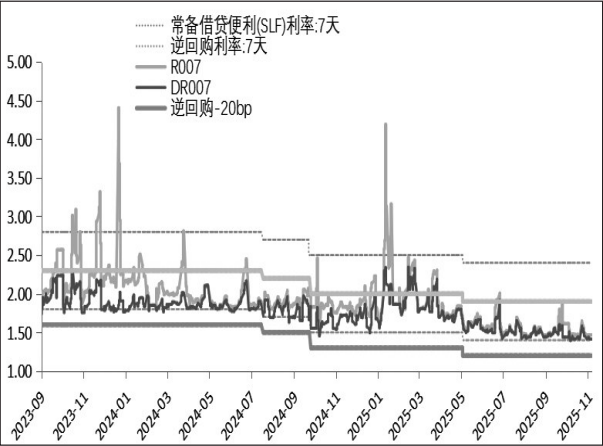
Group 1 - The overall interest rate market is in a state of "official anchoring, market self-pressing," with policy rates remaining stable while market rates are trending downward [1] - The 1-year and 5-year LPR remain unchanged at 3.0% and 3.5% respectively, marking five consecutive months of stability [1] - The 10-year government bond yield has decreased by approximately 6 basis points to around 1.8%, indicating a historical low since 2014 [1] Group 2 - The U.S. Congress has signaled an end to the government shutdown, which lasted nearly 40 days, leading to a recovery in market risk appetite [2] - The Congressional Budget Office (CBO) indicated that a four-week government shutdown could reduce Q4 GDP annualized growth by 1 percentage point [2] - In October, China's official manufacturing PMI fell to 49.0%, a decrease of 0.8 percentage points from the previous month, indicating a decline in manufacturing activity [2] Group 3 - The central bank has resumed open market operations with a net purchase of 20 billion yuan in government bonds, lower than market expectations [3] - The central bank's actions aim to stabilize expectations amid high government debt supply and low GDP readings [3] - Long-term, the central bank emphasizes a "self-directed" monetary policy, maintaining moderate easing and using various tools to ensure ample liquidity [3]
全球大反攻!金银价格飙升,美联储官员力挺降息
Qi Huo Ri Bao· 2025-11-11 00:34
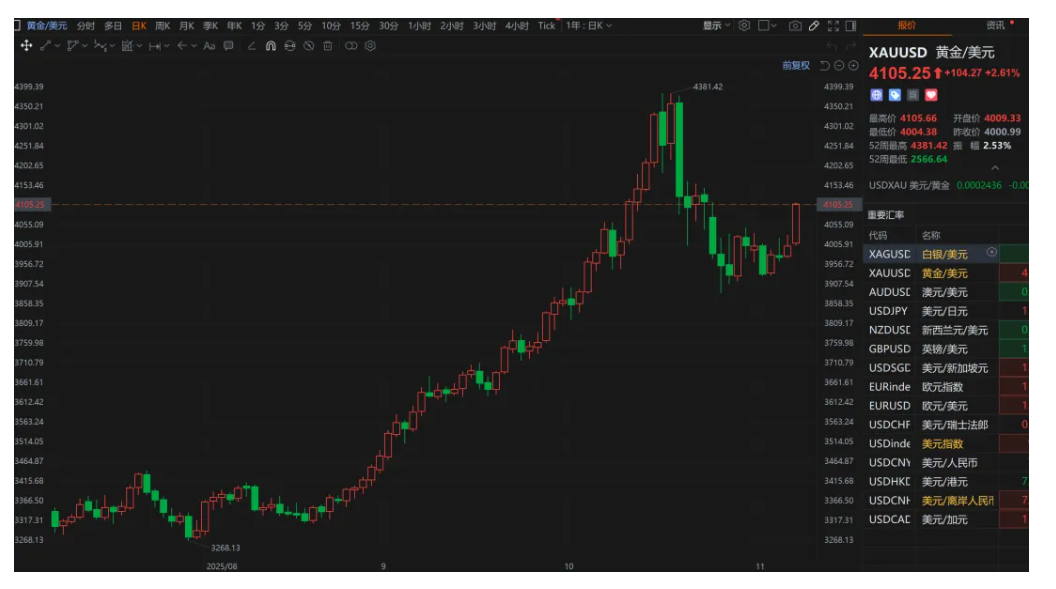
Group 1: Gold and Silver Market Trends - The price of spot gold has risen significantly, surpassing $4,100 per ounce for the first time since October 27, with an increase of over 2.6% in a single day [1] - As of November 10, spot gold is reported at $4,113.26 per ounce, with a daily increase of 2.81%, while spot silver has risen by 4.6% [3] - The China Gold Association reported that the domestic gold ETF increased its holdings by 79.015 tons in the first three quarters of 2025, marking a year-on-year growth of 164.03% [4] Group 2: Economic and Political Influences - The potential resolution of the U.S. government shutdown is seen as a factor influencing market conditions, with indications that a vote to end the shutdown is imminent [3] - The Federal Reserve's stance on interest rates remains cautious, with expectations of at least a 25 basis point cut in December [4] - Historical patterns suggest that gold prices are closely tied to geopolitical instability and economic weakness in the U.S., with current risks to gold prices being minimal [5] Group 3: Trading Volumes and Market Activity - The Shanghai Gold Exchange reported a total trading volume of 23,800 tons for all gold products in the first three quarters of 2025, a year-on-year increase of 2.45% [4] - The cumulative trading volume for gold futures and options on the Shanghai Futures Exchange reached 1,036,000 tons, reflecting a significant year-on-year increase of 59.98% [4] - China's gold reserves stood at 2,303.52 tons as of September 30, 2025, following an increase of 23.95 tons in the first three quarters of the year [4]
玻璃期价创阶段性新低
Qi Huo Ri Bao· 2025-11-11 00:18
Core Viewpoint - Glass futures prices have significantly declined, with the main contract dropping nearly 4%, reaching a four-month low, primarily due to weak demand from the real estate sector [1][2]. Supply and Demand Dynamics - Since October, glass production companies have been accumulating inventory, with sales improving slightly in the last week of October, but overall inventory levels remain historically high [1][2]. - The real estate sector's completion area has decreased, leading to a decline in glass demand during what is typically a peak season, with a reported 15.3% year-on-year drop in completed housing area from January to September 2025 [1][2]. - The average order duration for glass deep processing enterprises has fallen to 9-10 days, significantly lower than the 12-13 days seen in the same period last year [1]. Price Trends - Post-National Day holiday, average spot prices for glass have dropped by nearly 100 yuan per ton, with specific regional declines: 120 yuan in North China, 80 yuan in Central China, and 90 yuan in East China [1]. - Current average profit for float glass enterprises is reported at -32 yuan per ton, marking a continuous decline over four weeks, indicating a low valuation level [2]. Market Outlook - Future glass price trends will largely depend on the balance between supply and demand, with potential for inventory accumulation if supply remains stable or decreases only slightly [3]. - The industry faces a supply surplus, and short-term improvements are unlikely, suggesting that upstream companies should consider selling hedging opportunities [3]. - The ongoing transition to gas from coal in some production lines has slightly alleviated supply pressure, with a reported decrease in production by 2,400 tons to 159,135 tons [2].
全球大反攻!金银价格飙升 美联储官员力挺降息
Qi Huo Ri Bao· 2025-11-11 00:18
Group 1: Gold and Silver Market Trends - Gold prices have surged, with spot gold reaching $4,113.26 per ounce, marking a 2.81% increase, while silver prices rose by 4.6% [4][2] - Domestic gold ETF holdings increased by 164% year-on-year in the first three quarters of 2025, totaling 79.015 tons [5] - The Shanghai Gold Exchange reported a 2.45% increase in total gold trading volume, reaching 23,800 tons, and a 41.55% increase in trading value, totaling 17.68 trillion yuan [5] Group 2: Economic and Political Influences - The potential end of the U.S. government shutdown has been indicated by President Trump, which may positively impact market sentiment [4] - The Federal Reserve's stance on interest rates remains cautious, with expectations of a rate cut of at least 25 basis points by December [5] - Historical patterns suggest that gold prices are closely linked to geopolitical tensions and economic conditions, with current risks for price declines being minimal [6] Group 3: Stock Market Performance - U.S. stock indices experienced significant gains, with the Dow Jones up by 0.81% and the Nasdaq up by 2.27% [9] - Analysts predict that the reopening of the U.S. government will lead to a surge of economic data releases, which could influence market dynamics [9] - Major Wall Street firms maintain a bullish outlook on U.S. stocks, citing strong corporate earnings growth as a key driver for future market performance [10]

成本支撑偏强 烧碱跌势或将放缓
Qi Huo Ri Bao· 2025-11-10 23:31
Core Viewpoint - The domestic caustic soda industry is experiencing significant capacity expansion, with total production capacity expected to exceed 49 million tons by the end of 2024, continuing into 2025 despite a slowdown in new capacity additions in the second half of the year [1] Group 1: Supply Dynamics - The overall capacity utilization rate for domestic caustic soda plants has increased to 84.8%, up 0.5 percentage points from the previous week and 3.1 percentage points year-on-year, driven by new capacity stabilizing and strong production profits [1] - In early November, eight plants are expected to restart operations, significantly outpacing the four plants scheduled for maintenance, which may lead to increased supply pressure [2] - The execution of maintenance plans will be a key variable affecting supply elasticity, as some companies may delay maintenance to maintain high operational loads [2] Group 2: Downstream Demand - The downstream demand for caustic soda is diversified, with alumina being the primary consumer, accounting for over 30% of consumption, but alumina prices have been declining since mid-July 2025 due to increased supply [3] - The overall operating rate in the caustic soda industry has been significantly lower than the same period in 2024, as companies have reduced production in response to weak demand and profit expectations [3] - Non-alumina sectors are currently in a traditional off-season, with limited demand for caustic soda, primarily driven by essential small orders [4] Group 3: Cost Factors - The price of coal, a key component in caustic soda production, has increased by 15.59% since the long holiday, raising production costs and providing support against price declines [5] - Seasonal demand for electricity is expected to rise due to cold weather, which will further increase coal consumption [5] - Coal supply constraints and low inventory levels at northern ports are expected to maintain upward pressure on coal prices, providing cost support for caustic soda [6] Group 4: Market Outlook - The caustic soda market is facing a core contradiction of increasing supply and weak demand, leading to overall pressure on the fundamentals [6] - Despite the supply increase, the lack of marginal demand drivers is expected to limit the downward price movement of caustic soda, resulting in a predominantly weak oscillation in prices [6]
玉米稳步上行可期
Qi Huo Ri Bao· 2025-11-10 23:24
Core Insights - The global corn supply remains ample as the new season's corn is harvested in the Northern Hemisphere, leading to a continuous decline in domestic corn prices in China. However, as supply-side pressures are fully digested and demand enters a peak season, corn prices are expected to gradually rise [1] Group 1: Production Data - The International Grains Council forecasts that global corn production for the 2025/2026 season will remain stable at approximately 1.297 billion tons. In China, the corn planting area has increased by 134,000 hectares, a growth of 0.3%, while the yield per hectare has risen by 71 kg, or about 1.1%. Overall, corn production in China has increased by 4.08 million tons, reflecting a year-on-year growth of approximately 1.38% [2] Group 2: Import Trends - Due to trade disputes between China and the U.S. and Canada, imports of grains, including corn, are expected to decrease. Barley imports are projected to fall below 10 million tons, while sorghum imports are estimated to be between 5.5 million and 6.5 million tons. The recent decline in corn prices has diminished the substitution advantage of other grains against corn. For the 2025-2026 period, corn imports are expected to be around 6 million tons, not exceeding the quota limit of 7.2 million tons [3] Group 3: Seasonal Demand - Corn consumption in China is primarily driven by feed and deep processing sectors. As the fourth quarter approaches, demand from livestock, particularly broilers and pigs, is expected to rise, supporting corn feed demand. Additionally, after mid-October, profits for domestic starch and deep processing enterprises are anticipated to return to profitability and continue to rise, boosting production willingness. Data shows that by the end of October, the corn consumption of major deep processing enterprises increased by 6.71% week-on-week [4] Group 4: Inventory Stability - Domestic corn inventory is expected to stabilize around 41 million tons after rebounding in the 2022-2023 season. As of the end of October, the inventory of major deep processing enterprises was 2.827 million tons, reflecting a week-on-week increase of 7.82% but a year-on-year decrease of 13.41%. The inventory-to-consumption ratio for the new corn year remains reasonable, which will effectively buffer price fluctuations caused by supply growth. Despite a decrease in land rent, rising labor costs limit the decline in planting costs in major corn-producing regions, keeping planting returns at a relatively low level and constraining the downward space for corn prices [5]