
Qi Huo Ri Bao

Search documents
尿素 基本面维持宽松格局
Qi Huo Ri Bao· 2025-09-18 00:41
9月上旬尿素期货价格整体呈现下跌走势,现货市场观望情绪较浓。短期来看,尿素供需宽松,市场情 绪偏空。在缺乏明显利多驱动的情况下,预计期货价格维持偏弱震荡态势。 现货市场交投氛围依旧偏弱,部分地区现货报价明显下移,山东、河南等主要产区中小颗粒尿素出厂价 普遍跌至年内低位。在需求难以显著增长的情况下,现货市场疲软态势预计将持续。 供应方面,尽管部分装置检修导致日产量短期降至19万吨,但国内尿素整体供应仍处于相对高位。根据 隆众资讯数据,9月第2周新增4台装置停车,4台装置恢复生产,产量小幅上涨;产能利用率为 79.34%,环比上升1.24个百分点。随着计划检修的装置数量不断减少,预计尿素产能利用率和日产量都 将进一步提升。根据最新的产能投放计划,今年四季度仍有新增产能释放,2026年尿素日产量可能突破 21万吨大关,届时国内供应压力将进一步加剧。此外,当前上游企业库存持续累积,处于近5年同期高 位。最新数据显示,国内尿素企业总库存为113.27万吨,同比增长50%,库存压力较大。2025年尿素生 产利润同比明显下滑,新型气流床生产利润约300元/吨,传统固定床生产利润约50元/吨,天然气工艺 生产利润约150元/ ...
去库难以持续 对纯碱价格反弹不宜过度乐观
Qi Huo Ri Bao· 2025-09-18 00:26
Core Viewpoint - The continuous decline in soda ash inventory since mid-August and the recent price rebound may not indicate a fundamental improvement in the industry, as supply remains excessive and effective destocking has not occurred [1][2][3][5]. Group 1: Inventory Trends - Soda ash factory inventory has decreased for four consecutive weeks, reaching 1.7975 million tons, down 113,300 tons or 5.93% from the historical peak of 1.9108 million tons [2]. - However, social inventory has increased to 540,000 tons, up 90,000 tons from 450,000 tons in early August, indicating a transfer of inventory rather than effective destocking [2]. Group 2: Demand Dynamics - There is a slight improvement in downstream demand as glass prices strengthen with the arrival of the peak season, leading to an increase in glass production [3]. - Daily production of float glass rose to 160,175 tons, up 600 tons from August, while photovoltaic glass production also increased by 600 tons to 88,780 tons [3]. - Despite the overall increase in glass production, light soda ash inventory has been accumulating, indicating limited improvement in its downstream demand [3]. Group 3: Export Considerations - Soda ash exports have significantly increased, with a total of 1.154 million tons exported from January to July, a year-on-year increase of 128.38% [4]. - However, rising domestic prices may hinder export growth, as the export price in July was approximately 1,260 yuan per ton, which could lead to diminished export profits and exacerbate domestic oversupply [4]. Group 4: Production and Supply Outlook - The summer maintenance period for soda ash plants is ending, leading to a rise in operating rates and production levels, with a record output of 761,100 tons reported [5]. - The weekly demand for heavy soda ash from glass production is estimated at 348,500 tons, indicating a surplus of approximately 73,200 tons [5]. - With new production capacities coming online and the production season starting, soda ash supply is expected to remain high, and factory inventories may begin to accumulate again [5].
双粕联袂下跌 宏观预期生变?
Qi Huo Ri Bao· 2025-09-18 00:14
Group 1 - Soybean meal and rapeseed meal futures prices have significantly declined, with rapeseed meal leading the drop in the oilseed sector, primarily influenced by macroeconomic factors [1][2] - Analysts expect an increase in soybean imports from the U.S. due to changes in the macro environment, which may alleviate the tight domestic soybean supply situation [1][2] - The increase in Brazilian soybean exports and high export levels from Argentina have contributed to a surplus in international market supply, impacting U.S. soybean export opportunities [1][2] Group 2 - The anticipated high soybean import volume in China from September to December is expected to prolong the soybean meal inventory accumulation cycle until the end of November, leading to ample short-term supply [1][2] - Recent U.S.-China trade talks have made progress, enhancing expectations for China's procurement of U.S. soybeans for the 2025/2026 season, which may negatively affect soybean meal prices [2] - Domestic measures to adjust pig breeding capacity, including a reduction of approximately 1 million sows, may impact future demand for soybean meal as feed [2] Group 3 - The rapeseed meal market is facing weak fundamentals, with increased expectations for importing Canadian canola seeds due to improved relations between Canada and China [3] - Seasonal declines in aquaculture demand have led to decreased purchasing activity from farmers, resulting in reduced transaction volumes and continuous declines in spot prices for rapeseed meal [3] - The recent improvement in China-Australia relations and increased orders for Australian canola seeds have weakened the supportive impact of halting Canadian canola seed imports on domestic rapeseed meal prices [3]
凌晨重磅!美联储降息25个基点,鲍威尔“放鸽”
Qi Huo Ri Bao· 2025-09-17 23:44
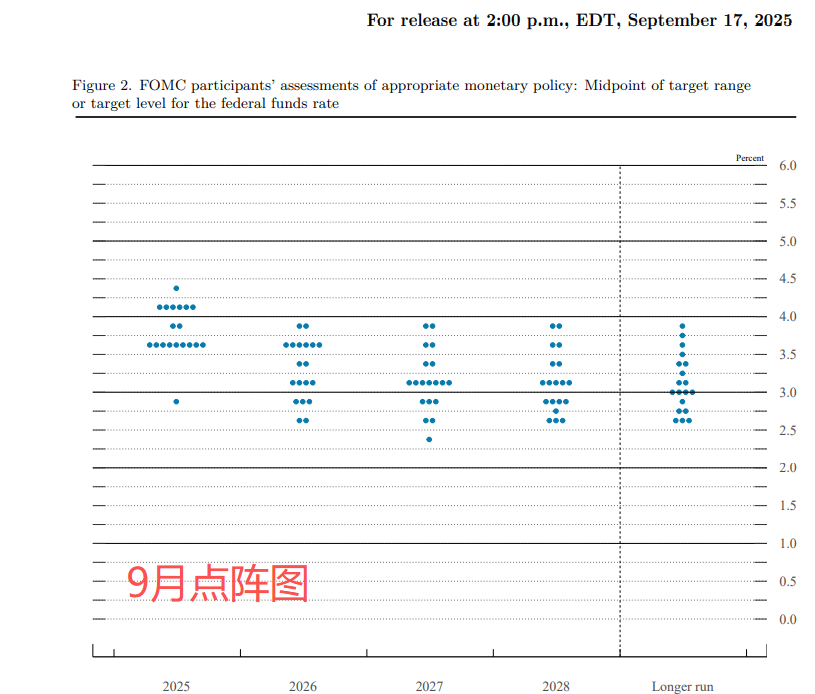
Core Viewpoint - The Federal Reserve has decided to lower the federal funds rate target range by 25 basis points to 4.00%-4.25%, marking its first rate cut since December 2024, primarily due to slower job growth and economic uncertainty [1][5]. Group 1: Federal Reserve's Decision and Economic Indicators - The decision to cut rates comes amid rising inflation and disappointing job growth, with recent indicators showing a slowdown in economic activity and increased risks in the labor market [1][5]. - The Federal Reserve will continue to reduce its holdings of U.S. Treasuries, agency bonds, and agency mortgage-backed securities, maintaining the current pace of balance sheet reduction [1]. - The dot plot indicates that Fed officials expect an additional 50 basis points cut by the end of the year, with further cuts of 25 basis points each year for the next two years [1][4]. Group 2: Diverging Opinions Among Officials - Newly appointed Fed Governor Stephen Milan is the only dissenting voice, advocating for a 50 basis point cut instead of the 25 basis points implemented [1][4]. - Among the 19 officials, 7 predict no further cuts this year, while 9 believe there will be two more 25 basis point cuts, indicating a divided outlook on future rate adjustments [4][6]. Group 3: Market Reactions and Asset Implications - Following the rate cut announcement, U.S. stock indices showed mixed results, with the Dow Jones rising by 260.42 points (0.57%) while the Nasdaq fell by 72.63 points (0.33%) [7]. - Gold prices have seen significant increases, with a 100% rise over the past two years and a 45% increase this year, reflecting market expectations of further rate cuts [6][10]. - Analysts suggest that the Fed's dovish stance may benefit risk assets, but caution that political pressures and economic data could influence future rate decisions [10][11].

乙二醇短期弱势难改
Qi Huo Ri Bao· 2025-09-17 23:35
Core Viewpoint - Ethylene glycol futures prices are experiencing a volatile consolidation phase, influenced by increased supply from new projects and declining industry profits [1][2][8] Supply - Ethylene glycol comprehensive capacity utilization rate is at 66.55%, down 0.9 percentage points week-on-week; total production is 404,600 tons, a decrease of 1.33% [2] - The production capacity of coal-based ethylene glycol is at 65.96%, down 2.47% week-on-week, while oil-integrated facilities show a slight increase in utilization [2] - Overall, supply remains relatively ample, with expectations of slight production growth as some coal chemical facilities resume operations [2][8] Inventory - As of September 15, the port inventory of ethylene glycol in East China is 395,600 tons, an increase of 32,400 tons from the previous week [4] Demand - Domestic polyester industry weekly production is 1,546,800 tons, a slight increase of 0.74% week-on-week, with an average capacity utilization rate of 87.9% [5] - Demand in the weaving sector shows a slight recovery, with average order days increasing to 14.55 days, although large orders remain scarce [7] Cost Factors - OPEC+ plans to increase production, but geopolitical risks and seasonal declines in oil consumption are putting pressure on international oil prices [1] - The cost structure for ethylene glycol is expected to continue to decline due to falling prices of crude oil and coal [8] Market Outlook - Short-term expectations indicate a decrease in domestic ethylene glycol production with a potential increase in imports, maintaining stable overall supply [8] - The weak price trend for ethylene glycol is likely to persist, with forecasts suggesting continued downward pressure [8]
烧碱供应压力增加
Qi Huo Ri Bao· 2025-09-17 23:35
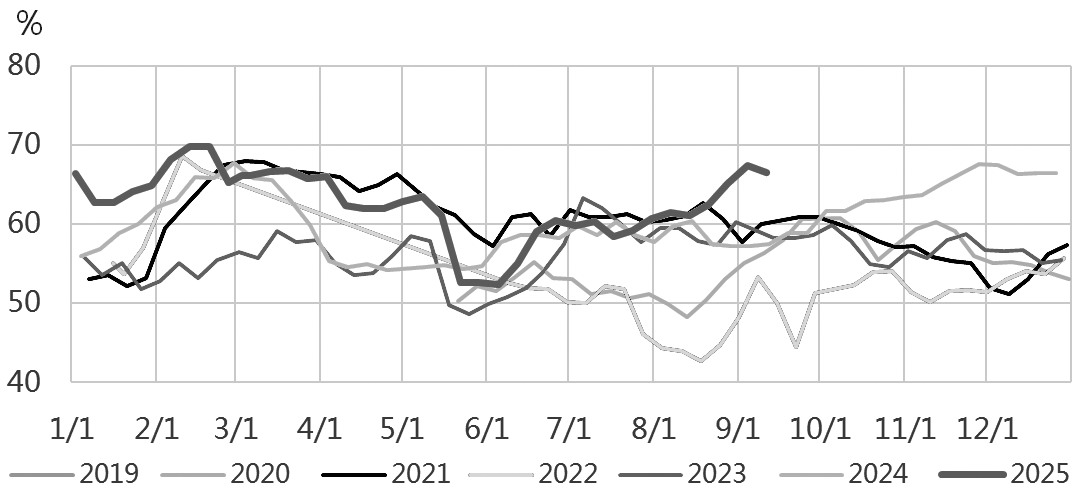
Core Viewpoint - The caustic soda futures prices have been weakly fluctuating since September, with domestic supply being ample and reduced purchasing from downstream enterprises leading to increased market supply pressure. The traditional peak season of "Golden September and Silver October" raises questions about whether the expected demand will materialize [1]. Supply and Production - As maintenance facilities resume production, the supply pressure of caustic soda is gradually increasing. As of September 12, the domestic weekly production of caustic soda was 821,100 tons, maintaining a high level for the same period over the past four years [1]. - The capacity utilization rate of caustic soda sample enterprises with a capacity of 200,000 tons and above was 83.4%, with expectations for further increases as maintenance plans decrease [1]. Inventory Levels - As of September 12, the inventory of enterprises was 356,800 tons, remaining at a relatively high level. In Shandong, the inventory reached 162,400 tons, an increase of 3.6% compared to the previous period [2]. Demand Dynamics - The capacity utilization rates in most downstream industries for caustic soda have peaked and are now declining. For alumina, the capacity utilization rate was 83% as of September 12, down 1 percentage point from the previous period, indicating a potential peak [2]. - In Shandong, the quantity of caustic soda delivered to major downstream customers has significantly increased, with alumina enterprises' raw material inventories also rising. The spot price of alumina in Shandong has decreased, negatively impacting the caustic soda market [2]. Market Sentiment and Price Trends - Despite being in the demand peak season of September and October, the overall capacity utilization in downstream industries is at high levels with limited room for further increases. The market supply pressure remains significant, suggesting that the weak fundamentals are unlikely to change [9]. - As of early September, caustic soda spot prices remained high, but by mid-September, prices showed signs of easing, with Shandong downstream enterprises continuously lowering procurement prices, leading to increased bearish sentiment in the market. As of September 16, the ex-factory average price of 32% liquid caustic soda in Shandong dropped to 820 yuan per ton [9]. Conclusion - Overall, while the demand growth expectations during the peak season may provide some support for prices, the limited room for further increases in capacity utilization in downstream industries and ongoing supply pressure suggest that the fundamentals remain weak. It is anticipated that spot prices may have further room to decline, with futures prices reflecting the demand-side benefits and likely maintaining a range-bound fluctuation during the peak season [9].
沥青 等待逢高做空机会
Qi Huo Ri Bao· 2025-09-17 23:35
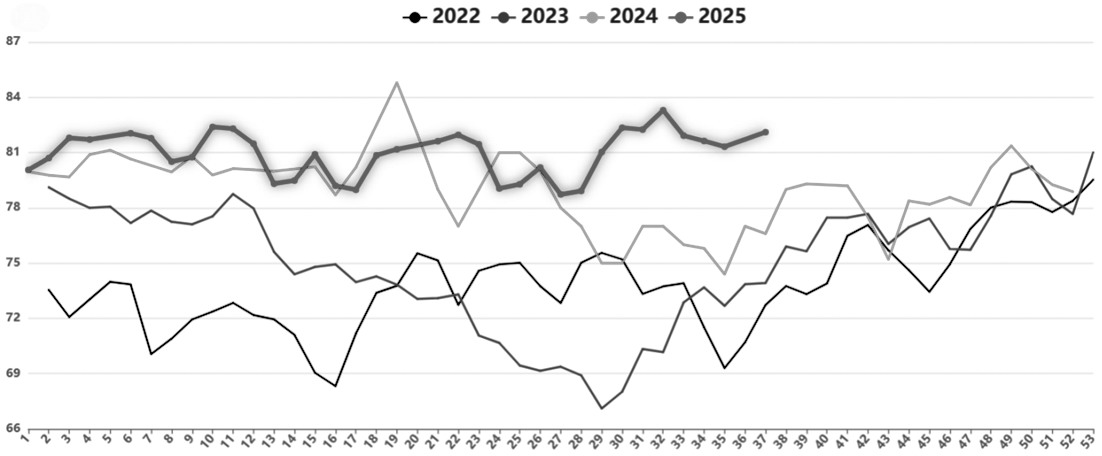
Group 1 - The asphalt market has entered the consumption peak season, traditionally from August to October, but this year it was delayed to September due to widespread rainfall across the country [1] - Despite being in the consumption peak season, the market is characterized by "active trading but weak prices," with asphalt prices not rising due to inventory depletion [1] - As of September 15, the low-price negotiation range for asphalt was 3520 to 3650 yuan/ton, with a slight increase, while the high-price negotiation range saw a small decline [1] Group 2 - The futures market is experiencing a decline in bullish sentiment due to weak fundamentals, leading to pressure on asphalt prices [2] - The International Energy Agency and the U.S. Energy Information Administration have both lowered global oil demand forecasts for the next two years, which weakens cost support for asphalt futures [2] - Despite the current weak market conditions, geopolitical risks and global trade tensions could lead to sudden increases in oil prices, potentially driving asphalt prices up [2]
双粕联袂下跌,宏观预期生变?
Qi Huo Ri Bao· 2025-09-17 23:32
Group 1 - Soybean meal and rapeseed meal futures prices have significantly declined, with rapeseed meal leading the drop in the oilseed sector, primarily influenced by macroeconomic factors [1] - Analysts expect an increase in China's imports of U.S. soybeans, which may alleviate the tight domestic soybean supply situation, while Brazilian soybean exports are rising and Argentine exports remain high, contributing to ample international supply [1][2] - Domestic soybean imports from September to December are projected to be high, leading to a continued accumulation of soybean meal stocks until the end of November, with weekly inventories rising [1][2] Group 2 - Recent U.S.-China trade talks have made progress, enhancing expectations for China's procurement of U.S. soybeans for the 2025/2026 season, which negatively impacts soybean meal prices [2] - Measures to adjust the breeding sow population in China may affect future demand for soybean meal in feed [2] - Despite a significant drop in soybean meal prices, uncertainties surrounding U.S. soybean exports may provide some rebound potential [2] Group 3 - The rapeseed meal market is facing weak fundamentals, with increased expectations for Canadian canola imports and a decline in purchasing activity from aquaculture due to seasonal demand [3] - Trade policies are acting as a double-edged sword for rapeseed meal prices, with the cessation of Canadian canola imports providing support, while improved relations with Australia and increased orders for Australian canola are weakening this support [3] - Canadian canola harvest is progressing, with a reported 3.6% year-on-year increase in production, which could further pressure rapeseed meal prices if imports resume [3][4] Group 4 - Short-term inventory pressures for rapeseed and rapeseed meal are manageable, but port inventories of granular meal are at historically high levels, limiting upward price movement [4] - Traders are advised to closely monitor developments in China-Canada trade negotiations [4]

债市 短线整理蓄势
Qi Huo Ri Bao· 2025-09-17 23:09
Group 1: Industrial Production - In August, the industrial added value of large-scale enterprises grew by 5.2% year-on-year, a decrease of 0.5 percentage points from July's 5.7% [1] - Month-on-month growth in August was 0.37%, slightly lower than July's 0.38% [1] - The decline in industrial added value is primarily attributed to a decrease in external demand and cautious expansion attitudes among enterprises due to high tariffs [1] Group 2: Consumer Retail and Services - From January to August, the total retail sales of consumer goods reached 323,906 billion yuan, with a year-on-year growth of 4.6% [1] - In August alone, retail sales totaled 39,668 billion yuan, growing by 3.4% year-on-year and 0.17% month-on-month [1] - The growth in retail sales was supported by strong demand in service consumption, particularly in tourism and transportation, while the reliance on subsidies decreased [1] Group 3: Fixed Asset Investment - From January to August, fixed asset investment (excluding rural households) was 326,111 billion yuan, with a year-on-year growth of 0.5%, showing a slowdown in growth [2] - In August, manufacturing investment fell by 1.3% year-on-year, with the decline accelerating compared to the previous month [2] - Real estate development investment dropped by 19.9% year-on-year in August, with a significant increase in the rate of decline compared to July [2] Group 4: Economic Indicators and Monetary Policy - In August, the Consumer Price Index (CPI) showed weak performance while the Producer Price Index (PPI) improved [2] - There is a strong market expectation for a 25 basis point rate cut by the Federal Reserve, which may ease external constraints and open up more room for domestic monetary policy to be "moderately loose" [2] - The potential for a rate cut in the fourth quarter is increasing due to the current economic conditions [2] Group 5: Bond Market Outlook - The impact of data on the bond market has become relatively muted, with the main influencing factors being the stock-bond "see-saw" effect, policy expectations, and institutional behavior [3] - The bond market is expected to experience short-term fluctuations, but the long-term outlook remains positive due to unchanged economic fundamentals and a loose monetary environment [3]
世贸组织报告:人工智能有望推动全球贸易增长
Qi Huo Ri Bao· 2025-09-17 16:06
Core Insights - The World Trade Organization (WTO) predicts that with appropriate policy support, the application of artificial intelligence (AI) could drive global trade growth by nearly 40% by 2040 [1] - AI is expected to significantly enhance global trade and GDP growth, with trade volumes projected to increase by 34% to 37% and global GDP by 12% to 13% by 2040, depending on policy and technological advancements [1] - The WTO emphasizes the potential of AI to reduce trade costs and improve productivity, but highlights the uneven ability of different economies to access AI technology and participate in digital trade [1] Trade and AI Development - Trade can facilitate access to AI and the necessary investments for its development, promoting innovation and opening new pathways for growth [1] - To harness the potential of AI in trade, stakeholders must take deliberate actions to bridge the digital divide and promote regulatory consistency [1] Policy Recommendations - The report notes a significant increase in restrictions on AI-related goods, from 130 measures in 2012 to nearly 500 by 2024, urging the need for open and predictable trade policies [1] - Strengthening international cooperation, particularly in the intersection of AI and trade, is essential for broader participation in AI development across economies [1] - The WTO is positioned to play a central role in ensuring that AI supports inclusive trade-led growth [1]