
Qi Huo Ri Bao

Search documents
年关临近 聚酯链品种能否重拾升势?
Qi Huo Ri Bao· 2026-01-07 00:20
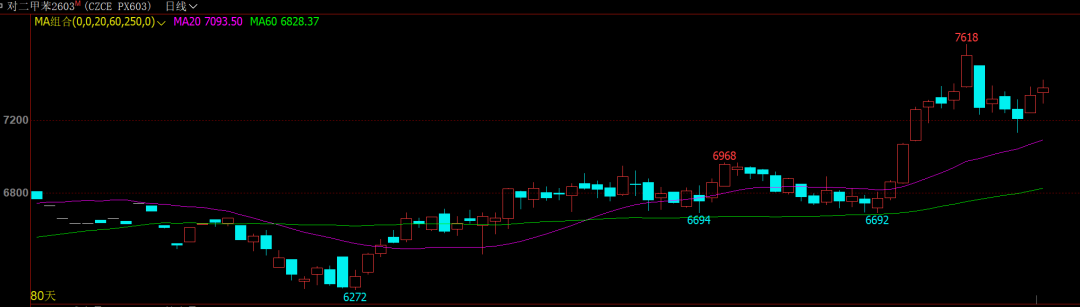
Core Viewpoint - The polyester chain market has experienced significant volatility since mid-December 2025, driven primarily by upstream PX price movements, leading to a focus on market dynamics and future trends [1][3]. Group 1: Market Dynamics - The core driver of the recent market fluctuations is the upstream PX, which saw a price increase from 6,800 yuan/ton to over 7,600 yuan/ton, with a significant rise in trading volume [3]. - After reaching a critical price level, the PX market experienced a decline in trading volume, leading to a notable price correction [1][3]. - Analysts suggest that the current price correction is a natural pressure release and does not alter the long-term optimistic outlook for PX [3]. Group 2: Industry Impact - The textile industry is entering a seasonal downturn, with decreasing orders and weaving operating rates, which is exacerbating cash flow pressures for polyester manufacturers [3][4]. - The rapid increase in raw material prices has forced some polyester enterprises to reduce production, creating a "hot upstream, cold downstream" scenario that hinders cost transmission within the industry [3][4]. - The upcoming Chinese New Year is expected to bring about a temporary halt in operations and a reduction in production, with downstream stocking intentions heavily influenced by market expectations [4][5]. Group 3: Future Outlook - The demand recovery post-Chinese New Year is seen as a critical factor for potential price increases in raw materials, with analysts indicating that a moderate price correction could benefit downstream operations [4][5]. - The timing of the Chinese New Year in 2026 may compress the demand release window, impacting downstream stocking enthusiasm and overall market dynamics [5]. - Short-term strategies are recommended to focus on profit-taking and risk aversion, with opportunities for buying on dips expected after price corrections [5].

四重因素共振,白银获强力支撑 | 破译金属新主线
Qi Huo Ri Bao· 2026-01-07 00:05
Group 1 - The silver market is currently experiencing a significant transformation driven by a combination of supply-demand gaps, declining inventories, emerging demand, and a return to its financial attributes, with strong price support expected through 2026 [2] - Since 2020, the global silver market has faced a continuous supply gap, projected to reach approximately 5,834 tons by 2025, with expectations that this gap may continue to widen in the next two years [2] - Key factors limiting silver production include rising mining costs, structural supply issues, insufficient new capacity, and the classification of silver as a strategic asset by various countries, which restricts its circulation [2] Group 2 - Emerging industrial demand, particularly from solar energy, electric vehicles, and AI data centers, is identified as a critical driver for silver demand growth, marking a shift towards silver as a high-tech metal [3] - Despite prolonged supply shortages, silver's financial attributes have historically lagged behind gold, with a significant price correction expected by 2025 as market awareness increases [3] - The recent surge in silver prices is attributed to a dual-driven mechanism, initially propelled by the spillover from a gold bull market and monetary easing, followed by a phase dominated by supply-demand imbalances and industrial demand surges [3]

四重因素共振,白银获强力支撑
Qi Huo Ri Bao· 2026-01-07 00:00
Group 1 - The silver market is experiencing a significant transformation driven by a combination of supply-demand gaps, declining inventories, emerging demand, and a return to its financial attributes, with strong price support expected through 2026 [1] - Since 2020, the global silver market has faced a continuous supply gap, projected to reach approximately 5,834 tons by 2025, indicating that the supply gap may continue to widen in the next two years [1] - Factors constraining silver production include rising mining costs, structural supply issues due to silver being a by-product, insufficient new capacity, and restrictions on circulation as countries classify silver as a strategic asset [1] Group 2 - Key drivers of silver demand include emerging industrial needs from sectors such as photovoltaics, electric vehicles, and AI data centers, which are transforming silver into a high-tech metal [2] - Despite prolonged supply shortages, silver's financial attributes have historically lagged behind gold, with a significant price correction expected by 2025 as market awareness increases [2] - The recent surge in silver prices is attributed to dual drivers: initial momentum from the gold bull market and monetary easing, followed by a later phase dominated by supply-demand imbalances and industrial demand surges [2]

年关临近,聚酯链品种能否重拾升势?
Qi Huo Ri Bao· 2026-01-06 23:56
Core Viewpoint - The polyester chain market has experienced significant volatility since mid-December 2025, driven primarily by upstream PX price movements, with expectations for future supply and demand dynamics influencing market behavior [1][3]. Group 1: Market Dynamics - The core driver of the recent market fluctuations is the upstream PX, which saw a price increase from 6,800 yuan/ton to over 7,600 yuan/ton, with a corresponding rise in the US spot price from $830/ton to nearly $920/ton, both exceeding 10% increases [3][4]. - Following a peak in PX prices, a decline in trading volume led to a significant price correction, indicating market divergence and profit-taking behavior [1][3]. Group 2: Supply and Demand Outlook - Analysts predict a supply gap for PX before the concentrated release of new capacity in Q3 2026, suggesting that PX remains the strongest product in the polyester supply chain [3]. - The textile industry is entering a seasonal downturn, with weakening orders and declining weaving operating rates, which may pressure cash flows for polyester producers and lead to production cuts [3][4]. Group 3: Seasonal Factors and Future Trends - The period before and after the Spring Festival is expected to see a slowdown in terminal operations and reduced demand, with downstream stocking intentions heavily influenced by market expectations [4][5]. - If raw material prices rise significantly again, it could lead to increased production halts among companies, exacerbating negative feedback in the market [4]. - The actual release of downstream demand post-Spring Festival will be crucial for determining whether upstream processing fees can maintain strength [5].
商务部:从五方面聚焦绿色消费
Qi Huo Ri Bao· 2026-01-06 14:44
Group 1 - The core viewpoint of the article emphasizes the promotion of green consumption through various initiatives led by the Ministry of Commerce, focusing on enhancing the "green content" of consumption and establishing a sustainable consumption cycle [1][2][3][4] Group 2 - The first initiative involves the implementation of a trade-in policy to boost green consumption, with subsidies for high-efficiency green appliances, green home products, green building materials, and new energy vehicles. From 2024 to 2025, it is projected that 17.673 million scrapped vehicles will be recycled, with an annual growth rate of 45.8% [1] - The second initiative focuses on building a green supply chain and enhancing the green circulation system. The use of standardized pallets in logistics is expected to reduce loading and unloading time by 80%, decrease damage rates by over 50%, and lower supply chain costs by approximately 20% [2] - The third initiative aims to improve the recycling system for used resources, with a target of 380 million tons of recycled resources by 2025. This includes the establishment of a network for recycling used home appliances and furniture, as well as promoting the use of reusable packaging in e-commerce [3] - The fourth initiative is about cultivating green circulation enterprises, with the goal of promoting green stores, restaurants, and hotels. As of now, 1,161 green stores and 3,500 green hotels have been cultivated across the country [3] - The final initiative promotes a green lifestyle and aims to create a positive social atmosphere. Various trade fairs will showcase green products and services, while campaigns will encourage consumers to adopt green consumption habits and reduce single-use plastic products [4]
新纪录,沪指13连阳→
Qi Huo Ri Bao· 2026-01-06 08:13
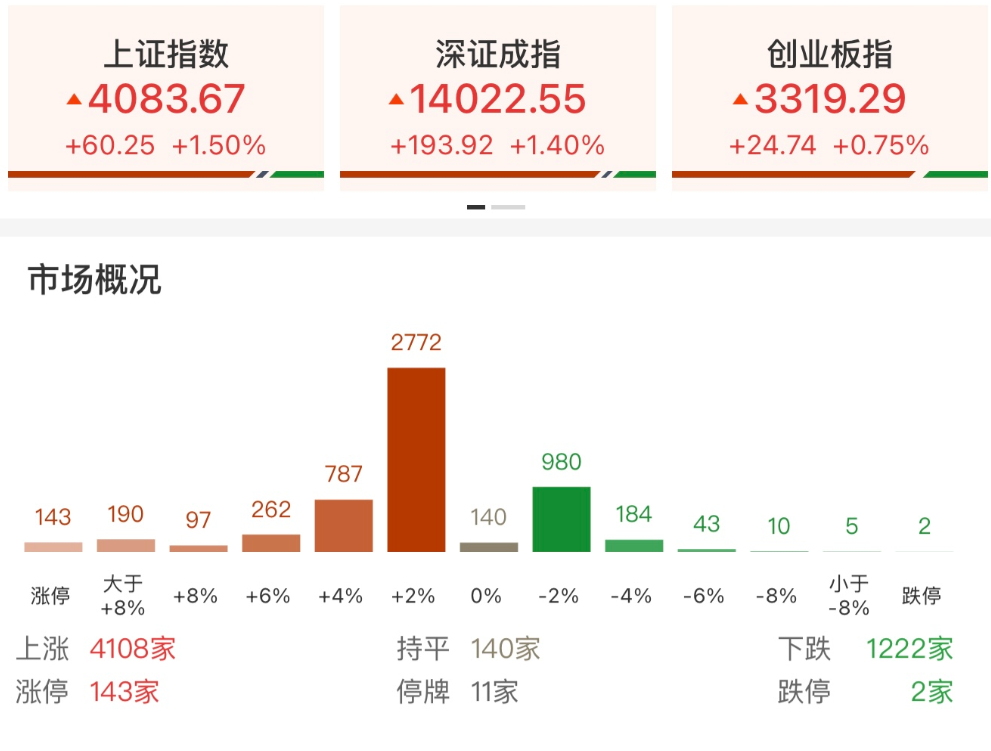
Group 1 - The A-share market continues its strong performance, with the Shanghai Composite Index breaking through the previous high of 4034.08 points, closing at 4083.67 points, an increase of 1.5%, marking a ten-year high [1] - The trading volume in the Shanghai and Shenzhen markets reached 2.81 trillion yuan, an increase of 260.2 billion yuan from the previous day, reflecting a growth of over 10% [1] - Over 3800 stocks in the market experienced gains, indicating a broad-based rally [1] Group 2 - The Shanghai Composite Index achieved a record 13 consecutive daily gains, the longest in its history [2] - Key sectors driving the market include commercial aerospace, brain-computer interface, large financial institutions, intelligent driving, and chemicals, with multiple stocks hitting the daily limit [2] - Analysts suggest that the core drivers of the current market rally have shifted from a single liquidity-driven approach to a combination of profit expectation recovery and improved liquidity environment [4] Group 3 - The manufacturing PMI in December 2025 exceeded expectations, indicating an earlier-than-expected economic recovery, which enhances the credibility of profit recovery [4] - The dual drivers of market performance are reflected in the broad asset class rally, contrasting with the previous year's focus on small-cap growth stocks [4] - The current index's industry weight composition has significantly changed compared to a year ago, with a higher technology content and structural increases in sectors reflecting economic highlights [4] Group 4 - There is a possibility of market consolidation or adjustment despite the positive PMI and profit recovery expectations, as the market is currently in a verification phase for profit levels [5] - Optimism remains regarding the potential for further upward movement in the three major indices, supported by increased trading volume and strong performance in key sectors [5] - The commercial aerospace sector, as a leading theme, is expected to maintain market sentiment as long as it does not experience significant corrections [5]
航运衍生品“护航”实体战略转型
Qi Huo Ri Bao· 2026-01-06 01:13
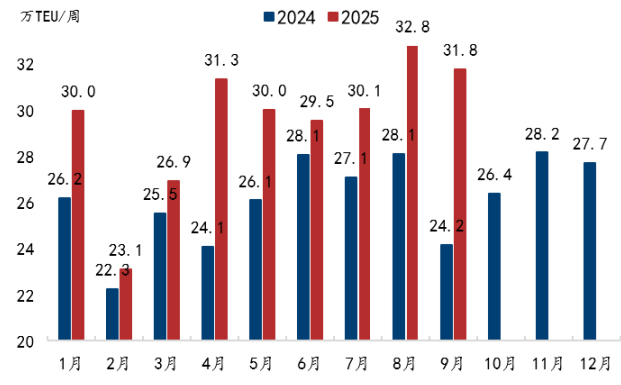
Core Viewpoint - A leading freight forwarding company in Shanghai is facing operational risks due to fluctuations in forward freight costs while expanding its direct customer market. Guotai Junan Futures has developed a tailored hedging solution to mitigate the risk of rising costs by purchasing the EC2512 contract, effectively locking in stable profits for the company [1][4]. Group 1: Industry Common Issues - Fluctuations in freight rates pose significant operational risks across the shipping market, impacting freight forwarders and shippers who face cost pressures from rising rates. Freight forwarders need to hedge against rising costs by purchasing shipping futures, while shipping companies and primary freight forwarders must guard against falling rates by selling futures contracts to lock in profits [2]. - Middle-tier freight forwarding companies often lack effective risk management tools due to insufficient contractual spirit in certain segments, leaving them exposed to unhedged risks [2]. Group 2: Company Background and Needs - The Shanghai-based freight forwarding company is a comprehensive enterprise with a global network. In 2025, the company aims to expand its direct customer market by participating in a tender for European export routes for home appliance companies, needing to quote a fixed price of $1,800/FEU while facing the risk of rising upstream freight costs [3]. Group 3: Service Solution and Implementation - The hedging strategy was designed based on fundamental research, considering geopolitical factors, European economic recovery, and shipping capacity control. Guotai Junan Futures recommended the company to buy shipping futures to hedge against future increases in spot freight costs [4]. - The company won a bid for 64 FEU (32 FEU each for November and December), locking in revenue at $1,800/FEU. To hedge against cost risks, Guotai Junan Futures advised purchasing 16 EC2512 contracts at a price of 1,000 points, corresponding to a freight rate of $1,500/FEU, effectively locking in future costs [6][8]. Group 4: Project Outcomes and Future Cooperation - The hedging strategy allowed the company to manage freight rate risks efficiently at a lower cost, achieving a risk-free profit of $300/FEU by locking in costs at $1,500/FEU while securing $1,800/FEU in revenue. The outcome was well-received by the company [8]. - Following the successful initial collaboration, the company engaged Guotai Junan Futures again in May 2025 for a new round of hedging for December tenders, completing the hedging of 60 FEU within a week, demonstrating improved cooperation efficiency and increased customer satisfaction [9]. Group 5: Industry Promotion and Innovation - Beyond traditional shipping companies and freight forwarders, other groups such as booking platforms and cross-border e-commerce businesses show potential for participating in the shipping derivatives market. These entities can integrate derivatives into their services, indirectly benefiting small and medium-sized freight forwarders [11]. - The "insurance + futures" model combines freight rate risk management with existing shipping insurance products, lowering industry entry barriers and enhancing overall risk coverage capabilities. This approach may be particularly appealing to cross-border e-commerce businesses facing intense competition and seeking to expand their operational space [13].
业内人士:原油市场短期地缘溢价或上升
Qi Huo Ri Bao· 2026-01-06 00:41
Core Viewpoint - The recent turmoil in Venezuela, the country with the largest proven oil reserves, has drawn global attention to the oil market, with expectations of only a short-term price premium due to limited export capacity and near-saturated global storage [1] Group 1: Current Situation and Impact - Venezuela's heavy crude oil production has been reduced by approximately 25% due to U.S. sanctions, leading to a current output of about 500,000 barrels per day [1] - The political vacuum following U.S. control over Maduro may disrupt port and logistics systems, further impacting oil exports [1] - Current estimates suggest that Venezuela's oil production may decline to between 700,000 and 800,000 barrels per day, with exports potentially dropping to 300,000 to 400,000 barrels per day [1][2] Group 2: Long-term Outlook - The supply elasticity of Venezuelan oil depends on political developments; a pro-U.S. regime could lead to a gradual easing of sanctions and a potential recovery of production to 1.2 to 1.5 million barrels per day within 6 to 12 months [2] - Conversely, if instability persists, production could fall below 500,000 barrels per day [2] - The refining sector may experience short-term declines in capacity due to management chaos and raw material shortages, but foreign investment could restore deep processing capabilities in the long term [2] Group 3: Global Oil Market Dynamics - Current global oil inventories are sufficient, with OECD oil stocks exceeding the five-year average by 120 million barrels, and the U.S. strategic and commercial reserves are also ample [3] - Venezuela's oil exports account for about 3% of global oil trade, and countries like Saudi Arabia, Iraq, and Russia can quickly replace its heavy crude supply [3] - The global oil market remains oversupplied, with the International Energy Agency (IEA) predicting that the increase in global oil supply will significantly outpace demand growth through 2026 [3] Group 4: Potential Risks and Geopolitical Factors - The situation in Venezuela could escalate geopolitical tensions in other regions, potentially affecting global oil prices, especially if unrest in Iran intensifies [4]
山东齐盛期货:焦煤补库预期仍存
Qi Huo Ri Bao· 2026-01-06 00:31
Core Viewpoint - The coking coal futures market is experiencing significant volatility, with prices showing a trend of initial decline followed by recovery and subsequent consolidation as it enters 2026. Market sentiment remains cautious due to various evolving factors impacting the coking coal market [1] Group 1: Market Dynamics - The core contradiction in the current coking coal market lies in the downward pressure transmitted from the downstream steel industry, where weak steel prices are compressing profit margins for steel mills, leading them to seek cost reductions from raw material suppliers [1] - The fourth round of price reductions for coke has been fully implemented, further impacting the coking coal market as steel mills push for lower procurement prices [1] - The spot market is reacting sharply, with a high auction failure rate of 36.6% in Shanxi's major mines, indicating a cautious purchasing attitude among downstream enterprises [2] Group 2: Supply and Demand Factors - The end of the year typically sees a reduction in coal production due to maintenance and safety regulations, with the utilization rate of coking coal mines dropping to 79.6%, a decrease of 4.6 percentage points [2] - Despite the supply reduction, prices have not seen a corresponding increase, as the market anticipates a return to normal production levels in 2026, which is expected to fill any short-term supply gaps [3] - The inventory of imported coal remains high at ports, with limited downstream purchasing activity, putting additional pressure on prices [3] Group 3: Future Outlook - Although there are significant pressures on supply and demand, new positive factors are emerging, such as the anticipated recovery in steel production as maintenance activities conclude, which could support coking coal demand [4] - The government's policy direction for large-scale equipment updates in 2026 may not immediately translate into physical demand for coking coal but could positively influence market expectations [4] - The current downward trend in coking coal prices is seen as a necessary market clearing process, with potential for recovery as steel mills' profit margins improve and inventory levels adjust [5]
多重利好消息提振 碳酸锂期价迎来“开门红”
Qi Huo Ri Bao· 2026-01-06 00:20
Core Viewpoint - The lithium carbonate futures market is experiencing a strong upward trend, driven by optimistic market sentiment and several favorable policy announcements, despite no significant changes in the fundamental market conditions compared to before the holiday [1][2]. Group 1: Market Dynamics - On the first trading day after the New Year holiday, the main LC2506 contract for lithium carbonate futures surged by 7.74%, reaching 129,980 yuan/ton [1]. - Analysts believe that the recent price increase is largely influenced by positive news and improved market confidence regarding the demand for new energy vehicles in the first quarter of 2026 [1][2]. - The State Council's recent action plan on solid waste management may impact certain mining operations in Jiangxi, potentially affecting supply dynamics [1]. Group 2: Supply and Demand Analysis - The current supply-demand balance for lithium carbonate is showing signs of marginal weakening, with a 6% decrease in downstream demand and a 2.5% decrease in supply for January 2026 [2]. - As of December 25, 2025, lithium carbonate weekly inventory was reported at 109,605 tons, reflecting a decrease of 168 tons, indicating that inventory depletion may be nearing its end [3]. - Despite a potential shift to inventory accumulation in January 2026, both upstream and downstream sectors are expected to have replenishment needs, limiting downward price pressure [3]. Group 3: Future Outlook - Analysts project that while demand for lithium carbonate may weaken in the short term due to maintenance at major cathode material manufacturers, long-term demand expectations remain strong [4]. - The market sentiment is significantly influencing prices, with expectations of continued high supply levels and potential price stability despite short-term fluctuations [4]. - There is caution regarding the sustainability of high growth in energy storage due to rising costs of battery-related materials like copper and aluminum [4].