
Tuopu Group(601689)

Search documents
L3商用加速落地,有望推动智能底盘批量应用 | 投研报告
Zhong Guo Neng Yuan Wang· 2025-12-17 02:04
Core Viewpoint - The recent approval of L3-level conditional autonomous driving vehicles by the Ministry of Industry and Information Technology (MIIT) marks a significant step towards the commercialization of advanced autonomous driving technology in China [2][5]. Group 1: L3 Autonomous Driving Approval - Changan Automobile and BAIC BluePark Magna Automotive have submitted applications for L3-level conditional autonomous driving vehicles, which have been approved by MIIT in the 401st batch of announcements [2][3]. - L3 autonomous driving allows for conditional self-driving within a limited operational range, differing fundamentally from L2 assistance systems [2][3]. Group 2: Impact on Intelligent Chassis - The approved vehicles include Changan's Deep Blue product and BAIC's Arcfox Alpha S (L3 version), which features a high-performance redundant sensor system with 34 sensors, including three LiDARs [3][4]. - The commercialization of L3 is expected to accelerate the application of intelligent chassis technologies, such as active suspension, electronic brake-by-wire (EMB), and steer-by-wire (SBW) systems [3][4]. Group 3: Investment Strategy - The approval of L3 vehicles provides policy support for the popularization of high-level autonomous driving, benefiting companies actively engaged in this sector [5]. - Key investment areas include vehicle application, where leading companies are establishing advantages in training data and smart driving ecosystems, and the intelligent chassis sector, which is expected to see rapid mass application by 2026 [5].






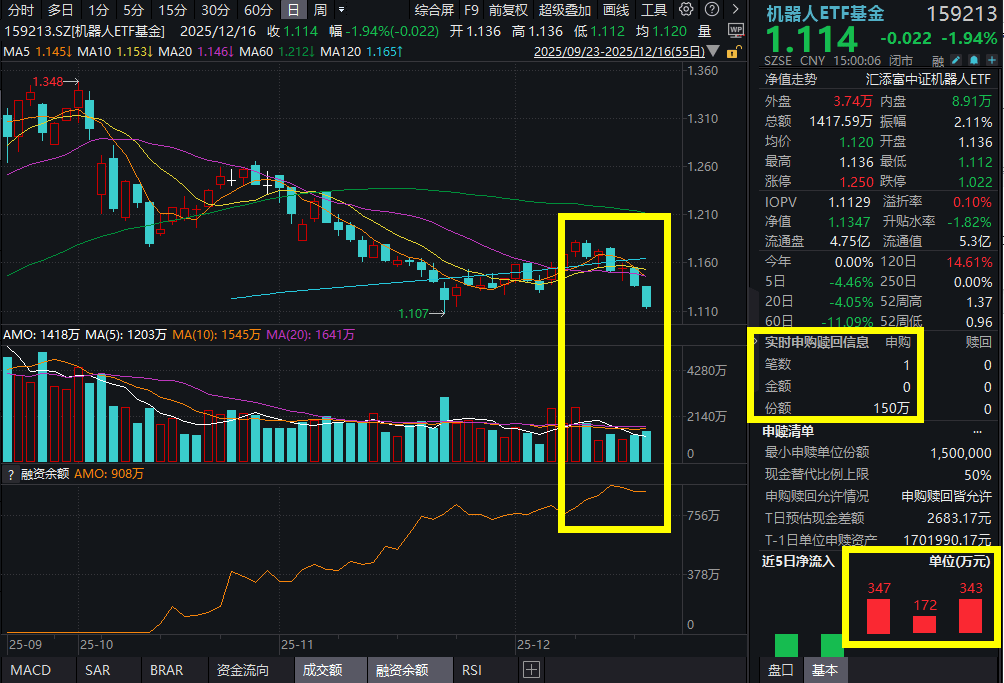
机器人再回调!拓普集团跌近2%,机器人ETF基金(159213)连续4日强势吸金超1000万元!大摩:2050年我国将掌控全球超60%人形机器人供应链!
Sou Hu Cai Jing· 2025-12-16 10:10
Core Viewpoint - The A-share market experienced significant declines, particularly in the robotics sector, with the Robotics ETF (159213) falling by 1.94% and continuing a downward trend for two consecutive days. Despite this, the ETF attracted nearly 2 million yuan in net subscriptions, marking over 10 million yuan in inflows over the past four days [1][3]. Group 1: Market Performance - The Robotics ETF (159213) has seen a decline, with major component stocks like Zhongkong Technology dropping over 3%, and others such as Dazhu Laser and Keda Xunfei falling more than 2% [3][4]. - The ETF's top ten component stocks mostly experienced declines, with Keda Xunfei down by 2.25% and Huichuan Technology down by 1.69% [4]. Group 2: Industry Growth and Projections - According to the National Bureau of Statistics, China's industrial robot production saw a growth of 20.6% in November, indicating a robust industrial performance [5]. - Morgan Stanley forecasts that global sales of robotics hardware will surge from $100 billion in 2025 to $5 trillion by 2030, and eventually exceed $25 trillion by 2050. China is expected to capture 26% of the global robotics market by 2050, with a dominant position in industrial robots and drones [5]. Group 3: Technological Advancements - Yushutech launched the world's first humanoid robot-specific "AppStore," allowing users to easily install skill packages for robots, which lowers the technical barriers for robot functionality development [5]. - The humanoid robot industry is accelerating its implementation, with policies and standards being established to support commercialization and B-end order validation [6][7]. Group 4: Market Dynamics and Opportunities - The market is witnessing a shift towards standardized technology and industrialization, with companies like Ubtech securing significant contracts, such as a 143 million yuan project for a humanoid robot data collection and training center [7]. - The industry is focusing on various application scenarios, including industrial logistics, elderly care, and specialized environments, indicating a broadening of market opportunities [8].




10月北美需求下滑,欧洲增幅收窄:汽车行业海外销量点评
Huachuang Securities· 2025-12-16 09:50
Investment Rating - The report maintains a "Buy" recommendation for the automotive industry [2]. Core Insights - Global light vehicle sales in October reached approximately 7.9 million units, a year-on-year increase of 2.6% and a month-on-month increase of 0.5%. However, overseas sales totaled about 4.77 million units, showing a year-on-year decline of 0.4% and a month-on-month decline of 1.5% [2]. - North American sales were 1.56 million units, down 5.0% year-on-year but up 1.1% month-on-month. European sales were approximately 1.48 million units, up 2.9% year-on-year but down 7.5% month-on-month. In contrast, Chinese sales reached 3.13 million units, up 7.6% year-on-year and 3.7% month-on-month [2]. - The report anticipates that overseas light vehicle sales will reach 55.88 million units in 2025, a year-on-year increase of 1.3%, and 56.14 million units in 2026, a year-on-year increase of 0.5% [2]. Summary by Sections 1. Industry: Sales, Exchange Rates, Freight - Global light vehicle sales data indicates a mixed performance across regions, with North America and Europe facing declines while China shows growth [2][5]. - The report highlights the impact of exchange rates and freight costs on the automotive industry, noting a downward trend in the CCFI (China Container Freight Index) [24]. 2. Market Competition - The competitive landscape is analyzed, showing the market shares of major automotive groups, including Toyota, Volkswagen, and BYD, with a focus on their performance in the global market [28][29]. - The report also discusses the dynamics of the global new energy vehicle market, emphasizing the growth of companies like BYD and Tesla [33][34]. 3. Export Situation of Automotive and Parts Companies - The report provides insights into the export performance of domestic automotive manufacturers, highlighting the monthly growth rates of narrow passenger vehicle exports [39][40]. - It lists companies with significant overseas revenue, indicating their reliance on international markets [42].



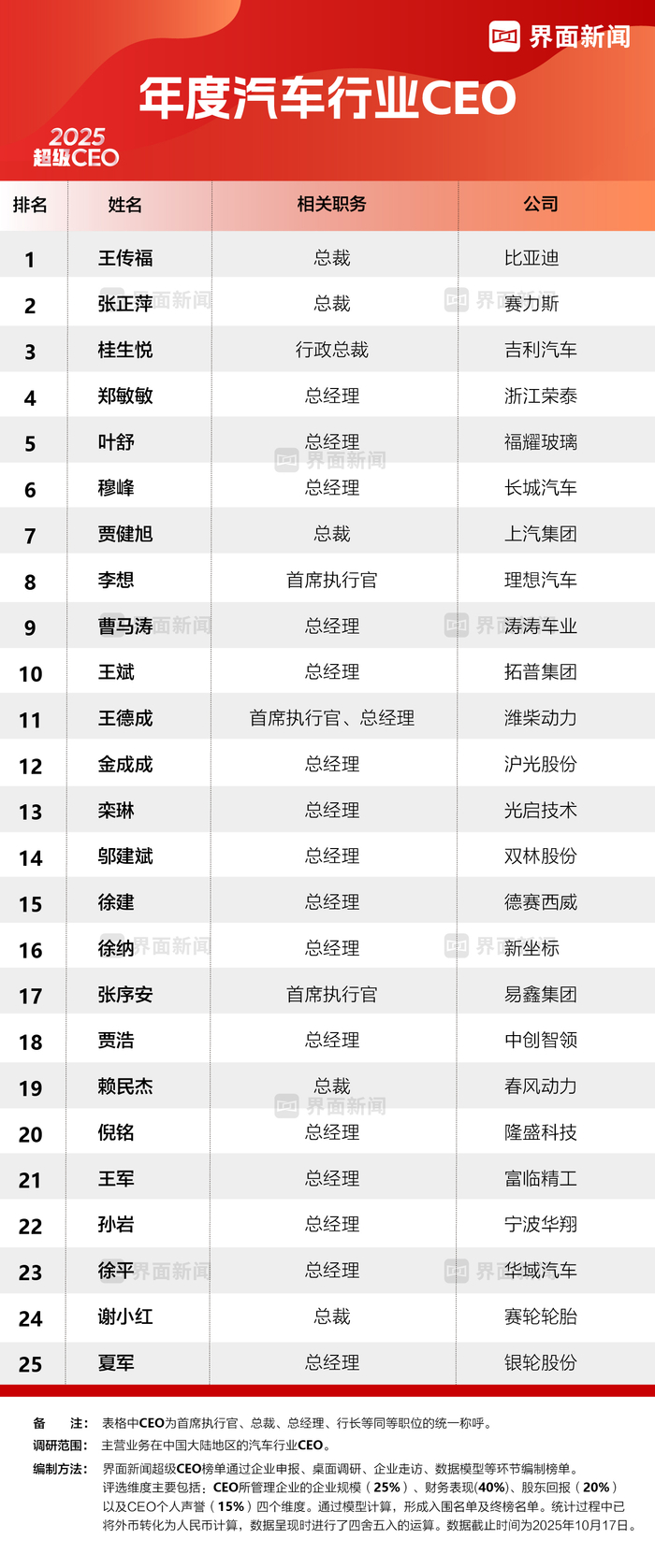
界面新闻发布2025年度汽车行业CEO榜单:比亚迪王传福、赛力斯张正萍、吉利汽车桂生悦位列前三
Xin Lang Cai Jing· 2025-12-16 08:10
Core Insights - The "Super CEO" list by Zhito Finance highlights outstanding leaders in the automotive industry, focusing on their financial growth and reputation, with BYD's Wang Chuanfu ranked first [1][12]. Industry Overview - The automotive industry in China, encompassing vehicles, parts, and services, is projected to produce and sell 31.28 million and 31.44 million units in 2024, reflecting year-on-year growth of 3.7% and 4.5% respectively, maintaining its position as the world's largest market for 16 consecutive years [2]. - In 2024, China's automotive exports are expected to reach 5.859 million units, marking a 19.3% increase, showcasing the industry's resilience amid global trade uncertainties [2]. New Energy Vehicles (NEVs) - NEVs are leading the transformation of the automotive industry, with production and sales expected to exceed 10 million units in 2024, achieving year-on-year growth of 34.4% and 35.5% respectively [3]. - NEV exports are projected to reach 1.284 million units, a 6.7% increase, as China strengthens its competitive edge in key overseas markets [3]. Automotive Parts Industry - The automotive parts sector is experiencing significant growth, with the demand for core components like batteries, motors, and electronic controls surging as NEV penetration exceeds 40% [4]. - In 2024, the installed capacity of power batteries is expected to grow by 47.6% to 531 GWh, with lithium iron phosphate batteries accounting for 69.2% of the total [4]. - The export value of automotive parts is anticipated to reach $105.61 billion, reflecting a 6.8% increase [4]. Intelligent Driving - The intelligent driving sector is witnessing rapid advancements, with consumer demand for safety and efficiency driving the adoption of L2 and higher autonomous driving features in mid-to-high-end vehicles [5]. - Technological breakthroughs in AI algorithms, automotive-grade chips, and high-precision mapping are laying a solid foundation for the industrialization of intelligent driving [5]. CEO Performance - The 25 CEOs on the list have demonstrated impressive performance, with median revenue growth of 23.3%, net profit growth of 31.42%, and return on equity of 15.35% [8]. - The average market capitalization of these companies is approximately 113.6 billion yuan, with 24 CEOs disclosing their 2024 salaries, the highest being 639.134 million yuan [8]. - The representation of post-80s CEOs has increased significantly, indicating a trend towards younger leadership in the automotive sector [8]. Notable CEOs - Wang Chuanfu of BYD leads the list, achieving sales of 4.2721 million units in 2024, with a revenue of 777.102 billion yuan, a 29.02% increase year-on-year [12]. - Zhang Zhengping of Seres has seen a remarkable revenue increase of over 305.04% to 145.176 billion yuan, with NEV sales rising by 182.84% [13]. - Li Xiang of Ideal Auto reported a revenue of 144.460 billion yuan, a 16.64% increase, and is focusing on expanding into the Middle East and Central Asia [14]. - Wang Bin of Top Group achieved a revenue of 26.6 billion yuan, growing by 35.02%, by implementing a Tier 0.5 platform strategy [15].


拓普集团(601689) - 拓普集团关于闲置募集资金现金管理到期赎回的公告
2025-12-16 08:01
证券代码:601689 证券简称:拓普集团 公告编号:2025-086 宁波拓普集团股份有限公司 关于闲置募集资金现金管理到期赎回的公告 本公司董事会及全体董事保证本公告内容不存在任何虚假记载、误导性陈述 或者重大遗漏,并对其内容的真实性、准确性和完整性承担个别及连带责任。 宁波拓普集团股份有限公司(以下简称"公司")分别于 2025 年 4 月 22 日 召开第五届董事会第二十一次会议及第五届监事会第十七次会议、2025 年 5 月 14 日召开 2024 年年度股东大会,审议通过了《关于使用部分暂时闲置募集资金 委托理财的议案》,授权公司(含全资子公司)使用最高额度不超过人民币 24 亿元的暂时闲置募集资金委托理财,用于结构性存款或购买保本型理财产品,授 权期限自 2025 年 7 月 1 日起至 2026 年 6 月 30 日止,额度内资金可以循环滚动 使用。详情请见公司于 2025 年 4 月 24 日在上海证券交易所网站披露的《拓普集 团关于使用部分暂时闲置募集资金委托理财的公告》。 一、本次现金管理产品到期赎回情况 2025 年 6 月 11 日,公司使用暂时闲置募集资金购买杭州银行宁波北仑支行 ...
线控制动/转向:法规渐松绑,有望加速步入放量周期
Hua Yuan Zheng Quan· 2025-12-15 11:13
Investment Rating - The report rates the automotive parts industry as "Positive" (First Time) [1] Core Viewpoints - The loosening of regulations is expected to accelerate the mass production of electronic mechanical brakes (EMB) and steer-by-wire (SBW), leading to a significant market expansion [3] - The domestic market for line-controlled chassis is projected to exceed 100 billion by 2030, driven by advancements in high-level autonomous driving [3][30] - The report emphasizes the importance of focusing on high-quality Tier 1 suppliers and upstream components such as motors and lead screws [4][9] Summary by Relevant Sections Line-Controlled Chassis - The pursuit of human-machine decoupling in line-controlled chassis is fundamental for achieving L3/L4 autonomous driving [9] - The market for line-controlled braking systems is expected to reach 50 billion by 2030, with EMB projected at 16.4 billion [3][30] - The line-controlled steering market is anticipated to reach 50 billion by 2030, with SBW projected at 21.5 billion [3][30] Regulatory Developments - Regulations allowing EMB to be implemented in vehicles will officially take effect on January 1, 2026 [3][26] - New policies regarding SBW are expected to be catalyzed within the year, although specific certification details remain unclear [3][26] Market Dynamics - The report highlights that the penetration rate of line-controlled chassis is expected to rise from 5% in 2025 to 30% by 2030 [31] - The overall market for intelligent chassis in China is projected to exceed 100 billion by 2030, with a compound annual growth rate (CAGR) of 37% from 2025 to 2030 [30][29] Key Companies to Watch - The report suggests focusing on leading Tier 1 suppliers with comprehensive platform capabilities, such as NEXTEER, ZF, and others [4][9]





汽车行业2026年度投资策略:破局与新生:整车出海、AI应用汽零,迎接优质公司价值重估
Orient Securities· 2025-12-14 06:32
Core Insights - The report emphasizes the importance of overseas expansion and AI applications in the automotive industry, particularly for vehicle manufacturers and parts suppliers, as a means to achieve growth and value reassessment by 2026 [2][9][14]. Group 1: Automotive Industry Overview - In 2025, the domestic automotive market experienced significant growth due to policies promoting vehicle replacement and increasing exports, with a notable rise in sales of new energy vehicles (NEVs) [14][19]. - The outlook for 2026 indicates potential growth pressures in the domestic market due to tightening policies and the phasing out of tax exemptions for NEVs, while exports are expected to remain a key growth driver [15][20]. Group 2: Vehicle Segment Analysis - The report forecasts that the domestic passenger vehicle market will see stable sales, with an estimated total of 30.37 million units in 2026, reflecting a 1.1% year-on-year increase, driven by export growth [29][39]. - The export volume of passenger vehicles is projected to reach approximately 6.56 million units in 2026, representing a 14% year-on-year increase, as domestic brands enhance their overseas presence [39][40]. Group 3: New Energy Vehicles (NEVs) - The penetration rate of NEVs is expected to continue rising, with sales projected at around 17.41 million units in 2026, marking a 12% year-on-year increase [9][30]. - The report highlights a shift from a "price war" to a "value war" among NEV manufacturers, indicating a competitive landscape focused on quality and technology [9][16]. Group 4: Auto Parts Industry - The report identifies overseas business as a crucial growth point for auto parts companies, with expectations of improved profitability from international operations as companies expand their global footprint [9][16]. - AI applications in areas such as humanoid robots, AI liquid cooling, and intelligent driving are anticipated to create new growth opportunities for parts suppliers, with significant advancements expected in 2026 [9][16][19]. Group 5: Investment Recommendations - The report recommends focusing on mid-cap blue-chip companies in the auto parts sector, as their overseas business is expected to contribute significantly to profitability in the coming years [3][9]. - Key investment targets include companies like Yinchuan, New Spring, Top Group, and others that are well-positioned to benefit from the trends in overseas expansion and AI integration [3].


拓普集团(601689) - 拓普集团关于闲置募集资金现金管理到期赎回的公告
2025-12-12 09:46
二、公司最近十二个月使用募集资金委托理财的情况 证券代码:601689 证券简称:拓普集团 公告编号:2025-085 截至 2025 年 12 月 12 日,公司最近十二个月使用募集资金委托理财的情况 如下表: 宁波拓普集团股份有限公司 关于闲置募集资金现金管理到期赎回的公告 本公司董事会及全体董事保证本公告内容不存在任何虚假记载、误导性陈述 或者重大遗漏,并对其内容的真实性、准确性和完整性承担个别及连带责任。 宁波拓普集团股份有限公司(以下简称"公司")分别于 2025 年 4 月 22 日 召开第五届董事会第二十一次会议及第五届监事会第十七次会议、2025 年 5 月 14 日召开 2024 年年度股东大会,审议通过了《关于使用部分暂时闲置募集资金 委托理财的议案》,授权公司(含全资子公司)使用最高额度不超过人民币 24 亿元的暂时闲置募集资金委托理财,用于结构性存款或购买保本型理财产品,授 权期限自 2025 年 7 月 1 日起至 2026 年 6 月 30 日止,额度内资金可以循环滚动 使用。详情请见公司于 2025 年 4 月 24 日在上海证券交易所网站披露的《拓普集 团关于使用部分暂时闲置募 ...
电动化拖垮百年老店,中国供应链扛起时代大旗
3 6 Ke· 2025-12-11 02:27
Core Insights - The Chinese automotive industry is experiencing a significant transformation, with high-end models like the Huawei's Zun Jie S800 driving advancements in domestic technology and supply chains [1] - The global automotive parts industry is facing a stark contrast in performance, with European and American giants struggling while Chinese suppliers thrive [3][4] Group 1: Performance of Global Automotive Parts Industry - European and American automotive parts companies are facing ongoing challenges, including significant profit declines and restructuring efforts [5][9] - Major companies like Schaeffler and Continental are reporting substantial losses, with Schaeffler's net profit down 45.9% and Continental's net loss exceeding 700 million euros [6][9] - In contrast, Japanese and Korean companies are benefiting from favorable exchange rates and government subsidies, leading to stable revenue growth [12][13] Group 2: Rise of Chinese Automotive Parts Suppliers - Chinese automotive parts suppliers are rapidly rising, with 15 companies making it to the top 100 global suppliers list, showcasing their growth potential [14][15] - The Chinese automotive market is booming, with production and sales figures showing double-digit growth, particularly in the electric vehicle sector [16] - Leading companies like CATL and Yanfeng are reporting impressive revenue growth, with CATL's revenue reaching 1041.86 billion yuan, a 41.21% increase year-on-year [18] Group 3: Challenges and Opportunities - Despite the growth, over 60 automotive parts companies in China are facing the "increased revenue without increased profit" dilemma, indicating a growing industry divide [20] - International companies are increasingly focusing on the Chinese market, with Magna and Denso expanding their investments and partnerships in the region [21][23] - The ongoing transition to electric and smart vehicles is reshaping the global automotive supply chain, with Chinese companies positioned to play a central role in this transformation [23]





2025年汽车悬架行业词条报告
Tou Bao Yan Jiu Yuan· 2025-12-10 12:13
Investment Rating - The report does not explicitly state an investment rating for the automotive suspension industry Core Insights - The automotive suspension industry is undergoing a profound transformation driven by electrification and intelligence, shifting the competitive focus from traditional mechanical hardware to a comprehensive system capability defined by software [4] - The demand for lightweight structural components and high-performance suspensions is increasing due to electrification, while intelligence is pushing the evolution of suspensions from passive adaptation to active prediction [4] - The value distribution across the entire industry chain will be redefined in this technological revolution, with investment opportunities focusing on leading domestic component manufacturers, system integrators with advantages in electric control suspensions, and suppliers providing key enabling technologies for intelligent suspensions [4] Summary by Sections Industry Overview - The automotive suspension system connects the vehicle body to the wheels, playing a crucial role in cushioning road impacts and ensuring good contact between the wheels and the ground [5] - The industry can be categorized into passive, semi-active, and active suspensions based on their working principles and application scenarios [5][6] Industry Characteristics - High-end market core technology barriers are significant, with foreign companies having established a "patent moat" in core suspension technologies [8] - Electrification is driving technological iterations, with new energy vehicles imposing stricter requirements on suspension systems [9] - Intelligent technology is enabling the transition of suspension systems from mechanical passive modes to electronically controlled active modes [10] Development History - The automotive suspension system has evolved from passive systems in the 1930s to semi-active systems in the 1970s, and to active systems gaining traction in the 1990s [11][12][13][14][15] Industry Chain Analysis - The automotive suspension industry chain consists of upstream (core materials and components), midstream (system design and assembly), and downstream (vehicle application and aftermarket services) [16] - The upstream component supply segment is highly concentrated, dominated by international suppliers like ZF and Continental [17][22] - Midstream, system integrators are increasingly investing in R&D to enhance differentiation and supply chain security [18][19] Market Size and Growth - The automotive suspension market size is projected to grow from 67.25 billion RMB in 2019 to 83.42 billion RMB in 2024, with a compound annual growth rate (CAGR) of 4.40% [29] - The market is expected to further expand to 111.45 billion RMB by 2029, with a CAGR of 6.10% [29] Future Trends - The demand for high-performance suspension systems is increasing, with technology being downscaled to mid-range markets [32] - The rise of line-controlled suspension systems is anticipated to support the development of automotive intelligence [33] Competitive Landscape - The competitive landscape is characterized by a "global leaders and Chinese tiered catch-up" scenario, with high market concentration [39] - Chinese manufacturers are rapidly closing the technology gap with international giants, driven by the growth of the new energy vehicle market [43][44]


