
LZLJ(000568)

Search documents
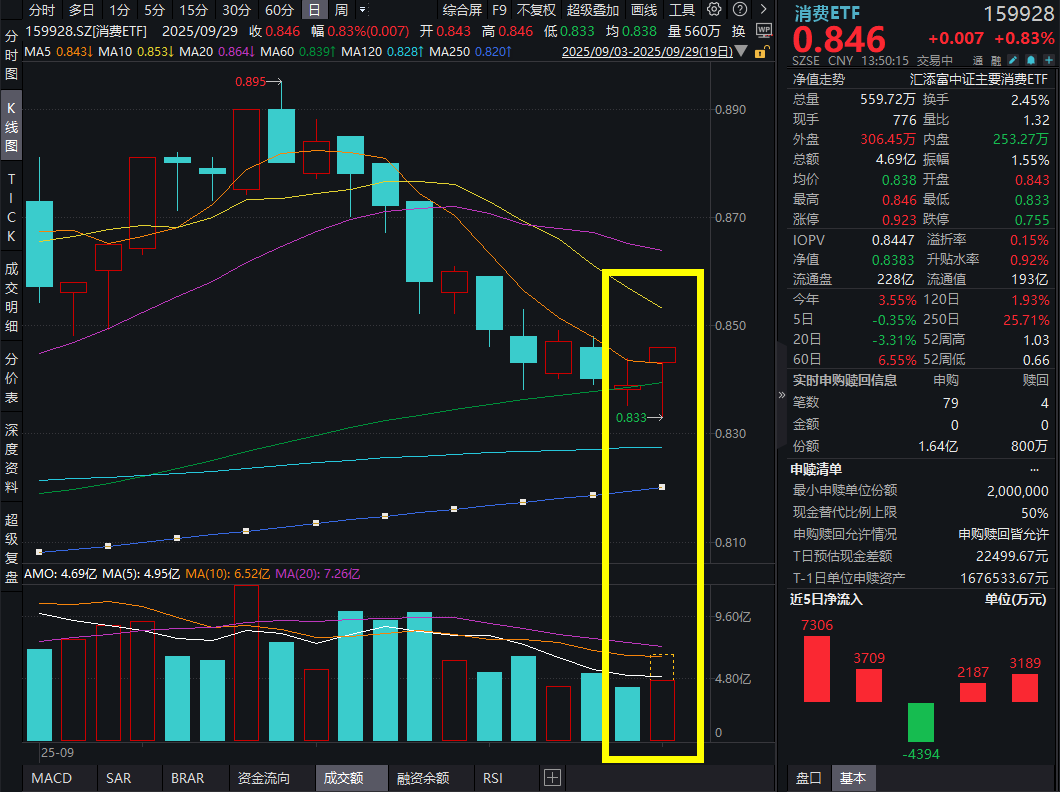
双节旺季将至,白酒龙头积极应对!消费ETF(159928)V型反转,盘中获1.56亿份净申购,最新份额创新高!
Xin Lang Cai Jing· 2025-09-29 06:13
Core Viewpoint - The consumption ETF (159928) shows a strong rebound with a net subscription of 156 million units, indicating robust investor interest in the consumer sector as the "super golden week" approaches, driven by increased travel and spending intentions [1][5]. Group 1: Market Performance - The major consumption index (000932) increased by 0.63%, with notable gains in stocks such as Yangyuan Beverage (603156) up 8.71%, Luzhou Laojiao (000568) up 4.16%, and Gujing Gongjiu (000596) up 3.42% [3]. - The top ten component stocks of the consumption ETF account for over 68% of the index, with four leading liquor stocks making up 32% and major consumer staples like Yili (9.56%) and Moutai (8.68%) also contributing significantly [7][8]. Group 2: Consumer Trends - The upcoming Mid-Autumn and National Day holidays are expected to boost consumer spending, with online travel platforms reporting a significant increase in travel bookings, particularly for interprovincial and outbound travel [5]. - The liquor market is experiencing a cautious inventory buildup, with traditional sales channels under pressure, while new retail formats like live streaming and instant retail are showing rapid growth [5]. Group 3: Industry Insights - Leading liquor companies are actively responding to market conditions, with Moutai initiating market research and price stabilization efforts, while Wuliangye is addressing pricing issues through dealer meetings [5]. - The food and beverage sector is seeing policy-driven catalysts, particularly in the prepared food segment, which may benefit leading brands through increased market share [6].



食品饮料行业周报:双节白酒持续磨底,关注高景气赛道机会-20250929
Huaxin Securities· 2025-09-29 05:42
Investment Rating - The report maintains a "Recommended" investment rating for the food and beverage industry [8][56]. Core Viewpoints - The white liquor sector is expected to face pressure during the upcoming National Day and Mid-Autumn Festival due to cautious inventory stocking and a significant impact on group purchasing channels. However, traditional channels like instant retail and live streaming are experiencing rapid growth, indicating a recovery in consumer demand [6][54]. - The report highlights opportunities in high-growth segments such as prepared dishes and snacks, driven by policy support and market expansion. The introduction of national standards for prepared dishes is expected to benefit leading companies in the sector [7][55]. - The beverage sector is approaching peak season, with a focus on new consumer opportunities and retail channel transformations. Companies like "Naixue's Tea" and "Chabaidao" are highlighted for their growth potential [8][56]. Summary by Sections 1. Weekly News Summary - Industry news includes the selection of five liquor companies for the Zhejiang Province Industrial Heritage list and a 1.7% growth in Guizhou's liquor and tea manufacturing from January to August [6][20]. - Company news features Guizhou Moutai's investment in a biotechnology company and the launch of "Longma Liquor" by Langjiu [6][21]. 2. Key Company Feedback - The report provides insights into the performance of key companies in the food and beverage sector, with a focus on stock price movements and market trends [32][34]. - The white liquor industry saw a cumulative production of 4.145 million tons in 2024, a decrease of 7.72%, while revenue reached 796.4 billion yuan, an increase of 5.3% [36][38]. 3. Industry Ratings and Investment Strategies - The report suggests focusing on leading companies in the white liquor sector such as Guizhou Moutai, Wuliangye, and Luzhou Laojiao, as well as flexible stocks like JiuGui Jiu and SheDe JiuYe [6][54]. - In the snack sector, companies like Wancheng Group and Anjiu Food are recommended due to their market positioning and growth potential [7][55]. 4. Key Company and Earnings Forecast - The report lists several companies with their respective stock prices, earnings per share (EPS), price-to-earnings (PE) ratios, and investment ratings, all indicating a "Buy" recommendation [10][25]. - Notable companies include Guizhou Moutai with a stock price of 1435.00 yuan and an EPS of 68.64 for 2024, and Wuliangye with a stock price of 120.17 yuan and an EPS of 8.21 for 2024 [10][25].


双节前名酒量价回升,食品饮料ETF天弘(159736)连续9日“吸金”, 流通份额超76亿份创新高
2 1 Shi Ji Jing Ji Bao Dao· 2025-09-29 02:58
Core Viewpoint - The food and beverage ETF Tianhong (159736) has shown significant market activity, with a notable inflow of funds and rising stock prices among key components, indicating a positive trend in the sector [2][3]. Group 1: ETF Performance - The Tianhong food and beverage ETF (159736) experienced a slight decline of 0.28% as of the latest report, with a premium rate of 0.04% and frequent premium trading observed [1]. - The ETF has seen a net inflow of nearly 170 million yuan over the past nine trading days, with a total circulation of 7.62 billion shares, reaching a historical high [2]. Group 2: Component Stocks - Key component stocks such as Yangyuan Beverage, Gujing Gongjiu, Luzhou Laojiao, and others have shown price increases, with Yangyuan Beverage rising over 4% [2]. - The ETF closely tracks the CSI Food and Beverage Index, which includes major stocks from the beverage, packaged food, and meat industries, featuring top holdings like Kweichow Moutai, Yili, and Wuliangye [2]. Group 3: Market Trends - Reports indicate a significant increase in the prices of premium liquor, with notable price hikes for products like Feitian Moutai and other well-known brands over a short period [3]. - The liquor market is experiencing a surge in demand, particularly in the mid-range price segment (50-200 yuan), with increased sales reported across various regions [3]. - The upcoming National Day holiday is expected to boost tourism and consumer spending, with a projected 130% increase in travel compared to the previous year, indicating a potential for strong sales in the food and beverage sector [4].


智通A股限售解禁一览|9月29日



智通财经网· 2025-09-29 01:04
Core Points - On September 29, a total of 25 listed companies had their restricted shares unlocked, with a total market value of approximately 24.818 billion yuan [1] Summary by Category Restricted Share Unlocking - The companies involved in the unlocking of restricted shares include: - Luzhou Laojiao (000568) with 102,700 shares from equity incentive restrictions - East China Pharmaceutical (000963) with 215,000 shares from equity incentive restrictions - Taiyuan Heavy Industry (600169) with 11.6502 million shares from equity incentive restrictions - Jinfat Technology (600143) with 7.406 million shares from equity incentive restrictions - Guotai Junan (601211) with 3.2495 million shares from equity incentive restrictions - Guanglian Da (002410) with 3.2334 million shares from equity incentive restrictions - Ningbo Port (601018) with 3.647 billion shares from A-share issuance to legal person allocation - Zhongjin Environment (300145) with 852,070 shares from equity incentive restrictions - Keli Ke (002782) with 768,000 shares from equity incentive restrictions - Yingjie Electric (300820) with 62,500 shares from equity incentive restrictions - Laobaixing (603883) with 868,400 shares from equity incentive restrictions - Zhaoxun Media (301102) with 218 million shares from extended lock-up period - Zhongjing Technology (003026) with 20,000 shares from equity incentive restrictions - Woge Optoelectronics (603773) with 14.8003 million shares from A-share issuance to original shareholders allocation - Hanrui Cobalt (300618) with 104,670 shares from equity incentive restrictions - Fujilai (301258) with 55.362 million shares from extended lock-up period - Wankai New Materials (301216) with 225 million shares from extended lock-up period - Weiteou (301319) with 29.8 million shares from pre-issue share restrictions - Guanshi Technology (605588) with 19,870 shares from equity incentive restrictions - Sanwang Communication (688618) with 13,500 shares - Xidi Micro (688173) with 771,800 shares - Rendu Biology (688193) with 8.4316 million shares - Jinchang Protein (688137) with 7.145 million shares - Jiao Cheng Ultrasound (688392) with 43.8612 million shares - Aike Saibo (688719) with 824,800 shares [1]
2025年第39周:酒行业周度市场观察
艾瑞咨询· 2025-09-29 00:05
Industry Environment - The white liquor industry is shifting its endorsement strategy from middle-aged male celebrities to younger, diverse stars like G.E.M. and Zhang Yixing, reflecting a trend towards a more youthful and lifestyle-oriented brand image [2][3] - The light bottle liquor market is experiencing a bifurcation, with traditional brands like Niulanshan facing significant revenue declines due to price competition, while high-quality products like Fenjiu's Guofen are in high demand, indicating a shift towards quality and brand strength in the market [4][5] - The upcoming 2025 China Open tennis tournament will feature enhanced spectator experiences and cultural integration, with Luzhou Laojiao as the exclusive partner, promoting Chinese liquor culture [5] - The high-end beer market is undergoing significant changes, with CR Beer surpassing Budweiser APAC in revenue, indicating the rise of local brands in the premium segment despite overall market contraction [6] - The banquet market is emerging as a new battleground for liquor companies, with several firms reporting double-digit growth in this segment as they adapt to changing consumer preferences [7] - Eight listed liquor companies reported direct sales revenue exceeding 640 billion yuan in the first half of the year, with Moutai and Wuliangye leading the market [8] - The past decade has seen significant changes in the regional liquor market, with notable growth among regional leaders while others struggle due to strategic missteps [9] Key Trends - The trend towards lower alcohol content in liquor is gaining traction, with companies like Wuliangye and Luzhou Laojiao launching lower-alcohol products to attract younger consumers, and the low-alcohol market expected to grow significantly [11] - Regional liquor companies are leveraging local sports events for marketing, enhancing brand connection with consumers, although the effectiveness of such strategies remains to be seen [12] - The first China Liquor Market Prosperity Index was released, indicating a favorable outlook for online sales and low-alcohol products driving consumption [10] Company Dynamics - Songhe Liquor is upgrading its quality strategy with a commitment to long-term aging processes, aiming to enhance its market position [13] - The launch of "Dazhen·Zhenjiu" has seen strong initial sales, indicating a successful entry into the high-end liquor market through strategic partnerships and pricing control [14] - Gujing Gongjiu is integrating cultural elements into consumer experiences, showcasing the importance of cultural heritage in modern marketing strategies [15] - The "Jiuxiao Er" brand is focusing on immediate retail and digital transformation to enhance consumer engagement and market presence [14][19] - Yanghe's summer marketing campaign successfully connected the brand with consumer experiences through sports and cultural events, emphasizing the importance of experiential marketing [20] Emerging Opportunities - The introduction of herbal yellow wine "Bencao Bang" targets health-conscious consumers, indicating a trend towards health-oriented products in the liquor market [21] - A strategic partnership between Huajun Media and Bojiangfang aims to reshape the market for sauce-flavored liquor through quality certification and consumer engagement [22] - The launch of UMEET blueberry distilled liquor exemplifies the industry's shift towards catering to younger, health-conscious consumers with innovative products [24]


品牌工程指数上周涨1.10%
Zhong Guo Zheng Quan Bao· 2025-09-28 20:46
Market Performance - The market saw an increase last week, with the China Securities Xinhua National Brand Index rising by 1.10% to 2019.88 points [1] - The Shanghai Composite Index rose by 0.21%, the Shenzhen Component Index by 1.06%, the ChiNext Index by 1.96%, and the CSI 300 Index by 1.07% [1] Strong Performing Stocks - Notable strong performers included Hu Silicon Industry, which increased by 19.75%, and Anji Technology, which rose by 19.05% [1] - Other significant gainers included Xinlitai (up 15.81%), Yangguang Power, and Zhongwei Company (both over 14%) [1] Year-to-Date Performance - Since the beginning of the second half of the year, Zhongji Xuchuang has surged by 183.63%, leading the gains [2] - Yangguang Power and Kewo Si have also shown substantial increases of 132.40% and 82.81%, respectively [2] Market Outlook - Starstone Investment suggests that the market's trading sentiment has declined due to risk aversion ahead of the long holiday, but this may indicate that funds are waiting for clearer policy and fundamental information [2] - The overall market remains strong, with no systemic risks identified, and various sectors are expected to present opportunities [2] Sector Rotation - Source Le Sheng Asset notes a clear rotation pattern this year, with sectors such as new consumption, innovative pharmaceuticals, technology, and high-dividend stocks experiencing alternating rises [3] - The investment strategy has been adjusted to reduce the proportion of technology stocks while increasing exposure to the manufacturing sector, focusing on technology, non-ferrous metals, manufacturing, and innovative pharmaceuticals [3]




泸州老窖20250926
2025-09-28 14:57
Summary of the Conference Call for Luzhou Laojiao Company Overview - **Company**: Luzhou Laojiao - **Industry**: Baijiu (Chinese liquor) Key Points and Arguments Sales Performance and Market Dynamics - The decline in sales of the high-end product, Guojiao, has led to a stock price correction, but the low-end Guojiao is performing well in advantageous regions, with expected revenue reaching 10 billion in 2024, limiting the overall growth impact [2][3] - The company has a strong presence in the mass-market product segment (Tequ series, New District II), covering price ranges of 100-400 yuan, which is expected to alleviate growth pressure and reach more consumers [2][4] Strategic Adjustments - The company is implementing refined channel operations and flexible pricing strategies to stabilize high-end Guojiao prices while actively developing specialized channels [2][5] - In response to industry demand downturns, the company is adjusting management and channel controls, increasing process assessment weights, enhancing subsidy measures, and repairing manufacturer relationships for long-term development [2][7] Valuation and Market Perception - The capital market's low valuation of Luzhou Laojiao is seen as somewhat biased, with a potential upside of 20%-30% compared to Fenjiu, given the company's competitive strengths in products and channels [2][6] - The market anticipates a 10% decline in annual profits, but the company remains undervalued due to its strong competitive position, particularly in low-end products [6][9] Future Development Strategies - Future strategies for high-end Guojiao include refined channel operations and maintaining market share during off-peak seasons, with potential price adjustments around the 2026 Spring Festival to boost sales [5][10] - The company is focusing on digital transformation to enhance channel and consumer data management efficiency, which supports timely expense reimbursement and personalized services [2][13] Organizational and Competitive Advantages - The core competitive advantages lie in organizational and channel management, with a strong organizational barrier established through deep reforms since 2015 [10][11] - The company has a highly market-oriented organizational structure and a professional sales team, enhancing strategic execution and channel effectiveness [11][12] Digital Transformation Impact - Digital transformation has improved efficiency in managing channel and consumer data, allowing for timely expense management and maintaining profit margins despite revenue contraction [13][14] - The company is transitioning from a single merchant model to a single customer model, requiring higher organizational capabilities and skilled personnel [22] Market Expansion Strategies - The company aims to expand nationally through a full-price product strategy and by deepening its presence in key markets like Sichuan and North China [23] - The low-end baijiu market is expected to grow, with 38-degree Guojiao gaining market share in regions like Hebei and Shandong, potentially achieving a 10% market share in a 3 trillion yuan market [24] Financial Forecast - Short-term projections indicate a revenue decline in 2025, with a net profit of approximately 12 billion yuan, corresponding to a 70% dividend payout ratio [25] - Long-term growth is anticipated due to product layout and national expansion, with a potential for double-digit growth rates in the coming years [25] Additional Important Insights - The company is enhancing its brand marketing strategies, focusing on youth engagement and cultural activities to improve brand image [17] - The digitalization process is crucial for adapting to the evolving market landscape, especially with the rise of e-commerce and direct-to-consumer models [21][22]
中经酒业周报∣8酒企上榜中国制造业企业500强,2025年IWSC首届中国区(邛崃)烈性酒大赛启动,茅台9月终端动销同比增20%
Xin Hua Cai Jing· 2025-09-28 11:16
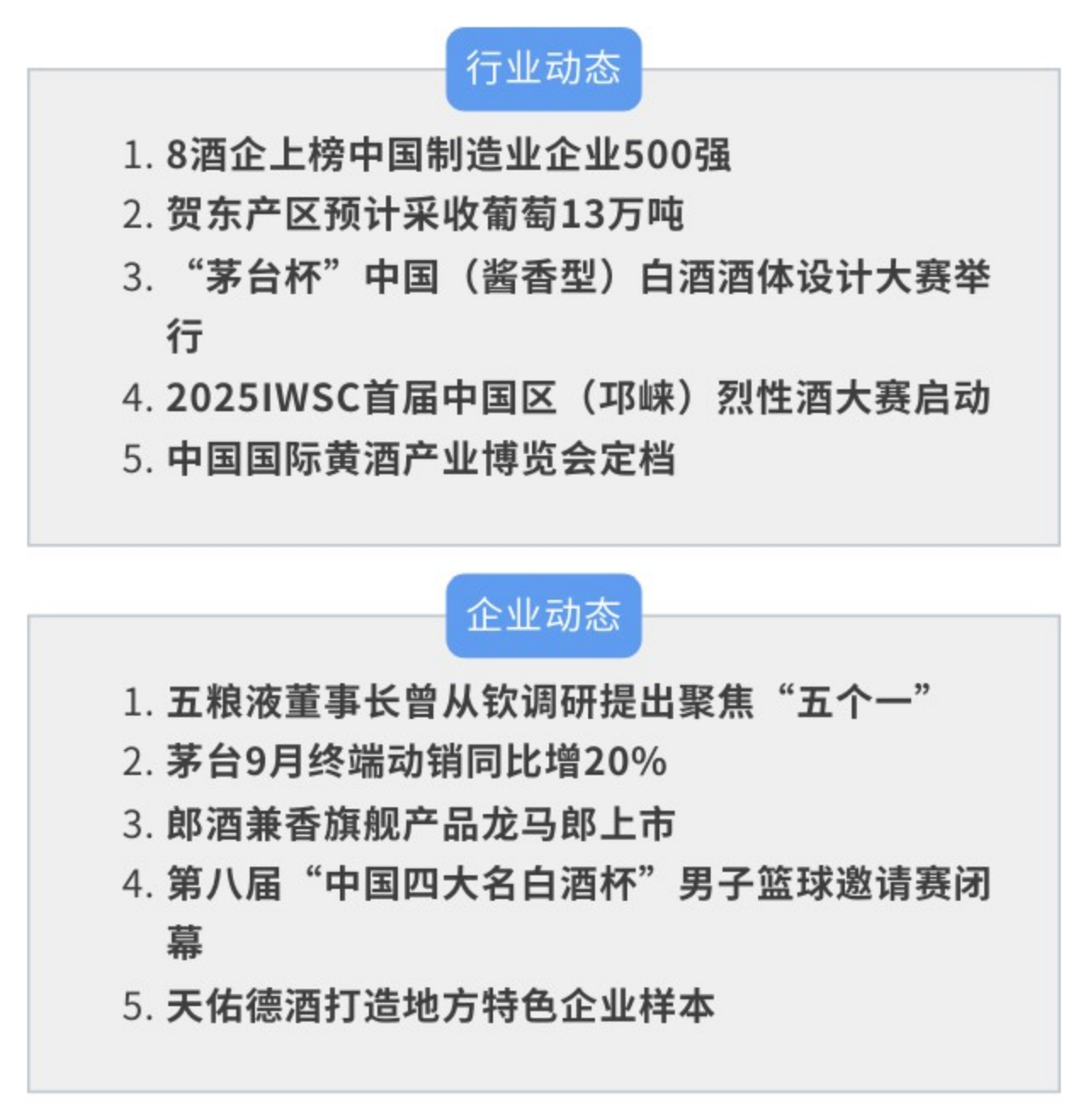
Industry Dynamics - Eight liquor companies made it to the list of China's top 500 manufacturing enterprises, including Sichuan Yibin Wuliangye Group, Guizhou Moutai, and Luzhou Laojiao [2] - The grape harvest season in the Helan Mountain East region started in mid-August and is expected to last until early October, with an estimated 130,000 tons of wine grapes to be harvested this year [3] - The "Moutai Cup" Chinese (Sauce Aroma) Baijiu Body Design Competition was held, with participants from 11 provinces, and a contestant from Guizhou Moutai winning first place [3] - The first China (Qionglai) Spirits Competition was launched, aiming to enhance the international brand recognition of Qionglai liquor [3] - The 2025 China International Huangjiu Industry Expo is scheduled for November 7-12 in Shaoxing, Zhejiang, featuring six exhibition areas and multiple related events [4] Company Dynamics - Wuliangye's chairman emphasized focusing on five strategies to enhance market presence and consumer engagement during a recent market research tour [5] - Moutai reported a 20% year-on-year increase in terminal sales for September, indicating a positive market trend [5] - Langjiu launched its flagship product "Longma Lang," which combines strong and sauce aroma techniques, as part of its ongoing product strategy [5] - The eighth "Four Famous Baijiu Cup" basketball invitation tournament concluded, with the Shaanxi team winning the championship [6] - Tianyoude Liquor, the only listed company in Qinghai's liquor industry, is focusing on local特色 and has developed a tourist attraction that has become popular among visitors [6]

飞天茅台批价回升,推荐白酒底部配置
SINOLINK SECURITIES· 2025-09-28 11:13
Investment Rating - The report suggests a positive outlook for the liquor sector, particularly for high-end brands like Guizhou Moutai and Wuliangye, indicating a left-side configuration opportunity in the white liquor segment [3][12][14]. Core Insights - The report highlights that the core products in the liquor industry, such as Feitian Moutai and Wuliangye, have seen a rebound in wholesale prices, attributed to effective channel management by manufacturers [2][12]. - It is anticipated that the sales volume in the white liquor sector will decline by approximately 20% year-on-year, but the rate of decline is expected to narrow compared to previous months, indicating a potential stabilization in the market [11][12]. - The report emphasizes the increasing diversification of purchasing channels for liquor, with a notable shift towards online and new media platforms, which is reshaping consumer behavior [2][12][14]. Summary by Sections White Liquor - The report notes a recovery in the wholesale prices of key products, driven by improved channel management and a positive reception during the upcoming Mid-Autumn and National Day holidays [2][12]. - It suggests that the white liquor sector is entering a phase where inventory levels can be significantly reduced, leading to a temporary release of price pressure [12][14]. - Recommendations include focusing on high-end brands with strong market positions and exploring potential catalysts in the broader liquor market [3][12][14]. Beer - The beer sector is experiencing steady recovery in on-premise consumption, with companies diversifying into non-draft channels and soft drinks [14]. - The report encourages continued attention to the beer sector due to its solid performance and dividend levels [3][14]. Yellow Wine - The yellow wine industry is seeing price increases among leading brands, which may lead to a more stable competitive landscape [14]. - The report highlights the importance of marketing and product innovation in the yellow wine sector as it approaches peak season [14]. Snacks - The snack industry is maintaining high growth, with new retail channels expanding rapidly and product diversity increasing [4][15]. - The report suggests that the upcoming holiday season will boost demand for snack products, particularly nut gift boxes [4][15]. Soft Drinks - The soft drink sector is nearing the end of its peak season, with segments like energy drinks and sugar-free teas showing strong growth [4][16]. - The report indicates that traditional categories are facing challenges, but health-oriented products are performing well [4][16]. Condiments - The condiment sector is stabilizing, with expectations of demand recovery in the restaurant chain segment [5][17]. - The report recommends focusing on companies with strong competitive advantages and improving profit margins [5][17].



25年中秋国庆白酒渠道跟踪专题报告:需求缺口依然存在,马太效应加剧
CMS· 2025-09-28 10:33
Investment Rating - The report maintains a strong buy rating for key companies such as Guizhou Moutai, Wuliangye, and Shanxi Fenjiu, while recommending an increase in holdings for companies like Yingjia Grape Wine and Kuaijie Wine [8][33]. Core Insights - The demand gap remains significant, with a 20% year-on-year decline in sales during the Mid-Autumn Festival and National Day holidays, despite a month-on-month improvement [2][11]. - The report highlights a continued "Matthew Effect," where leading brands like Moutai and Wuliangye are gaining market share at the expense of lower-tier competitors [2][8]. - The recovery of high-end liquor sales is slow, with a notable increase in demand for mid-range and low-end products, particularly in banquet settings [3][12]. Summary by Sections 1. Sales Feedback for the Holiday Season - Sales performance during the Mid-Autumn Festival and National Day was generally flat, with a 20% decline compared to the previous year, although there was a month-on-month improvement [2][11]. - Mid-range and low-end liquor sales outperformed high-end products, with brands like Moutai and Wuliangye gradually capturing market share from competitors due to price declines [2][12]. 2. Company Tracking - Guizhou Moutai's sales are on track, with a completion rate of approximately 75% for the year, and inventory levels are stable at 0.5-1 month [26][31]. - Wuliangye's sales completion rate is around 70%, with inventory levels between 1-2 months, and recent promotional efforts have improved dealer confidence [26][31]. - Shanxi Fenjiu maintains a completion rate of 75%-80%, with stable inventory levels and a strong market presence for its products [27][31]. 3. Investment Recommendations - The report suggests focusing on companies that are showing resilience and potential for recovery, particularly those that have adjusted their strategies ahead of the market, such as Shanxi Fenjiu and Guizhou Moutai [32][33]. - The anticipated recovery in demand for white liquor is expected to be supported by a positive price index in 2026, which may lead to inflation and increased profitability for companies in the sector [4][32].