CITIC Securities Co., Ltd.(600030)

Search documents
佳禾食品工业股份有限公司关于使用部分暂时闲置募集资金进行现金管理提前赎回的公告
Shang Hai Zheng Quan Bao· 2025-12-25 18:22
Group 1 - The company has approved the use of up to RMB 550 million of temporarily idle raised funds for cash management, investing in low-risk financial products with high safety and liquidity [1] - The company purchased a financial product from CITIC Securities on September 22, 2025, with a total investment of RMB 200 million, which was scheduled to mature on December 22, 2025 [2][3] - The financial product was terminated early on December 22, 2025, due to the performance of the underlying assets meeting the predetermined conditions, resulting in a principal recovery of RMB 200 million and an additional income of RMB 1.48 million [2] Group 2 - As of the date of the announcement, the company has a remaining balance of RMB 290 million in temporarily idle raised funds for cash management, with no overdue amounts [2]


年内券商斥资超107亿元参与定增
Zheng Quan Ri Bao Zhi Sheng· 2025-12-25 16:34
Core Insights - The capital market has shown positive trends this year, with active investment and financing, particularly through private placements (定增) which have become a significant fundraising method for listed companies [1] - The total amount raised through private placements in A-shares has increased by over 375% year-on-year, providing more business opportunities for securities firms [1][2] Group 1: Market Performance - As of December 25, 153 listed companies have implemented private placements, raising a total of 814.25 billion yuan, marking a year-on-year increase of 375.14% [2] - Major banks such as China Bank, Postal Savings Bank, and others have led the market in fundraising, collectively raising 520 billion yuan [2] - The surge in the private placement market is attributed to multiple factors, including policy support, macroeconomic recovery, and strong investor confidence [2] Group 2: Securities Firms' Involvement - A total of 33 securities firms have participated in private placements this year, with CITIC Securities sponsoring 17 companies and earning 209 million yuan in underwriting and advisory fees [2] - Securities firms have engaged in 141 instances of private placements, with a total investment of 10.742 billion yuan, reflecting a year-on-year growth of 69.65% [3] - Leading firms like GF Securities and Guotai Junan have been actively involved, with GF participating in 38 placements and investing 2.735 billion yuan [3] Group 3: Investment Trends and Outcomes - The private placements have attracted significant interest from securities firms, which have utilized their research capabilities to select quality investment targets, thereby boosting market confidence [3] - Among the 69 companies that received investments, several have seen their stock prices double compared to their placement prices, indicating strong market performance post-placement [4] - The semiconductor industry has been a focal point, with 9 companies in this sector participating in private placements, reflecting the industry's growth potential [4]


富安娜:收到一审判决书,中信证券被判向公司赔偿本金损失2928.63万元
Xin Lang Cai Jing· 2025-12-25 15:18
Core Viewpoint - The company has initiated legal action against CITIC Securities due to overdue payments on a financial product, resulting in a court ruling for compensation of principal losses [1] Group 1: Legal Action and Court Ruling - In December 2021, the company purchased a fixed-income financial product "Fu An No. 1" from CITIC Securities, which experienced overdue payment issues on March 19, 2022 [1] - On August 31, 2023, the company filed a lawsuit against CITIC Securities for disputes related to the financial trust management contract [1] - The Shenzhen Futian District People's Court has ruled that CITIC Securities must compensate the company for principal losses amounting to 29.2863 million yuan [1] Group 2: Financial Impact - The court's ruling is a first-instance judgment, and its impact on the company's current and future profits remains uncertain [1]

富安娜:收到一审判决书 中信证券被判向公司赔偿本金损失2928.63万元
Di Yi Cai Jing· 2025-12-25 15:13
Core Viewpoint - The company has initiated legal action against CITIC Securities due to overdue payments on a financial product purchased in 2021, resulting in a court ruling that mandates compensation for principal losses [1] Group 1: Legal Action and Court Ruling - The company purchased a fixed-income financial product "Fu'an No. 1" from CITIC Securities in 2021, which experienced overdue payment issues on March 19, 2022 [1] - On August 31, 2023, the company filed a lawsuit against CITIC Securities for financial trust contract disputes [1] - The Shenzhen Futian District People's Court has ruled that CITIC Securities must compensate the company for principal losses amounting to 29.2863 million yuan [1] Group 2: Financial Impact - The court's ruling is a first-instance judgment, and its impact on the company's current and future profits remains uncertain [1]
一单赚3.9亿!2025投行大战:中信仍是老大,赚钱越来越难
2 1 Shi Ji Jing Ji Bao Dao· 2025-12-25 14:30
Group 1 - The core viewpoint of the article highlights a significant transformation in the A-share IPO underwriting landscape, with a near doubling of total underwriting amounts in 2025 compared to the previous year, indicating a recovery in the market [1] Group 2 - The rankings among major brokerage firms are shifting, with the newly merged "giant" Guotai Junan surpassing CITIC Securities in the number of underwritings, although CITIC Securities maintains its lead in underwriting amounts and actual revenue [1] - China International Capital Corporation (CICC) has made a strong comeback to the top five, achieving nearly three times growth [1] Group 3 - The profitability of underwriting has decreased, with a project raising over 3 billion yuan potentially yielding only 50 million yuan in underwriting fees, indicating a trend of discounted IPO fees across the industry [1] - Even CITIC Securities has seen significant reductions in revenue from its previously high-earning "star projects" [1] Group 4 - Top brokerage firms are still able to secure a few lucrative deals, such as CITIC Securities earning 390 million yuan in underwriting and sponsorship fees from a project on the Sci-Tech Innovation Board, but these cases are extreme and do not alter the overall trend towards more rational fee structures [1] - The investment banking sector is moving towards a new phase characterized by more balanced business operations and pragmatic fee structures, where adaptability to this new normal will determine future success [1]
理财变“踩雷”!“券业一哥”中信证券被判赔偿2930万
Xin Lang Cai Jing· 2025-12-25 13:59
Group 1 - The core issue revolves around a legal dispute where CITIC Securities is ordered to compensate Fuanna for a principal loss of nearly 29.3 million yuan due to a financial management contract dispute [1][9][13] - The case, which began in 2022, has reached a significant milestone with the court's ruling after nearly three years of proceedings [2][10] - Fuanna invested 120 million yuan in a customized asset management plan from CITIC Securities, which faced overdue payments starting March 19, 2022, leading to substantial financial losses [4][12] Group 2 - As of the end of 2024, Fuanna has only recovered 14.3 million yuan from the investment, with 106 million yuan and expected fixed returns still unrecovered [4][12] - The asset management plan primarily invested in problematic projects, including a well-known "unfinished building" in Hangzhou, leading to significant bad debts [4][12] - The court ruling stipulates that CITIC Securities must compensate Fuanna within ten days and that any future recoveries from the asset management plan will be split equally between the two parties [5][13] Group 3 - There is a noticeable trend of declining investment in financial products by listed companies, with a reported 18.64% decrease in total subscription amounts year-on-year [6][14] - The preference for financial products has shifted towards more cautious and diversified options, with structured deposit products being the most popular among listed companies [6][14] - Regulatory concerns have been raised regarding companies investing heavily in non-core areas, suggesting a need for stricter oversight and limits on such financial activities [7][15]

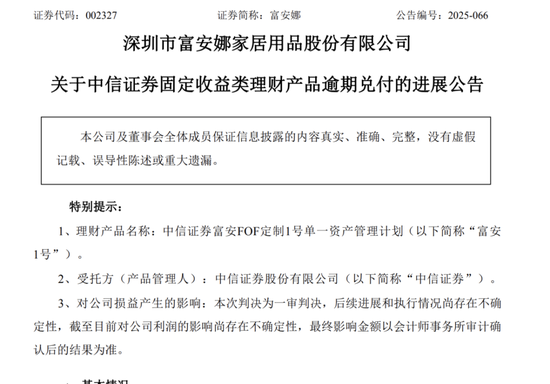
中信证券被判赔偿富安娜本金损失近2930万元
Zhong Guo Ji Jin Bao· 2025-12-25 13:53
Group 1 - The court ruled that CITIC Securities must compensate Fuanna for a principal loss of nearly 29.3 million yuan due to a financial dispute related to a wealth management product [2][7] - The case, which began in 2022, has seen significant developments, culminating in this first-instance judgment [3] - Fuanna had invested 120 million yuan in CITIC Securities' customized asset management plan, but only managed to recover 14.3 million yuan, with the remaining principal of 106 million yuan and expected fixed income unrecovered [6][7] Group 2 - The asset management plan primarily invested in problematic real estate projects, leading to substantial losses, including a 100 million yuan bad debt from a project associated with a well-known "unfinished building" [6] - The court's decision also stated that Fuanna and CITIC Securities would split any future recoveries from the asset management plan equally [7] - The overall trend in the industry shows a decline in the scale of wealth management product purchases by listed companies, with a 34% drop in 2023 and a further 5.45% decrease in 2024 [8]

理财变“踩雷”!“券业一哥”被判赔偿2930万
Zhong Guo Ji Jin Bao· 2025-12-25 13:49
Core Viewpoint - The court ruled in favor of Fuanna, ordering CITIC Securities to compensate nearly 29.3 million yuan for losses related to a financial management contract dispute, marking a significant development in a case that has persisted since 2022 [1][2][6]. Group 1: Case Background - In 2021, Fuanna invested 120 million yuan in a customized asset management plan from CITIC Securities, expecting stable returns, but the product faced overdue payments starting March 19, 2022 [5]. - By the end of 2024, Fuanna had only recovered 14.3 million yuan from the investment, with 106 million yuan and expected fixed returns still unrecovered [5]. - The main holdings of the asset management plan included problematic real estate projects, leading to significant losses due to defaults [5]. Group 2: Court Ruling Details - The court's ruling requires CITIC Securities to compensate Fuanna nearly 29.3 million yuan within 10 days of the judgment, with future recoveries from the asset management plan split equally between Fuanna and CITIC Securities [6]. - The court dismissed Fuanna's other claims and noted that Fuanna had already withdrawn 5.59 million yuan from a dedicated asset account, with additional recoveries pending [6]. Group 3: Industry Trends - There has been a noticeable decline in the scale of financial products purchased by listed companies, with a total investment of 966.8 billion yuan in 2023, down 18.64% year-on-year [8]. - This marks the third consecutive year of decline in the scale of financial product purchases by listed companies, with a 34% drop in 2023 and a smaller decline of 5.45% in 2024 [8]. - Companies are becoming more cautious and diversified in their investment choices, with structured deposit products being the most popular, accounting for nearly 60% of total subscriptions [9].
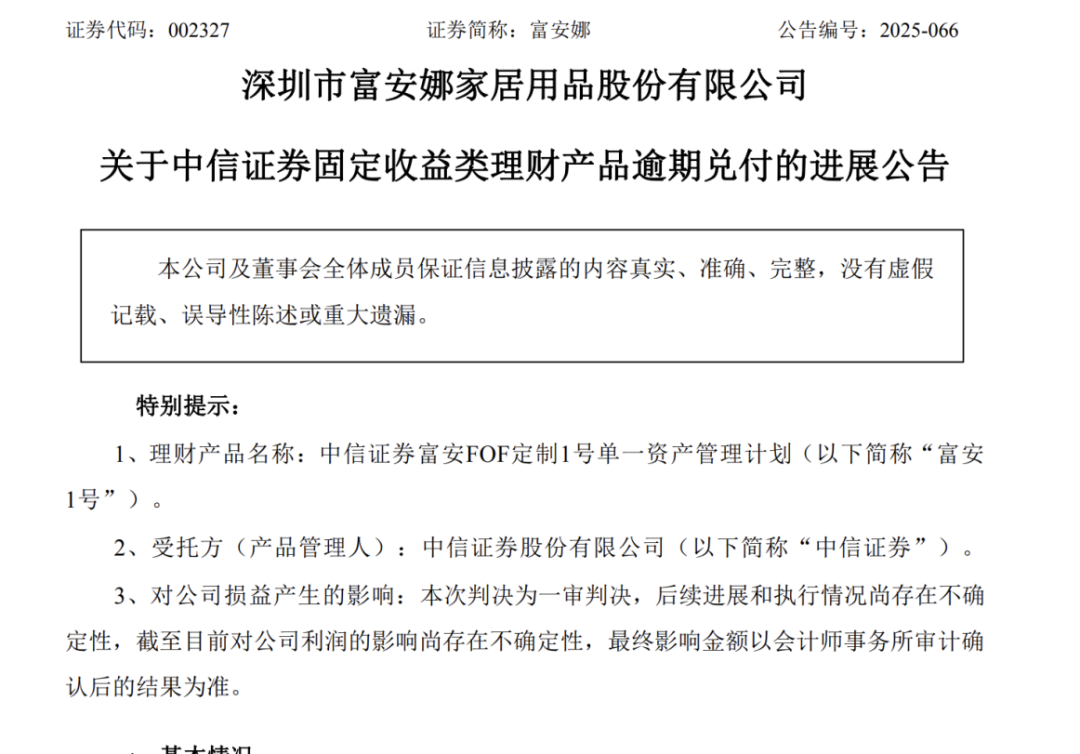
起诉中信证券理财产品违规!获赔近3000万 富安娜:不排除继续上诉
Zheng Quan Shi Bao Wang· 2025-12-25 13:49
Core Viewpoint - The court ruling in favor of Fuanna against CITIC Securities regarding overdue financial products marks a significant development in the ongoing dispute, with the company set to recover a substantial portion of its investment [2][3]. Group 1: Legal Proceedings and Rulings - Fuanna has received a first-instance judgment from the Futian District People's Court, which mandates CITIC Securities to compensate Fuanna with 29.2863 million yuan within ten days of the ruling's effectiveness [2]. - The court has determined that any subsequent recoveries from the involved asset management plan will be split equally between Fuanna and CITIC Securities, with the compensation capped at the aforementioned amount [2]. - The case stems from Fuanna's purchase of the fixed-income financial product "Fu An No. 1" in 2021, which defaulted on March 19, 2022, leading to Fuanna filing a lawsuit in August 2023 [2][3]. Group 2: Financial Implications - As of September 30, 2025, the net asset value of "Fu An No. 1" is reported to be 77.8205 million yuan, with Fuanna still expecting to recover 106 million yuan in principal and related fixed income [3]. - The total amount recoverable from the product, including already withdrawn and pending investment returns, suggests that Fuanna could recover nearly 70% of its principal investment [3]. - Fuanna has previously recognized an impairment loss of 27.8772 million yuan related to the overdue payments from "Fu An No. 1" [3]. Group 3: Company Response and Future Actions - Fuanna has expressed dissatisfaction with the judgment and has not ruled out the possibility of appealing the decision [4]. - The company is taking the legal proceedings seriously and has engaged a professional legal team to protect its and its shareholders' rights [3].
理财变“踩雷”!“券业一哥”被判赔偿2930万
中国基金报· 2025-12-25 13:47
Core Viewpoint - The court ruled that CITIC Securities must compensate Fuanna for a principal loss of nearly 29.3 million yuan due to a financial dispute over a wealth management product, marking a significant development in a case that has lasted nearly three years [2][3]. Group 1: Case Background - In 2021, Fuanna invested 120 million yuan in a customized asset management plan from CITIC Securities, expecting stable returns, but the product faced overdue payments starting March 19, 2022 [7]. - By the end of 2024, Fuanna had only recovered 14.3 million yuan from the CITIC product, with 106 million yuan in principal and expected fixed returns still unrecovered [7]. - The main holdings of the product included investments in problematic real estate projects, leading to significant losses [7]. Group 2: Court Ruling - The court ordered CITIC Securities to compensate Fuanna nearly 29.3 million yuan within ten days of the ruling, with future recoveries from the asset management plan split equally between Fuanna and CITIC [8]. - The court also noted that Fuanna had previously withdrawn 5.59 million yuan from the asset account and received additional returns from West Trust, which have not yet been withdrawn [8]. Group 3: Industry Trends - There has been a notable decline in the scale of wealth management products purchased by listed companies, with a total subscription amount of 966.8 billion yuan in 2023, down 18.64% year-on-year [10]. - This decline marks the third consecutive year of reduced investment in wealth management products by listed companies, with a significant drop of 34% in 2023 [10]. - Companies are becoming more cautious and diversified in their investment choices, with structured deposit products being the most popular, accounting for nearly 60% of total subscriptions [10].