SAIC MOTOR(600104)

Search documents
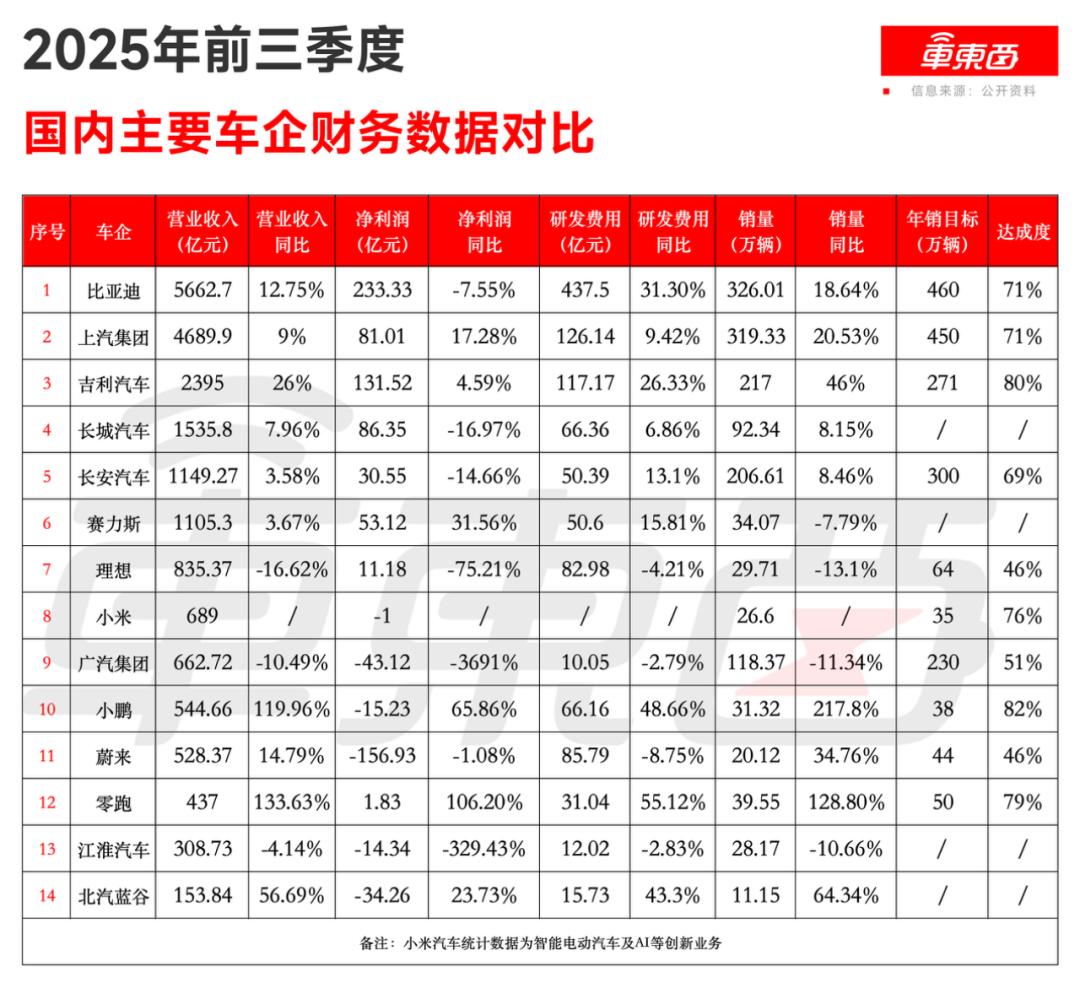
比亚迪赚走6成利润,6家新势力亏掉107亿,14大车企前三季度业绩锐评
3 6 Ke· 2025-12-05 02:56
Core Insights - The financial reports of 14 major domestic car manufacturers for the first three quarters of 2025 show a total revenue of 2.07 trillion yuan and a net profit of 364 billion yuan, resulting in a net profit margin of only 1.76% [2][6][22]. Group 1: Financial Performance - Among the traditional car manufacturers, eight companies reported a combined net profit exceeding 471 billion yuan, with BYD leading with a net profit of 233 billion yuan, accounting for 64% of the total net profit of the 14 companies [4][8]. - Geely's revenue reached 239.5 billion yuan, a 26% increase year-on-year, with a net profit of 131.52 billion yuan, benefiting from its accelerated transition to new energy vehicles [8][22]. - The new energy vehicle sector is experiencing significant losses, with six new entrants collectively losing 107 billion yuan, while only Seres, Li Auto, and Leap Motor reported profits [4][6][22]. Group 2: Revenue and Profit Comparison - BYD's revenue was 566.27 billion yuan, a 12.75% increase, while its net profit decreased by 7.55% [5][7]. - SAIC Group reported a revenue of 468.99 billion yuan and a net profit of 81.01 billion yuan, both showing growth [11][22]. - NIO's revenue was 528.37 billion yuan, with a significant net loss of 156.93 billion yuan, highlighting the challenges faced by the company [22][24]. Group 3: R&D Investment - BYD led in R&D investment with 437.5 billion yuan, a 31.3% increase, indicating a commitment to technological expansion despite a slight decline in net profit [25][29]. - Geely's R&D expenditure was 117 billion yuan, up 26%, reflecting its focus on innovation [29][32]. - NIO, despite its losses, invested 85.79 billion yuan in R&D, maintaining a strong commitment to technology development [32][36]. Group 4: Sales Performance - The total sales volume for the 14 companies reached 15 million units, with BYD, SAIC, Geely, and others achieving significant growth [37][41]. - BYD sold 3.26 million vehicles, a year-on-year increase of 18.64%, while SAIC's sales reached 3.19 million units, growing by 20.53% [38][45]. - New entrants like Leap Motor and Xpeng saw substantial sales increases, with Leap Motor's sales up 128.8% and Xpeng's up 217.8% [49][50]. Group 5: Market Dynamics - The competitive landscape in the automotive industry is intensifying, with companies facing pressures from supply chain costs, rapid technological changes, and the need for substantial R&D investments [52]. - The performance of these 14 companies reflects a growing divide in profitability, with only a few achieving a balance between revenue growth and profit margins [22][52].




上汽大众陶海龙:全栈自研、盲目追求大而全削弱了产业链的分工与合作基础
Xin Lang Cai Jing· 2025-12-05 02:39
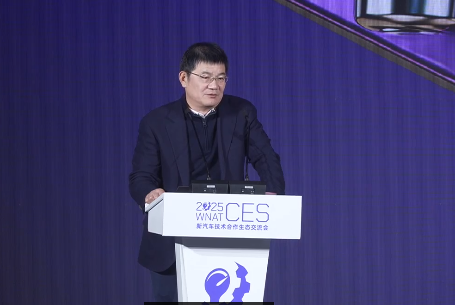
专题:2025新汽车合作生态交流会 2025新汽车合作生态交流会于12月5日-6日在苏州举行。上汽大众汽车有限公司党委书记、总经理陶海 龙表示,现在行业中逐渐出现一种倾向,将全栈自研视为可以标榜的路径,它削弱了产业链的分工与合 作基础。 陶海龙称,我们尊重技术路径的多元探索,但必须指出,盲目追求大而全,往往会背离专业化分工这一 现代工业文明的基石,导致资源重复投入,创新效率低下,最终削弱的是整车乃至整个产业链的可持续 竞争力。 陶海龙称,我们尊重技术路径的多元探索,但必须指出,盲目追求大而全,往往会背离专业化分工这一 现代工业文明的基石,导致资源重复投入,创新效率低下,最终削弱的是整车乃至整个产业链的可持续 竞争力。 新浪声明:所有会议实录均为现场速记整理,未经演讲者审阅,新浪网登载此文出于传递更多信息之目 的,并不意味着赞同其观点或证实其描述。 责任编辑:王翔 新浪声明:所有会议实录均为现场速记整理,未经演讲者审阅,新浪网登载此文出于传递更多信息之目 的,并不意味着赞同其观点或证实其描述。 责任编辑:王翔 专题:2025新汽车合作生态交流会 2025新汽车合作生态交流会于12月5日-6日在苏州举行。上汽大众 ...

丰田杀入车险赛道!跨界玩家能否搅动行业风云?
Guo Ji Jin Rong Bao· 2025-12-04 14:29
车企跨界卖保险再添一例。 12月4日,《国际金融报》记者注意到,北京盛唐保险经纪有限公司近日发布公告称,由于经营需要, 公司名称变更为"丰田保险经纪(北京)有限公司"(下称"丰田保险经纪")。 据公司官网介绍,丰田保险经纪依托股东资源并凭借广泛的业务布局,致力于为丰田及雷克萨斯经销商 及零售和机构客户提供丰富多元的保险产品,涵盖零售客户车险、库存融资财产险、大客户车险,以及 其他特色非车险等。 近年来,车企"闯关"保险业脚步加快。在业内人士看来,对车企而言,卖保险可谓"一箭多雕":既可以 构建"车+险"服务闭环,通过保险业务链接购车、售后等场景,增强与用户之间的联系;也可以依托车 辆数据优化风险定价模型,推出更个性化的保险产品,拓展佣金及增值服务等盈利渠道。 那么,车企竞相布局保险业务的背后,究竟是在下怎样一盘棋? 车企扎堆涉"险" 公开资料显示,丰田保险经纪是国家金融监督管理总局批准成立的全国性保险经纪公司,总部设于北 京,在全国八个省份设立了分支机构,包括广东、浙江、新疆、云南、四川、河南、辽宁、吉林。 穿透股权关系来看,丰田保险经纪是丰田金融服务(中国)有限公司的全资子公司,后者则隶属于丰田 汽车株式会 ...

繁荣表象下存隐忧:新能源汽车用户满意度80%,新车故障率同比增加18次
Hua Xia Shi Bao· 2025-12-04 13:59
Core Insights - The penetration rate of new energy vehicles (NEVs) in China has surpassed 50%, indicating a shift from trend to mainstream [2] - The user satisfaction index for the NEV industry in 2025 is reported at 80 points, a year-on-year increase of 1 point, marking a recovery in user satisfaction [2] - Despite high satisfaction, the number of faults per 100 vehicles has increased to 109, up by 18 from the previous year, highlighting ongoing quality and reliability challenges [2][6] User Satisfaction and Brand Performance - User perception of quality and value are driving factors behind the increase in satisfaction, with scores of 80.6 for quality and 79.7 for value, both exceeding the overall satisfaction increase [3] - Domestic brands have achieved a user satisfaction score of 80, matching that of joint venture brands in the NEV sector, while still trailing by 1 point in traditional fuel vehicles [3][4] - Domestic brands are outperforming joint ventures in terms of reliability, with significantly lower fault rates, particularly in smart cockpit systems [4] Market Dynamics and Competitive Landscape - As of October 2025, the market share of domestic passenger vehicles has risen to approximately 72%, disrupting the previous market dynamics where joint ventures led [5] - The shift in user decision-making criteria towards product value over brand prestige is reshaping competition in the automotive sector [5] - Analysts suggest that future competition will focus on a comprehensive experience across R&D, manufacturing, and service, rather than just individual parameters [5] Challenges Facing the Industry - The industry is grappling with a high concentration of faults, particularly in smart cockpit, smart driving assistance, and interior systems, which together account for 60% of total faults [6] - Users exhibit a lower tolerance for faults in NEVs compared to traditional vehicles, creating pressure on manufacturers to enhance reliability [6] - There is a noticeable gap in service satisfaction, with sales service remaining stable at 81 points, while after-sales service satisfaction has dropped to 79 points, indicating a need for improvement in service capabilities [7] Strategic Recommendations - Domestic brands are advised to focus on consolidating strengths while addressing weaknesses, particularly in quality and after-sales service [8] - Reducing fault rates, especially in smart technology, is crucial to meet rising user expectations and maintain competitive advantages [8] - The industry is encouraged to prioritize quality and service improvements to build long-term trust and brand loyalty among consumers [8]
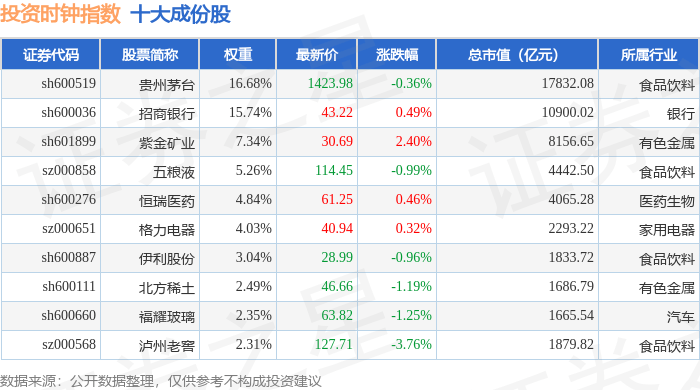
12月4日投资时钟(399391)指数跌0.13%,成份股西安饮食(000721)领跌
Sou Hu Cai Jing· 2025-12-04 09:46
Market Overview - The Investment Clock Index (399391) closed at 3348.4 points, down 0.13%, with a trading volume of 67.987 billion yuan and a turnover rate of 0.74% [1] - Among the index constituents, 28 stocks rose while 71 stocks fell, with China High-Tech leading the gainers at an 8.25% increase and Xi'an Catering leading the decliners with a 5.74% drop [1] Top Constituents - The top ten constituents of the Investment Clock Index include: - Kweichow Moutai (16.68% weight) at 1423.98 yuan, down 0.36% [1] - China Merchants Bank (15.74% weight) at 43.22 yuan, up 0.49% [1] - Zijin Mining (7.34% weight) at 30.69 yuan, up 2.40% [1] - Wuliangye (5.26% weight) at 114.45 yuan, down 0.99% [1] - Hengrui Medicine (4.84% weight) at 61.25 yuan, up 0.46% [1] - Gree Electric Appliances (4.03% weight) at 40.94 yuan, up 0.32% [1] - Yili Industrial (3.04% weight) at 28.99 yuan, down 0.96% [1] - Northern Rare Earth (2.49% weight) at 46.66 yuan, down 1.19% [1] - Fuyao Glass (2.35% weight) at 63.82 yuan, down 1.25% [1] - Luzhou Laojiao (2.31% weight) at 127.71 yuan, down 3.76% [1] Capital Flow - The net outflow of main funds from the Investment Clock Index constituents totaled 3.827 billion yuan, while speculative funds saw a net inflow of 1.326 billion yuan and retail investors had a net inflow of 2.502 billion yuan [1] - Detailed capital flow for specific stocks includes: - China High-Tech with a net inflow of 1.30 billion yuan from main funds [2] - Yunnan Copper with a net inflow of 85.73 million yuan from main funds [2] - Weichai Power with a net inflow of 82.78 million yuan from main funds [2]





购置税“限额减半”在即,年底“0利率”买车能捡到漏吗?
Tai Mei Ti A P P· 2025-12-04 09:35
Core Viewpoint - The impending change in the new energy vehicle (NEV) purchase tax policy is creating a dilemma for potential buyers, as the full exemption will end in 2026, leading to a significant shift in market dynamics and pricing strategies among automakers and banks [1][2]. Group 1: Policy Changes and Market Impact - The new policy will halve the purchase tax for NEVs starting January 1, 2026, with a maximum deduction of 15,000 yuan per vehicle, marking the end of the full exemption era [1]. - Automakers are responding to the new tax structure by adjusting their pricing strategies, particularly for vehicles priced below 300,000 yuan, which will still benefit from the tax reduction [1][2]. - The average annual price of battery-grade lithium carbonate is projected to drop significantly, providing automakers with room to absorb increased costs from the tax changes [2]. Group 2: Consumer Behavior and Financing Trends - The increase in purchase tax is expected to raise the cost of NEVs by 6,000 to 15,000 yuan, influencing consumer purchasing decisions, especially among budget-conscious buyers [3][5]. - There is a notable increase in loan applications for NEVs priced above 300,000 yuan, with a year-on-year growth of over 20% since November [2]. - Consumers are actively participating in year-end promotions, with many opting to purchase vehicles now to take advantage of current discounts before the tax changes take effect [3][5]. Group 3: Promotional Strategies and Market Competition - Automakers and banks are launching aggressive year-end promotions, including cash discounts, trade-in subsidies, and zero-interest financing offers, to boost sales [3][4]. - The average price of NEVs has decreased significantly, with a reported drop of 14% from peak levels, allowing for competitive pricing strategies [4]. - Some automakers are resorting to selling vehicles at a loss to meet sales targets, indicating intense competition and pressure to clear inventory before the new tax policy takes effect [4][6]. Group 4: Risks and Challenges in Financing - Consumers are facing potential pitfalls in financing options, including hidden fees and inflated vehicle prices disguised as zero-interest loans [3][4][5]. - The banking sector is adapting to the changing landscape, with a focus on high-end vehicle loans and innovative financing solutions to capture market share [8][9]. - The collaboration between banks and automakers is expected to deepen, with many automakers forming joint financial companies to enhance customer acquisition and financing options [9].

上汽牵头线控转向新国标发布,智己LS9 Hyper版将首搭
Qi Lu Wan Bao· 2025-12-04 08:26
Core Viewpoint - The release of the national standard GB17675-2025 for automotive steering systems marks a significant milestone for China's intelligent automotive industry, laying the regulatory foundation for the large-scale application of advanced steering technologies like steer-by-wire (SBW) [1][4]. Group 1: National Standard and Technological Advancements - The GB17675-2025 standard was developed by SAIC Motor Corporation in collaboration with the China Automotive Technology and Research Center and other authoritative institutions, indicating a collective effort to advance automotive technology [1]. - This standard supports the implementation of steer-by-wire technology, which is crucial for the future of intelligent vehicles [1][6]. Group 2: Product Launch and Features - The Zhiji LS9 Hyper version, a high-end electric vehicle under SAIC, will be the first model to achieve mass production in compliance with the new national standard, showcasing its advanced steer-by-wire capabilities [4]. - The LS9 Hyper version will feature the "full-blooded" Lingxi Digital Chassis 3.0 and a high-performance three-motor vector four-wheel drive system, enhancing driving performance and safety [4][6]. Group 3: Industry Impact and Future Outlook - The successful implementation of the new standard and the LS9 Hyper version positions SAIC and Zhiji as leaders in the high-end intelligent chassis sector, setting benchmarks for the global automotive industry [6]. - This initiative is expected to propel the intelligent mobility sector into a new era characterized by enhanced safety and efficiency [6].
1-11月上汽集团新能源车销售149.9万辆 同比大涨38.8%
Yang Shi Wang· 2025-12-04 07:20
Core Insights - SAIC Motor Corporation reported a total vehicle sales of 4.108 million units from January to November, representing a year-on-year increase of 16.4%, surpassing last year's total sales [1] - The company's self-owned brand sales reached 2.666 million units, up 25.7% year-on-year, while new energy vehicle sales hit 1.499 million units, growing by 38.8% [1] - Sales in overseas markets amounted to 969,000 units, reflecting a 3.4% increase year-on-year, indicating strong performance in international markets [1] Self-Owned Brand Performance - In November, SAIC's self-owned brand sales reached 316,000 units, a 9.5% increase year-on-year, contributing to a total of 2.666 million units sold from January to November, which accounted for 64.9% of total sales, an increase of 4.8 percentage points from the previous year [3] - Passenger vehicle sales exceeded 100,000 units in November, marking a significant 36.4% year-on-year growth, with domestic market sales soaring by 97.6% [3] - SAIC Maxus sold 24,000 units, reflecting an 81.3% increase, while SAIC-GM-Wuling maintained its leading position in key market segments with sales of 166,000 units [3] New Energy Vehicle Sales - In November, SAIC sold 209,000 new energy vehicles, achieving a historical high for the third consecutive month, with a year-on-year growth of 19.7% [4] - Cumulatively, 1.499 million new energy vehicles were sold from January to November, representing a 38.8% increase [4] - The sales of the new generation of models, including the intelligent LS6 and LS9, have been strong, with the new MG4 semi-solid battery version set to begin deliveries in December [4] Overseas Market Performance - In November, overseas sales reached 107,000 units, a 13.9% increase year-on-year, with total sales of 969,000 units from January to November, up 3.4% [5] - The MG brand has become a leading Chinese brand in the European market, with cumulative deliveries of 285,000 units this year, reflecting a growth of over 25% [5] - Notable sales growth was observed in Spain (58.48%), France (57.49%), and Poland (138.29%), with MG electric vehicles achieving a historical cumulative sales milestone of over 100,000 units in the UK [5] Future Outlook - SAIC is focusing on building a more flexible and efficient operational mechanism, accelerating its transformation and upgrade processes [5] - The company aims to leverage innovations in solid-state batteries, digital chassis, efficient powertrains, intelligent driving, and smart cabins to enhance user experience and establish itself as a globally competitive automotive group [5]
多家车企11月销量创新高 新能源车和出口市场表现成亮点
Zhong Guo Zhi Liang Xin Wen Wang· 2025-12-04 05:20
Core Insights - The automotive industry in November showed strong sales performance across various companies, with a notable focus on electric vehicle (EV) transitions and global expansion strategies [1][2][3][4] Group 1: Traditional Domestic Brands - BYD achieved a record monthly sales of 480,000 units, maintaining the top position, with overseas sales surpassing 130,000 units, marking a historical high [1] - Geely sold 310,000 units in November, a year-on-year increase of 24%, with its Galaxy series seeing a 76% growth [1] - Chery reported sales of 273,000 units, with EV sales reaching 117,000 units, a 50.1% increase, and export sales of 137,000 units, up 30.3% [1][2] Group 2: New Energy Vehicle Performance - Changan's November sales reached 283,000 units, with EV sales at 125,000 units, a 23% increase [2] - SAIC Group set a new record for EV sales at 209,000 units, reflecting a 38.8% year-on-year growth [2] Group 3: New Forces in the Automotive Sector - Huawei's HarmonyOS Automotive division delivered 82,000 vehicles in November, a remarkable 89.61% increase, establishing itself as a leader among new entrants [3] - Leap Motor delivered over 70,000 vehicles in November, achieving a cumulative sales milestone of over 500,000 units [3] - Xiaomi's automotive division also exceeded its annual delivery target, with over 40,000 units delivered in November and a total exceeding 350,000 units [3] Group 4: Market Dynamics and Challenges - Xpeng and NIO experienced a decline in sales, with Li Auto delivering 33,181 units, a slight increase of 4.45% month-on-month but a 31.92% year-on-year drop [4] - The automotive market is shifting from subsidy-driven growth to a more competitive landscape focused on product capabilities and brand strength, as consumer behavior evolves post-subsidy [4]

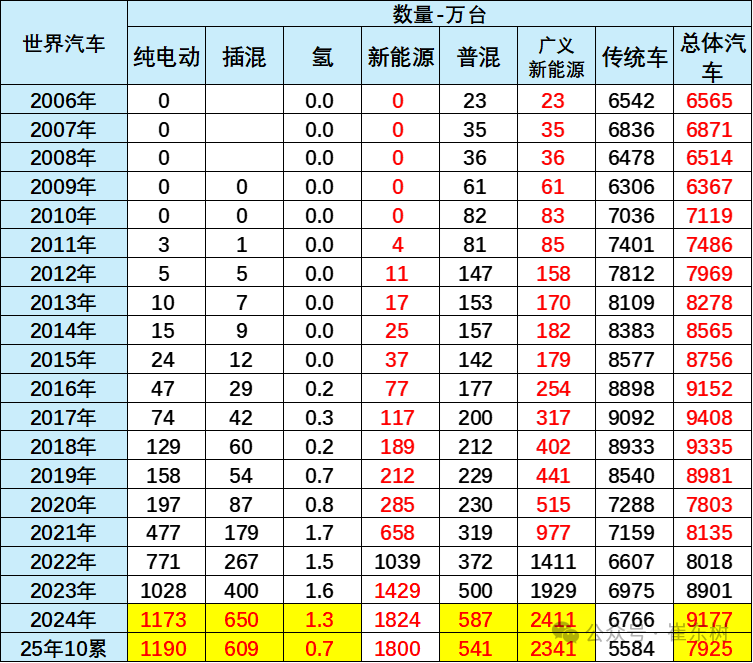
崔东树:1-10月世界新能源乘用车同比增30% 中国占世界新能源车份额68%
Zhi Tong Cai Jing· 2025-12-04 02:29
Core Insights - The global sales of new energy passenger vehicles reached 17.36 million units from January to October 2025, representing a year-on-year increase of 30% [1][8] - In October 2025, global sales of new energy passenger vehicles were 2.11 million units, showing a year-on-year increase of 17% but a month-on-month decrease of 3% [1][8] - The market share of new energy vehicles in China is projected to be 68% by 2025, with a significant share of 75% in October 2025 [1][25] - The penetration rate of new energy vehicles globally is expected to reach 25.2% by the fourth quarter of 2025, with China leading at 49% [1][20] Global Market Performance - The contribution of China to the global increase in new energy vehicles from January to October 2025 is 68%, while Germany and the UK contribute 5% and 4% respectively [2][23] - The overall penetration rate of new energy vehicles in the world has been rapidly increasing, reaching 13% in 2022, 16% in 2023, and projected to reach 19.5% in 2024 [1][20] Regional Insights - The U.S. new energy vehicle sales reached 1.4 million units from January to October 2025, with a growth rate of 10%, but saw a significant drop in October with sales of 93,000 units, down 32% year-on-year and 51% month-on-month [18][1] - In Europe, new energy vehicle sales for the same period reached 2.91 million units, a year-on-year increase of 28% [19][1] Company Performance - BYD continues to lead the global market with a share of 22.3% in 2025, while Tesla's share has declined to 8.6% [26] - Geely and Changan are showing strong performance in the new energy sector, while traditional automakers like Volkswagen and BMW are facing challenges [27][26] Export Trends - The share of Chinese autonomous new energy vehicles in overseas markets increased from 8.7% in 2024 to 13.8% in 2025, with a notable rise to 17.7% in October 2025 [12][1]