反内卷

Search documents
如何展望钢铁成本和供给侧的催化和节奏?
Changjiang Securities· 2026-01-06 04:44
Investment Rating - The investment rating for the steel industry is Neutral, maintained [9] Core Insights - The report highlights that the expansion of low-cost capacities, such as Simandou and the four major mines, is expected to drive long-term declines in iron ore prices. A significant drop in prices is anticipated in March and April, with current iron ore inventories at historical highs, suggesting a potentially larger decline [2][6] - The steel industry is experiencing a reduction in supply pressure due to self-initiated production cuts, leading to a slight improvement in profitability despite weak demand in the construction steel sector. Total steel demand is supported by resilient plate demand, with a year-on-year decline of 3.57% and a month-on-month decline of 0.56% in apparent consumption [4][5] - The report emphasizes the importance of supply-side policies aimed at reducing low-end exports and eliminating outdated capacities, with a focus on environmental and energy efficiency evaluations expected to be completed by the end of 2025 [2][6] Summary by Sections Cost Analysis - The black industrial chain's profits are largely captured by iron ore, with total profits estimated at 4,127 billion for iron ore, 337 billion for coking coal, and 1,264 billion for steel, representing 72%, 6%, and 22% of total profits respectively. The majority of iron ore is imported, leading to a significant outflow of profits overseas [5] - The Simandou project is expected to begin production by the end of 2025, with anticipated sales of 30 million tons from the northern mine and 5 to 10 million tons from the southern mine in 2026, contributing to a projected 4.3% increase in global iron ore supply [5] Supply Analysis - The report indicates that the steel industry is focused on reducing excess capacity, with policies aimed at "grading management and eliminating the weak" expected to be implemented in 2026. Non-compliant enterprises may face significant production cuts, highlighting the importance of regulatory compliance [6] - The report notes that the overall steel inventory has decreased by 2.70% week-on-week, while year-on-year it has increased by 12.34%, indicating a gradual reduction in inventory levels [4]
人形机器人开跑 上证指数冲关:2025年A股十大名场面
Xi Niu Cai Jing· 2026-01-06 03:42
Group 1 - The A-share market experienced significant fluctuations in 2025, with a notable "slow bull" trend emerging despite initial downturns [2] - The launch of DeepSeek in February 2025 ignited a major rally in the technology sector, leading to a revaluation of Chinese assets and a surge in stock prices for companies involved in AI technology [3] - The A-share index reached a ten-year high on August 18, 2025, and subsequently broke through key psychological levels of 3800, 3900, and 4000 points [2] Group 2 - The stock of Upwind New Materials became the "first妖股" of 2025, achieving a 1900% increase in value after a major acquisition announcement [4] - Cambrian's stock price surged to become the new "king of stocks" in A-shares, driven by the explosive growth in the AI chip market [6] - The GPU sector saw significant market interest, with companies like Moer Thread and Muxi achieving remarkable stock performance shortly after their IPOs [8][9] Group 3 - A-share companies distributed a record total of over 2.6 trillion yuan in dividends in 2025, marking a significant increase from the previous year [10] - The total market capitalization of A-shares surpassed 100 trillion yuan for the first time, reflecting a new phase in the development of China's capital market [11] - A wave of mergers and acquisitions occurred in 2025, with significant transactions involving major financial and industrial players [12] Group 4 - The concept of "anti-involution" gained traction in the capital market, leading to industry self-regulation and price stabilization in sectors like steel and solar energy [13] - The structural changes in the capital market aligned with the real economy, with a shift in investment focus towards high-quality, technology-driven sectors [14] - The trends observed in 2025 are expected to lay the groundwork for continued development in 2026, emphasizing high-quality growth in the Chinese economy and stock market [15]



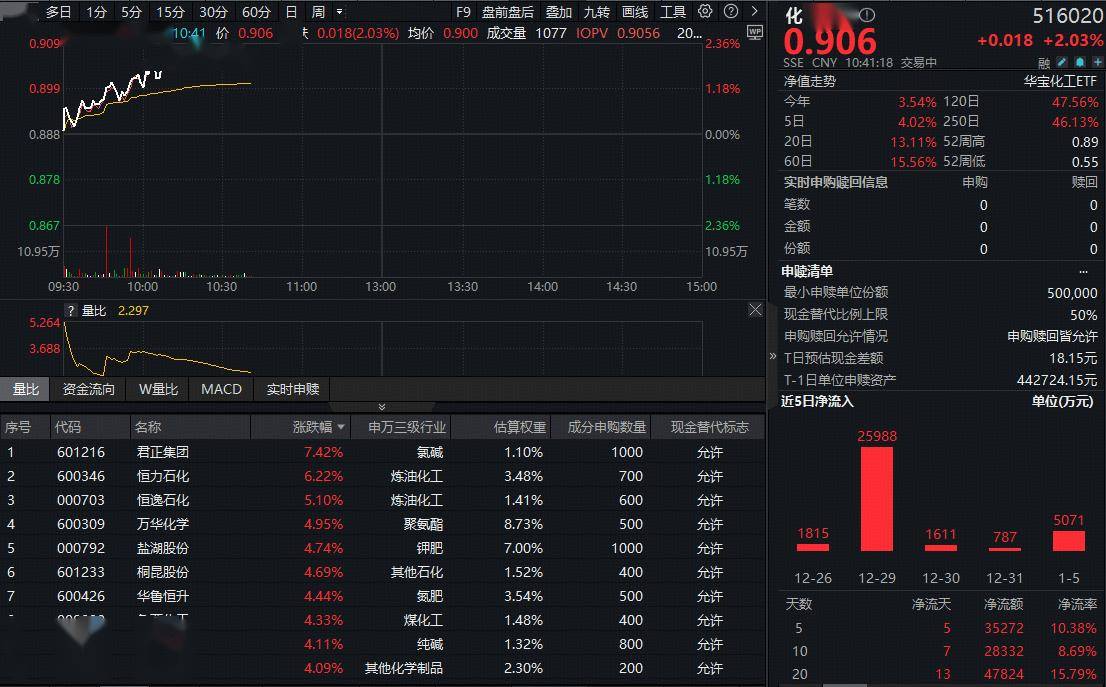
ETF盘中资讯|万华化学调价!化工板块狂飙,化工ETF(516020)盘中涨超2%! 机构:化工板块有望迎来业绩、估值双重抬升
Sou Hu Cai Jing· 2026-01-06 03:07
Group 1 - The chemical sector continues to show strong performance, with the chemical ETF (516020) rising by 2.03% as of the latest report, reflecting a robust market trend [1] - Key stocks in the sector include Junzheng Group, which surged over 7%, Hengli Petrochemical up over 6%, and Hengyi Petrochemical increasing by over 5% [1][2] - The overall market sentiment is positive, driven by price increases in core products like MDI/TDI by Wanhua Chemical, which plans to raise prices in line with international giants [1][3] Group 2 - The chemical industry is expected to experience a dual uplift in performance and valuation due to the "anti-involution" policy, with a 10% year-on-year decrease in construction projects among basic chemical companies [3] - Demand is being supported by domestic consumption and resilient exports, indicating a recovery in the supply-demand balance [3] - Analysts predict that the chemical industry may reach a cyclical turning point by 2026, driven by policy expectations and a potential increase in demand as the U.S. enters a rate-cutting phase [3] Group 3 - The chemical ETF (516020) tracks the CSI sub-sector chemical industry index, with nearly 50% of its holdings in large-cap leading stocks like Wanhua Chemical and Salt Lake Shares, providing investors with strong investment opportunities [4] - The ETF also diversifies its holdings across various sub-sectors, including phosphate and nitrogen fertilizers, fluorochemicals, and other chemical leaders [4]

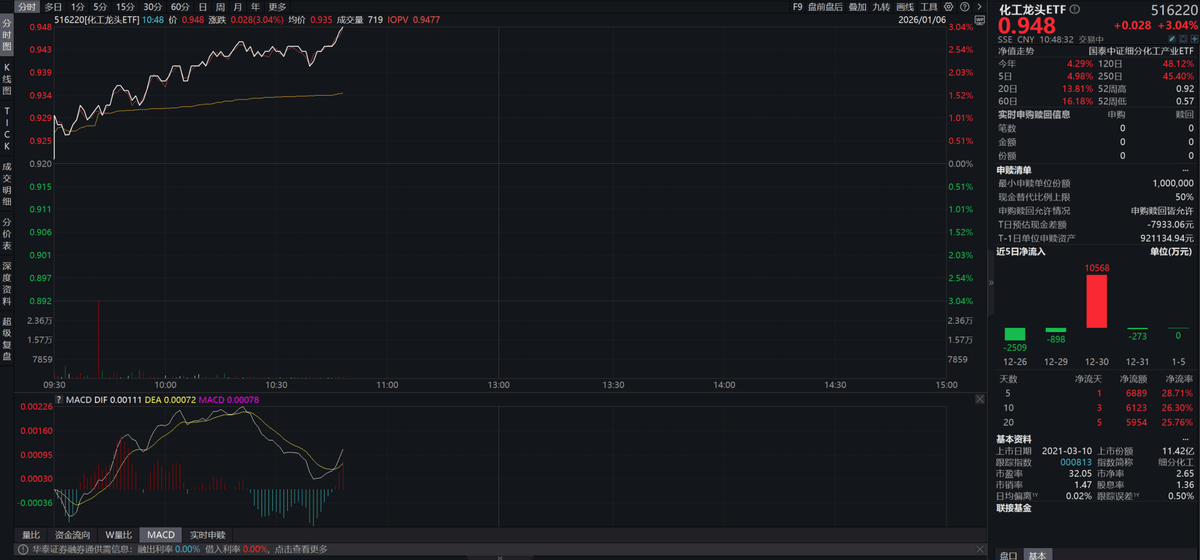
聚酯产业链有望走出板块性行情,化工龙头ETF(516220)涨超3%
Sou Hu Cai Jing· 2026-01-06 03:07
Core Viewpoint - The polyester industry chain is expected to experience a sector-wide market trend driven by a dual resonance of "cyclical reversal and emerging demand" in 2026, following a prolonged down cycle of approximately 3.5 years in the chemical industry [3]. Group 1: Industry Dynamics - The chemical industry is entering a low growth phase due to a continuous decline in capital investment and the accelerated exit of outdated overseas production capacity [3]. - The price of PX has been rising due to increased demand from overseas oil adjustments, leading to tighter PX supply [3]. - The polyester filament industry has announced self-regulated production cuts to maintain prices, which began on December 24 and will be expanded as the Spring Festival approaches [3]. Group 2: Price Trends - BOPET prices have been steadily increasing since December 22, supported by sufficient existing orders and rising raw material costs [4]. - A PTA facility in East China with a capacity of 3.6 million tons has reduced its output due to operational issues, with the recovery timeline still pending [5]. Group 3: Investment Opportunities - The polyester industry chain shows strong potential for reversing the trend of internal competition, with conditions such as nearing the end of capacity expansion, sustained demand growth, and high market share among leading companies [5]. - The chemical sector is expected to undergo structural optimization on the supply side, with domestic policies frequently emphasizing "anti-involution" [6]. - The chemical industry is at the bottom of its down cycle and is gradually moving towards an up cycle, with emerging demands likely to enhance chemical valuations [7].
有色牛气冲天,再刷十年新高!有色ETF华宝(159876)涨逾3%,获资金实时净申购3300万份
Mei Ri Jing Ji Xin Wen· 2026-01-06 03:02
Group 1 - The core viewpoint of the news is that the non-ferrous metal sector continues to show strong performance, with the Huabao Non-Ferrous ETF (159876) reaching a new high and significant capital inflow expected in the future [1] - The macroeconomic environment is projected to influence commodity markets through three main themes by 2026: green inflation, anti-involution, and a rate-cutting trend, which are expected to drive price increases in commodities like copper and aluminum [1] - The sustainability of the super cycle in non-ferrous metals is contingent on three factors: the recovery of US dollar credit, the progress of strategic reserves, and the effectiveness of anti-involution policies, suggesting that the super cycle is likely to continue until 2026 [1] Group 2 - The Huabao Non-Ferrous ETF (159876) and its linked fund (017140) cover a wide range of sectors including copper, aluminum, gold, rare earths, and lithium, providing a diversified investment option compared to single metal investments [2] - As of January 5, the latest scale of the Huabao Non-Ferrous ETF (159876) is 879 million yuan, making it the largest ETF tracking the same index among three similar products in the market [2]
2026A股开门红,地缘扰动下贵金属走强
Hua Tai Qi Huo· 2026-01-06 03:02
Report Summary 1. Report Industry Investment Rating - Not provided in the given content 2. Core View of the Report - After the A - share market opened in 2026, precious metals strengthened under geopolitical disturbances. There are risks of policy expectation swings both at home and abroad. The market showed an overall upward trend on January 5, with the Shanghai Composite Index returning above 4000 points and the ChiNext Index rising nearly 3%. There is a certain divergence in domestic and foreign economic prosperity. The report suggests focusing on commodities such as non - ferrous metals, precious metals and also mentions investment strategies for commodities and stock index futures [2][6] 3. Summary by Related Catalogs Market Analysis - Policy expectations may swing. The Central Economic Work Conference in December emphasized boosting consumption and anti - "involution" measures. Future price recovery depends on supply - side policies. After important domestic meetings and the Fed's stance adjustment, there are risks of policy expectation swings. The geopolitical situation tightened during the New Year's Day holiday, which may drive up commodity prices. On January 5, the market trended upward, with the Shanghai Composite Index above 4000 points and the ChiNext Index up nearly 3% [2] - There is a divergence in domestic and foreign economic prosperity. Overseas prosperity has declined since October, but China's exports and new orders are still positive. China's November foreign trade growth rebounded, with exports increasing by 5.9% and imports by 1.9% year - on - year. China's December official manufacturing PMI and non - manufacturing PMI were better than expected, but new export orders in the service industry contracted. The US economic data was generally weak [3] Commodity Analysis - Focus on non - ferrous metals and precious metals with high certainty, and look for opportunities for low - valued commodities to make up for losses. The long - term supply shortage in the non - ferrous metal sector remains unresolved, and aluminum is a preferred choice within the sector. In the energy sector, the focus is on future crude oil supply growth after the US "temporarily manages" Venezuela. In the chemical sector, pay attention to the "anti - involution" space of methanol, PTA, etc. For agricultural products, monitor weather and short - term pig diseases. For precious metals, consider buying on dips, but be aware that short - term silver risks have increased [4] Strategy - For commodities and stock index futures, consider buying on dips for stock index futures, precious metals, and non - ferrous metals [5] To - do News - The market trended upward on January 5, with the Shanghai Composite Index above 4000 points, the ChiNext Index up nearly 3%, and the CSI A500 Index up over 2%. More than 4100 stocks in Shanghai, Shenzhen and Beijing stock exchanges rose, and the trading volume was 2.57 trillion. China's December RatingDog service industry PMI was 52, remaining in the expansion range but with new export orders contracting. The US launched an air strike on Venezuela, and Trump said he would "manage" Venezuela and involve in the oil industry. OPEC+ will maintain the oil supply unchanged in the first quarter. Some commodity futures prices rose significantly, while others declined [6]
化工行业周报20260104:国际油价小幅上涨,草甘膦、环氧丙烷价格下跌-20260106
Bank of China Securities· 2026-01-06 02:57
Investment Rating - The report rates the chemical industry as "Outperform the Market" [1] Core Views - The report suggests focusing on undervalued leading companies in the industry, the impact of "anti-involution" on supply in related sub-industries, and the importance of self-sufficiency in electronic materials companies amid strong downstream demand and price increases in certain new energy materials [1][11] Summary by Sections Industry Dynamics - In the week of December 29 to January 4, 32 out of 100 tracked chemical products saw price increases, 29 saw declines, and 39 remained stable. The average price of 51% of products increased month-on-month, while 39% decreased, and 10% remained unchanged [10][30] - International oil prices rose slightly, with WTI crude oil futures closing at $57.32 per barrel, a weekly increase of 1.02%, and Brent crude oil futures at $60.75 per barrel, a weekly increase of 0.18% [10][31] Investment Recommendations - As of January 4, the TTM price-to-earnings ratio for the SW basic chemical sector is 25.69, at the 76.92 percentile historically, while the price-to-book ratio is 2.33, at the 61.13 percentile historically. The SW oil and petrochemical sector has a TTM price-to-earnings ratio of 13.92, at the 41.86 percentile historically, and a price-to-book ratio of 1.35, at the 46.17 percentile historically [11] - Recommended stocks include Wanhua Chemical, Hualu Hengsheng, Satellite Chemical, and others, with a focus on companies in emerging fields such as semiconductor materials, OLED materials, and new energy materials [11][19] Price Changes of Key Products - Glyphosate prices decreased to an average of 23,596 CNY/ton, down 2.50% week-on-week and 0.05% year-on-year. The market remains oversupplied with weak demand [32] - Epoxy propane prices fell to an average of 7,785 CNY/ton, down 3.89% week-on-week. The industry operating rate is 63.73%, a decrease of 2.42 percentage points [33] Market Performance - The basic chemical industry experienced a decline of 0.27% in the week, ranking 14th among 31 primary industries, while the oil and petrochemical industry rose by 3.92%, ranking 1st [10][11]
日度策略参考-20260106
Guo Mao Qi Huo· 2026-01-06 02:51
Report Industry Investment Rating No relevant information provided. Report Core Viewpoints - Short - term, the stock index may continue a relatively strong trend, but attention should be paid to the impact of overseas geopolitical events on market risk appetite. In the long - term, the stock index is expected to rise in 2026 based on 2025 [1]. - Asset shortage and weak economy are beneficial to bond futures, but the central bank has recently warned of interest - rate risks, and attention should be paid to the Bank of Japan's interest - rate decision [1]. - Different commodities have various trends, including price increases, oscillations, and potential reversals, with corresponding investment strategies recommended [1]. Summary by Related Catalogs Macro Finance - Short - term, the stock index may continue to be strong, and in the long - term (2026), it is expected to rise on the basis of 2025 due to factors like continuous policy efforts, inflation recovery, capital market reform, and the support of Central Huijin [1]. - Asset shortage and weak economy benefit bond futures, but the central bank warns of interest - rate risks, and the Bank of Japan's interest - rate decision should be watched [1]. Metals Non - ferrous Metals - Copper: The price has further increased due to weak industry fundamentals but positive macro sentiment and continuous premium. However, short - term adjustment risks should be guarded against, and the upward trend is expected to continue [1]. - Aluminum: Domestic electrolytic aluminum has accumulated inventory, but positive macro sentiment and the early fermentation of supply - tightness expectations are likely to keep the price strong [1]. - Alumina: The supply side has a large release space, and the weak industry fundamentals put pressure on the price. However, the current price is near the cost line, so it is expected to oscillate [1]. - Zinc: The fundamentals have improved, the cost center has moved up, recent negative factors have been mostly realized, and market sentiment is volatile, leading to price oscillations [1]. - Nickel: Positive macro sentiment, concerns about supply due to Indonesian events, slow inventory accumulation, and unconfirmed Indonesian policies are likely to keep the short - term price strong. It is recommended to go long at low prices and control risks [1]. - Stainless Steel: Positive macro sentiment, concerns about raw - material supply, a rebound in nickel - iron prices, a slight reduction in social inventory, and an increase in January production plans are likely to keep the short - term futures price strong. It is recommended to go long at low prices, and enterprises should wait for opportunities to sell and hedge [1]. - Tin: The industry association's initiative has put pressure on the price, but considering the tense situation in Congo - Kinshasa, the supply may still be affected. After a short - term decline, the downward space is limited, and low - long opportunities near the support level are recommended [1]. - Precious Metals: Geopolitical risks and international - order uncertainties have boosted the demand for hedging, making the price strong in the short - term. However, the high VIX of silver indicates potential risks. Platinum and palladium are expected to fluctuate widely in the short - term, and platinum can be bought at low prices or a [long - platinum short - palladium] arbitrage strategy can be adopted in the long - term [1]. Black Metals - Iron Ore: There is a combination of weak reality (weak direct demand, high supply, and inventory accumulation) and strong expectation (potential supply disturbances from energy - consumption control and anti - involution). The near - month contract is restricted by production cuts, while the far - month contract has upward potential [1]. - Steel (including Rebar): The valuation of the price is not high, and it is not recommended to short. Positions in cash - and - carry arbitrage can take rolling profits [1]. - Glass: Supply and demand are acceptable, and the valuation is low, so the downward space is limited, and it may be under pressure to oscillate [1]. - Soda Ash: It follows the trend of glass, with acceptable supply and demand, low valuation, and limited downward space, and may oscillate under pressure [1]. - Coking Coal: The fourth - round spot price cut has started. After the futures price dropped to the corresponding position and rebounded, attention should be paid to whether it can reach a new low during the implementation of the price cut. There is a high possibility of wide - range oscillations [1]. - Coke: The logic is the same as that of coking coal [1]. Energy and Chemicals - Crude Oil: OPEC + has suspended production increases until the end of 2026, the uncertainty of the Russia - Ukraine peace agreement, and US sanctions on Venezuelan oil exports have an impact on the price [1]. - Fuel Oil: The short - term supply - demand contradiction is not prominent, and it follows the trend of crude oil. The probability of the 14th Five - Year Plan's rush - work demand is falsified, the supply of Marey crude oil is sufficient, and the asphalt profit is high [1]. - Asphalt: The cost is strongly supported, the spot - futures price difference is low, and the mid - stream inventory may tend to accumulate [1]. - Rubber: For natural rubber, the mid - stream inventory may tend to accumulate, and the price oscillates. For BR rubber, the futures position has declined, the price increase has slowed down, the processing profit is gradually repaired, it maintains high - level operation in terms of production and inventory, and the spot trading is weak [1]. - PTA: The PX market has experienced a sharp increase, and the domestic PTA maintains high - level operation, benefiting from stable domestic demand and the recovery of exports to India since the end of November [1]. - MEG: Two sets of MEG devices in Taiwan, China, are planned to stop production due to efficiency reasons. The price has rebounded rapidly due to supply - side news, and the downstream polyester operating rate is over 90%, with better - than - expected demand [1]. - Short - fiber: The price continues to fluctuate closely following the cost [1]. - Styrene: The Asian styrene market is generally stable. Suppliers are reluctant to reduce prices due to continuous losses, while buyers keep pressing prices due to weak downstream demand and profit compression. The market is in a weak - balance state, and the short - term upward momentum depends on overseas market drive [1]. - Steam: The upward space is limited due to insufficient domestic demand, but there is support from anti - involution and the cost side [1]. - Propylene: The supply pressure is large, the downstream improvement is less than expected, the cost is strongly supported by high - level propylene monomers and rising crude - oil prices, and there is a risk of rising crude - oil prices due to intensified geopolitical conflicts [1]. - PVC: The global production in 2026 is expected to be low, but currently, new capacity is being released, the supply pressure is increasing, and the demand is weak [1]. - Chlorine: The inventory pressure in Shandong is large, the supply pressure is high due to high - level operation and few overhauls, the non - aluminum demand is in the off - season, and the cost support is weakened by the rising price of liquid chlorine [1]. - LPG: The January CP has risen unexpectedly, providing strong cost - end support. Geopolitical conflicts in the US, Venezuela, and the Middle East have increased the short - term risk premium. The EIA weekly C3 inventory is in an accumulation trend, with a temporary slowdown in overseas demand. The domestic PDH maintains high - level operation but is deeply in deficit, and the overseas olefin blending - oil demand is acceptable [1]. New Energy and Silicon Industry - Polysilicon: There is production increase in the northwest and decrease in the southwest. The December production plan has decreased. A capacity storage platform company has been established, with a long - term expectation of capacity reduction. The terminal installation in the fourth quarter has increased marginally. Large enterprises are willing to support the price but not to deliver. The short - term speculative sentiment is high [1]. - Lithium Carbonate: It is the traditional peak season for new - energy vehicles, the energy - storage demand is strong, the supply - side production resumption has increased, and the price has risen rapidly in the short - term [1]. Agricultural Products - Palm Oil: The MPOB December data is expected to be negative, but it may reverse under themes such as seasonal production reduction, the B50 policy, and US biodiesel. If the price gaps up due to geopolitical events, short - selling can be considered [1]. - Soybean Oil: It follows the trend of other oils in the short - term, and waiting for the January USDA report is recommended [1]. - Rapeseed Oil: News of blocked trader purchases and Australian seed imports has led to a large rebound in the single - side price and the 1 - 5 spread, but it is difficult to change the subsequent loosening of the fundamental situation. A decline in sentiment is expected, and short - selling on rebounds can be considered [1]. - Cotton: The domestic new - crop harvest is expected to be good, but the purchase price of seed cotton supports the cost of lint. The downstream operation rate remains low, but the yarn - mill inventory is not high, with rigid restocking demand. The cotton market is currently in a situation of "having support but no driver", and attention should be paid to factors such as the central government's No. 1 Document in the first quarter of next year, planting - area intentions, weather during the planting period, and peak - season demand [1]. - Sugar: There is a global surplus and a large supply of domestic new - crop sugar, with a strong consensus on short - selling. If the futures price continues to fall, the cost support is strong, but the short - term fundamentals lack continuous driving forces, and attention should be paid to changes in the capital side [1]. - Corn: The grass - roots grain - selling progress is relatively fast, the current port and downstream inventory levels are still low, and most traders have not started strategic inventory building. The spot price is expected to be strong in the short - term, and the futures price is expected to have limited decline and then maintain an oscillating and strengthening trend [1]. - Soybeans: Attention should be paid to the adjustment in the January USDA report and the impact of Brazilian harvest selling pressure on CNF premiums. The M05 contract is expected to be relatively weak, while the M03 - M05 spread is expected to be in a positive - arbitrage situation in the short - term, but caution should be exercised due to potential changes in customs policies, soybean auctions, and directional policies [1]. - Pulp: The 05 contract is expected to oscillate in the range of 5400 - 5700 yuan/ton due to the tug - of - war between "strong supply" and "weak demand" [1]. - Logs: The spot price has shown signs of bottom - rebounding, and the downward space of the futures price is limited. However, the January overseas quotation has slightly declined, and there is a lack of upward - driving factors in the spot - futures market. It is expected to oscillate in the range of 760 - 790 yuan/m³ [1]. Livestock - Hogs: The spot price has gradually stabilized recently, with demand support. The slaughter weight has not been fully cleared, and the production capacity still needs to be further released [1].
黑色金属数据日报-20260106
Guo Mao Qi Huo· 2026-01-06 02:50
Report Industry Investment Rating - Not provided in the given content Core Viewpoints - The steel market is expected to be weak in the short term, with prices fluctuating. There is a need to wait for new driving forces. The market for silicon - iron and manganese - silicon is under pressure due to high supply and weak demand. The coking coal and coke market has a fifth - round price cut expectation. The iron ore price has limited upside and downside space [3][6][7] - The strategy for steel is to operate within a range, exit short - long positions, and conduct rolling operations for hot - rolled coil spot - futures arbitrage or use option strategies to assist spot procurement and sales. Industrial clients of silicon - iron and manganese - silicon should sell on rallies [9] Summary by Directory Steel - On Monday, both spot and futures prices weakened, and trading volume decreased. Macroscopically, there are few new driving forces and news. The black sector needs new driving forces and capital inflows. Industrially, the supply - demand of five types of steel is weak, but the iron - water output has stabilized and rebounded marginally. The negative pressure on furnace materials caused by the decline in steel output has weakened. The de - stocking pressure of plate products is prominent, which restricts the price increase and the willingness of market participants to hold goods. After January, the iron - water output is more likely to rise, and there will be some restocking behavior, providing support at low prices. The strategy is to view it with a fluctuating mindset, and after January, market capital may be more abundant, which is beneficial for spot - futures positions to enter the market. The spot - futures stop - loss arbitrage of hot - rolled coils can still be rolled [3] Silicon - Iron and Manganese - Silicon - On the demand side, as steel prices are under pressure, steel mill profits are poor, and the iron - water output has a large downward adjustment pressure. The weekly apparent demand for double - silicon has dropped to the lowest point of the year. In the off - season of terminal demand, demand is difficult to improve. On the supply side, although the overall alloy factory profits are poor, the output is still high. The driving force for alloy factories to cut or control production is insufficient, and the medium - term supply surplus pressure remains high. Recently, the output and start - up rate of silicon - iron have declined significantly, and the supply pressure is relatively lighter than that of manganese - silicon. The supply - demand surplus of manganese - silicon is more obvious, and the alloy inventory has continuously reached new highs. Although the silicon - iron inventory has decreased, the overall level is still high. Macroscopically, domestic macro - policies are accelerating, and there are mainly positive stimulus policies. Under the goals of "dual - carbon" and anti - involution, relevant departments have recently mentioned anti - involution, which forms an impact on the supply of double - silicon and cost - support expectations. Overall, the fundamentals of double - silicon are under pressure, and there is a large risk of a downward - falling market [4][6] Coking Coal and Coke - In the spot market, with the decline of the futures price, the expectation of the fifth - round price cut has increased. The online auction of coking coal is mainly concluded at a reduced price. The port - traded quasi - first - grade coke is quoted at 1440 (- 10), and the coking coal price index is 1252.3 (- 6.4). In the Mongolian coal market, the trading atmosphere is cold, and the inventory at the Ganqimaodu port is at a relatively high level without a de - stocking expectation. In the futures market, on the first trading day of the new year, coking coal and coke weakened again. The fourth - round coke warehouse - receipt cost did not form effective support, and funds continued to short - allocate coking coal and coke. Fundamentally, the steel market is still in the off - season, but the market contradiction is not prominent. The steel inventory is normally de - stocked, the output has increased at the beginning of the year, and the iron - water output has bottomed out and rebounded. After the fourth - round price cut of coke, the coking coal auction in the production area still mainly shows a decline, and the downstream has not started to replenish inventory intensively. The coking coal price has insufficient support, and there is still an expectation of a fifth - round price cut. The coke 05 contract has broken through the support at the fourth - round price - cut warehouse - receipt cost, and the futures price may look for support around 1000 - 1050 of coking coal [7] Iron Ore - The iron - water output has remained stable and shows signs of bottoming out. Due to supply - demand factors, the iron ore port inventory will continue to rise, and the price has a clear upward pressure. Recently, the apparent demand for steel has declined slightly, and the total steel inventory is still in the de - stocking state. The downstream data is moderately positive, but considering the situation of iron ore itself, the contradiction of black iron elements is still accumulating, so the overall fluctuation is limited. According to the steel mill maintenance plan and seasonal factors, it is expected that the iron - water output will stabilize, and steel mills will gradually resume production and increase iron - water output in January. Considering that the steel mill's iron ore inventory is at a low level, they will purchase and replenish iron ore before resuming production, so the upward and downward space of the iron ore price is limited [8]
【建筑建材】北京市优化地产政策,《求是》强调地产政策不能采取添油战术——建材、建筑及基建公募REITs半月报(孙伟风/鲁俊)
光大证券研究· 2026-01-05 23:05
Group 1 - The core viewpoint of the article emphasizes the optimization and adjustment of housing purchase policies in Beijing, aiming to support housing demand for non-local families and families with multiple children [4] - The article highlights the adjustment of personal housing credit policies, including the removal of distinctions between first and second home loan interest rates, and an increase in public fund support for housing consumption [4] - It mentions the shift in project approval for real estate development from city-level to district-level, indicating a more localized approach to real estate management [4] Group 2 - The article discusses the cyclical nature of the industry, with a focus on the "anti-involution" theme, particularly in the cement and glass sectors, where supply-side dynamics are crucial amid declining demand [5] - It notes that the average profitability of the cement and float glass industries has fallen below the breakeven point, making supply-side adjustments a key observation area [5] - The article identifies new areas of interest, including electronic fabrics, clean rooms, and commercial aerospace, driven by high capital expenditures in the semiconductor and storage sectors [5]