反内卷政策

Search documents
基础化工2025年Q3业绩前瞻:Q3淡季叠加成本走高,周期品价差回落,化工盈利季节性承压
Shenwan Hongyuan Securities· 2025-10-14 07:14
Investment Rating - The report maintains an "optimistic" rating for the chemical industry [5] Core Insights - In Q3 2025, the chemical industry faces seasonal pressure due to the traditional off-peak period, with chemical product prices declining from high levels. However, strong demand in sub-sectors like agricultural chemicals supports performance [4][5] - The report highlights that the supply-side capital expenditure in the chemical sector is nearing its end, and policies aimed at reducing excess capacity are being intensified. This is expected to lead to a long-term upward trend in demand as oil prices stabilize and liquidity conditions improve [5] Summary by Relevant Sections Q3 2025 Performance Forecast - The average EPS for major chemical companies is projected at 0.25 yuan, with a year-on-year increase of 24.93% and a slight quarter-on-quarter decline [4] - Key sectors expected to see significant year-on-year profit growth include pesticides, phosphate chemicals, potassium fertilizers, fluorochemicals, and semiconductor materials [4] Key Company Forecasts - Wanhua Chemical is expected to achieve a net profit of 3 billion yuan in Q3 2025, a year-on-year increase of 3% [4] - Yuntianhua is projected to reach 1.9 billion yuan, with a year-on-year increase of 20% [4] - The report also forecasts significant growth for companies in the fluorochemical sector, with Juhua expected to achieve 1.25 billion yuan, a year-on-year increase of 196% [4] Investment Recommendations - The report suggests focusing on the agricultural chemical chain, textile and apparel chain, export-related chemicals, and companies benefiting from policies aimed at reducing excess capacity [5] - Specific companies recommended for investment include Hualu Hengsheng, Baofeng Energy, and Yunnan Tin for agricultural chemicals, and companies like Juhua and Sanmei for fluorochemicals [5]
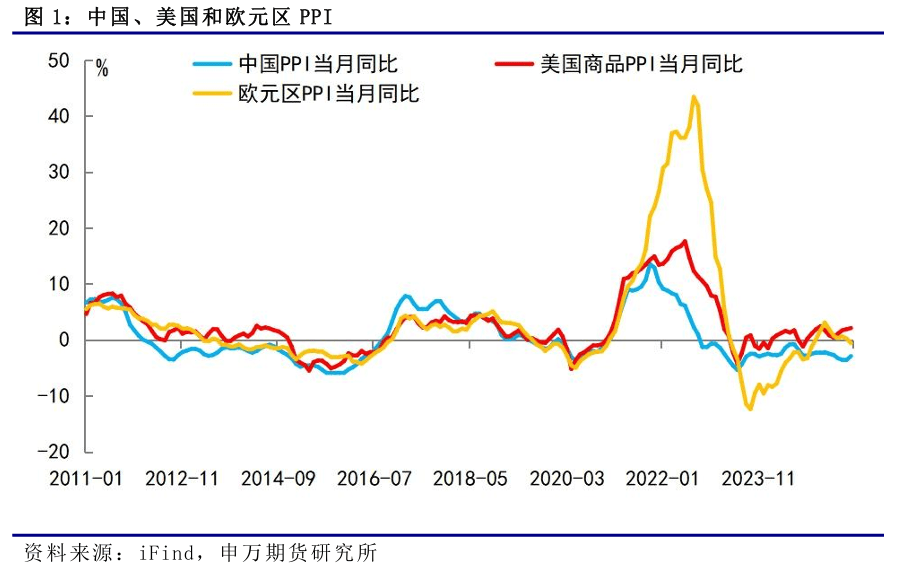
薛鹤翔:中美欧PPI为什么脱钩?
Sou Hu Cai Jing· 2025-10-14 06:31
Core Insights - The PPI trends in China, the US, and Europe have diverged significantly post-pandemic, with China experiencing low PPI, the US maintaining relatively high PPI, and Europe showing considerable volatility. This divergence is primarily attributed to differences in energy structures and demand dynamics across these regions [1][4]. Energy Structure Impact - China's PPI is highly sensitive to coal prices, which are currently low due to weak demand and expanded supply. The domestic coal production has exceeded historical levels, and the demand from traditional sectors like real estate has decreased, leading to a prolonged low PPI [8][18]. - The US has a strong energy independence, primarily relying on oil and natural gas. The PPI is less affected by energy price fluctuations compared to Europe, with stable natural gas prices and a significant impact from rising oil prices due to global supply and demand dynamics [11][13]. - Europe's PPI has been significantly influenced by volatile natural gas prices, especially following the Russia-Ukraine conflict, which led to a sharp increase in energy costs. The subsequent measures to reduce dependency on Russian gas have also contributed to PPI fluctuations [14][22]. Demand Dynamics - In China, the transition from traditional to new economic drivers is underway, with the real estate sector in a downturn. This has led to reduced demand for related products, suppressing PPI. However, new economic drivers are beginning to support a gradual recovery in PPI [2][16]. - The US has shown strong demand resilience due to substantial fiscal stimulus during the pandemic, which increased disposable income and consumer spending. Despite rising labor costs and interest rates, the PPI has only seen moderate declines [19][20]. - Europe is experiencing a mild recovery in demand post-pandemic, but high energy costs and external demand declines have previously suppressed PPI. Recent economic recovery efforts and fiscal policies are expected to support a gradual increase in PPI [15][22].

橡胶利空尚未兑现,但市场情绪维持偏弱
Zhong Xin Qi Huo· 2025-10-14 02:35
1. Report Industry Investment Ratings - The report does not explicitly provide an overall industry investment rating. However, it gives individual outlooks for different agricultural products, including "oscillating" for some and "oscillating weakly" for others [5][6][7][8][9][11][13][14][15][17][18][20] 2. Core Viewpoints of the Report - The report analyzes various agricultural products. Overall, the market shows a mixed trend with some products facing downward pressure while others are in a state of oscillation. The macro - environment, supply - demand relationship, and policy factors all have an impact on the market [1][5][6][7][8][9][11][13][14][15][17][18][20] 3. Summary by Relevant Catalogs 3.1 Market Outlook for Each Product - **Oils and Fats**: Concerned about the effectiveness of the lower technical support. Due to the pessimistic outlook for US soybean export demand, the market is in an oscillating and downward - adjusting state. Palm oil may continue to accumulate inventory, while domestic soybean oil inventory may peak and decline, and rapeseed oil inventory may continue to decrease. Overall, the oils and fats market may continue to oscillate and consolidate [5] - **Protein Meal**: The sentiment boost is limited, and the market continues to oscillate at a low level. US soybeans are facing challenges in exports, and the domestic supply pressure is large in the short - term, but the demand may increase steadily in the long - term [5][6] - **Corn/Starch**: With the new grain selling pressure coming, the spot price drives the futures price to decline significantly. In the short - term, the market needs to deal with the new grain listing pressure, and in the long - term, it may show a pattern of short - term bearish and long - term bullish [6][7] - **Pigs**: The planned slaughter volume in October increases, and the pig price is under pressure. In the short - term, the supply pressure increases, and in the long - term, if the capacity reduction is implemented, the supply pressure may ease in the second half of 2026 [8] - **Natural Rubber**: The negative factors have not been realized, but the market sentiment remains weak. The futures price may have over - declined due to sentiment. NR may show a relatively strong performance in the near - term. In the short - term, it can be considered from a long - bias perspective of oversold rebound, but the increase range is limited [1][9][11] - **Synthetic Rubber**: The raw material has weakened significantly, and the futures price has dropped sharply. The high production volume and high inventory are the main pressures, and the market is expected to oscillate at the bottom [13] - **Cotton**: The decline of cotton price has slowed down, and attention should be paid to the purchase price. Based on the expected increase in production, the cotton price is expected to oscillate weakly. It is recommended to adopt a short - on - rebound strategy [14] - **Sugar**: Both domestic and international sugar prices have weakened. In the medium - and long - term, the sugar market is expected to be in a bearish pattern due to the expected increase in global supply [15] - **Pulp**: The game of the virtual - to - real ratio may lead to intraday fluctuations, but the effectiveness needs to be observed. The high supply and the issue of birch pulp warehouse receipts are the main downward drivers [17] - **Double - Glued Paper**: The spot price is stable, and the futures price oscillates. The market supply and demand are in a loose pattern, and the price may decline slightly after the festival [18] - **Logs**: The peak season is not prosperous, and the logs oscillate weakly. The weak demand and high inventory are the main factors affecting the market [20] 3.2 Variety Data Monitoring - The report mentions the data monitoring of various varieties, including oils and fats, corn, starch, pigs, cotton, sugar, pulp, double - glued paper, and logs, but does not provide specific data analysis content [22][54][67][113][126][140][163] 3.3 Rating Standards - The report provides rating standards, including "strong", "oscillating strongly", "oscillating", "oscillating weakly", "weakly", with a time cycle of 2 - 12 weeks and a standard deviation calculation method [175]
旺季成色不足 玻璃易跌难涨
Qi Huo Ri Bao· 2025-10-14 02:15
Core Viewpoint - The glass market is facing a significant contradiction where demand continues to decline while production is on the rise, leading to an oversupply situation that is expected to keep prices under pressure [8]. Supply and Demand Analysis - Glass inventory has returned to historically high levels, indicating a clear oversupply, making it difficult for prices to rise unless effective "anti-involution" policies are implemented [1][10]. - As of October 10, the production profit for float glass using coal as fuel increased to 143.93 CNY/ton, up 36.39 CNY/ton from early September, while profits for oil coke and natural gas processes also saw significant increases [2]. - The daily production of float glass reached 161,300 tons as of October 10, slightly up from 159,600 tons on September 2, nearing last year's levels, but the production and sales rate has been declining [4]. - The average production and sales rate for float glass across major regions was 84% as of October 10, remaining below 100% for 12 consecutive days, indicating weak demand [4]. Real Estate Sector Performance - The real estate sector, a key downstream industry for glass, has shown weak performance, with the transaction area of commercial housing in 30 major cities dropping by 11.78% year-on-year in September [5]. - From January to August 2025, domestic real estate investment totaled 49,589.45 billion CNY, down 13.67% year-on-year, with new construction area and completed area also showing significant declines [5]. - The inventory of unsold commercial housing reached 76.2 million square meters, the highest level since 2019, further indicating a contraction in demand for glass [5]. Processed Glass Demand - Demand for processed glass remains weak, with order days for downstream manufacturers dropping to 11 days, the lowest level for the same period in the past seven years [6]. - Although automotive production has increased by 10.5% year-on-year, accounting for only 15%-20% of flat glass demand, it is insufficient to offset the decline in demand from the real estate sector [6]. Market Outlook - The current supply-demand imbalance is expected to lead to further inventory accumulation, with float glass factory inventory reaching 62.824 million heavy boxes, a 6.76% increase year-on-year and the second-highest level for the same period in history [8][10]. - Without a significant reduction in production capacity through policy measures, glass prices are likely to remain under pressure, making it advisable for companies to consider hedging opportunities during price rebounds [10].
文字早评2025/10/14星期二:宏观金融类-20251014
Wu Kuang Qi Huo· 2025-10-14 01:35
Report Industry Investment Ratings No relevant content provided. Core Viewpoints of the Report - The stock market has uncertainties in the short - term due to concerns about Sino - US tariffs, but the long - term strategy is to buy on dips as policy support for the capital market remains unchanged [4]. - The bond market may improve in the fourth - quarter supply - demand pattern and is likely to oscillate. Attention should be paid to the stock - bond seesaw effect [6]. - Precious metals are in an accelerating upward phase in the short - term. It is recommended to hold existing long positions, and new long positions at current prices carry high risks [8]. - For non - ferrous metals, the prices of copper, aluminum, etc. may be affected by Sino - US trade relations and their own supply - demand fundamentals, with different price trends and trading suggestions [10][11][12][13]. - In the black building materials sector, steel and iron ore prices may be affected by Trump's tariff statements and their own supply - demand situations. The future trend depends on policy and demand recovery [31][33]. - In the energy - chemical sector, the prices of various products such as rubber, crude oil, and methanol are affected by macro factors, supply - demand fundamentals, and policy expectations, with different trading strategies [47][52][56]. - For agricultural products, the prices of products like hogs, eggs, and soybeans are affected by supply - demand relations, seasonal factors, and trade policies, and corresponding trading suggestions are given [76][78][80]. Summaries by Categories Macro - Financial Stock Index - **Market Information**: In September, passenger car retail sales reached a new peak. The Nasdaq Golden Dragon China Index rebounded significantly. COMEX gold futures exceeded $4100 per ounce, up 56% this year. JPMorgan will provide up to $1.5 trillion in financing for key US industries [2]. - **Strategy**: After the previous continuous rise, high - level hot sectors such as AI have shown differences. The short - term index faces uncertainties due to Sino - US tariff concerns, but the long - term strategy is to buy on dips [4]. Treasury Bonds - **Market Information**: On Monday, the main contracts of TL, T, TF, and TS had different changes. China's foreign trade data showed an increase in exports and a slight decrease in imports. Trump said the Gaza war was over. The central bank conducted a net injection of 137.8 billion yuan [5]. - **Strategy**: The recent escalation of Sino - US trade disputes is beneficial for the bond market's repair in the short - term, but the long - term trend depends on fundamentals and institutional allocation. The bond market is expected to oscillate in the fourth quarter [6]. Precious Metals - **Market Information**: Shanghai gold and silver futures rose. COMEX gold and silver also had certain prices. The shortage of silver in the London spot market drove up prices, and the inventory of COMEX silver decreased [7][8]. - **Strategy**: Precious metals are in an accelerating upward phase in the short - term. It is recommended to hold existing long positions, and new long positions at current prices carry high risks [8]. Non - Ferrous Metals Copper - **Market Information**: The concern about Sino - US trade relations eased, and copper prices rebounded. LME copper inventory decreased, and domestic social and bonded area inventories changed [10]. - **Strategy**: Trump's tariff threat is uncertain. The supply - demand relationship supports copper prices. If the trade situation is a short - term shock, copper prices may remain strong [11]. Aluminum - **Market Information**: Market sentiment recovered, and aluminum prices rose. The inventory of domestic aluminum ingots and aluminum rods increased, and the LME aluminum inventory decreased [12]. - **Strategy**: Sino - US trade relations are uncertain. Aluminum prices are expected to oscillate strongly due to factors such as domestic consumption and copper price drive [13]. Zinc - **Market Information**: Shanghai zinc index slightly declined, and LME zinc rose. Domestic and foreign inventories and other data were provided [14][15]. - **Strategy**: After the holiday, domestic zinc production was normal. The low registered LME zinc warehouse receipts pose a structural risk. Short - term, Shanghai zinc is expected to oscillate at a low level with increased risk [16]. Lead - **Market Information**: Shanghai lead index declined, and LME lead also fell. Domestic and foreign inventories and other data were provided [17]. - **Strategy**: The lead market has some changes in supply and demand. Due to Trump's tariff statement, short - term Shanghai lead is expected to oscillate at a low level with increased risk [17]. Nickel - **Market Information**: Nickel prices oscillated. The cost of nickel ore was stable, and the price of nickel iron was slightly weak [18]. - **Strategy**: In the short - term, Sino - US trade friction may affect market sentiment, but the impact on nickel prices is relatively small. In the long - term, nickel prices have support. It is recommended to wait and see in the short - term and consider buying on dips [20]. Tin - **Market Information**: Shanghai tin futures declined. The supply of tin ore was tight, and the demand was mixed [21]. - **Strategy**: In the short - term, Sino - US trade friction may affect market sentiment, but tin prices are expected to remain high and oscillate due to supply - demand balance and seasonal demand [21]. Carbonate Lithium - **Market Information**: The spot index of carbonate lithium was stable, and the futures price declined slightly [22]. - **Strategy**: Affected by macro news, carbonate lithium prices are expected to oscillate weakly. Attention should be paid to macro environment changes and demand expectations [22]. Alumina - **Market Information**: The alumina index declined. The spot price in Shandong decreased, and the import window was close to closing [24]. - **Strategy**: The short - term ore price has support, but the alumina smelting capacity is in surplus. It is recommended to wait and see, focusing on supply - side policies and Fed policies [25]. Stainless Steel - **Market Information**: The stainless - steel futures price declined, and the spot price also decreased. The inventory increased after the holiday [26]. - **Strategy**: After the holiday, the inventory increased, and the terminal consumption was weak. The market is expected to trend weakly [26]. Cast Aluminum Alloy - **Market Information**: The AD2511 contract of cast aluminum alloy declined. The inventory decreased slightly, and the trading was light [27]. - **Strategy**: The cost - side aluminum price rebounded, but the increase in warehouse receipts puts pressure on the price [28][29]. Black Building Materials Steel - **Market Information**: The prices of rebar and hot - rolled coil futures declined. The inventory and spot prices also changed [31]. - **Strategy**: Trump's tariff statement may impact the steel market. The demand during the National Day holiday was weak. The future trend depends on policy and demand recovery [31]. Iron Ore - **Market Information**: The iron - ore futures price rose. The spot price and basis were provided [32]. - **Strategy**: The supply of iron ore decreased seasonally, and the demand was relatively stable. The future trend depends on downstream demand and trade policies [33][34]. Glass and Soda Ash - **Market Information**: The glass futures price declined, and the inventory increased. The soda - ash futures price rose slightly, and the inventory also increased [35][36]. - **Strategy**: Glass prices are expected to oscillate narrowly, and soda - ash prices are expected to trend weakly due to supply - demand imbalance [35][36]. Manganese Silicon and Ferrosilicon - **Market Information**: The prices of manganese silicon and ferrosilicon futures declined. The spot prices and basis were provided [37]. - **Strategy**: The black - building materials sector may first decline and then rise. Manganese silicon and ferrosilicon are likely to follow the sector's trend [39][40]. Industrial Silicon and Polysilicon - **Market Information**: The industrial - silicon futures price rose, and the polysilicon futures price declined. The supply - demand and inventory data were provided [41][44]. - **Strategy**: Industrial - silicon prices may rise in the long - term due to supply reduction and cost support. Polysilicon prices are expected to adjust technically in the short - term [43][45]. Energy - Chemical Rubber - **Market Information**: Due to the US tariff statement, global risk - asset prices declined. The rubber market has different views on supply and demand [47][48]. - **Strategy**: The rubber price has broken down in the short - term. It is recommended to wait and see or operate short - term. A hedging strategy is also suggested [51]. Crude Oil - **Market Information**: Crude - oil and refined - oil futures prices declined. China's crude - oil and refined - oil inventory data changed [52]. - **Strategy**: Although the geopolitical premium has disappeared, oil prices should not be overly bearish in the short - term. It is recommended to wait and see and test OPEC's export - support willingness [53]. Methanol - **Market Information**: Methanol prices in different regions changed. The basis and 1 - 5 spread also changed [54]. - **Strategy**: The methanol market has supply - demand pressure, but the short - term downward space is limited. It is recommended to wait and see [56]. Urea - **Market Information**: Urea prices in different regions declined. The basis and 1 - 5 spread changed [57]. - **Strategy**: After the holiday, the urea market has supply - demand pressure. It is recommended to wait and see at low prices [57]. Pure Benzene and Styrene - **Market Information**: The prices of pure benzene and styrene changed. The supply - demand and inventory data were provided [58]. - **Strategy**: The BZN spread has room for upward repair. Styrene prices may stop falling due to inventory reduction [59]. PVC - **Market Information**: The PVC futures price declined. The cost, supply - demand, and inventory data were provided [60][61]. - **Strategy**: The PVC market has a supply - demand imbalance. It is recommended to consider short - selling opportunities in the medium - term [62]. Ethylene Glycol - **Market Information**: The ethylene - glycol futures price rose. The supply - demand and inventory data were provided [63]. - **Strategy**: The ethylene - glycol market is expected to accumulate inventory in the fourth quarter. It is recommended to short - sell on rallies [64]. PTA - **Market Information**: The PTA futures price declined. The supply - demand, inventory, and processing - fee data were provided [65]. - **Strategy**: The PTA market has a short - term de - stocking pattern, but the processing - fee space is limited. It is recommended to wait and see [67]. Para - Xylene - **Market Information**: The PX futures price declined. The supply - demand, inventory, and valuation data were provided [68]. - **Strategy**: The PX market is expected to accumulate inventory. It is recommended to wait and see and pay attention to terminal and PTA valuation changes [69]. Polyethylene (PE) - **Market Information**: The PE futures price declined. The supply - demand, inventory, and basis data were provided [70]. - **Strategy**: The PE price is expected to oscillate at a low level due to cost and inventory factors [71]. Polypropylene (PP) - **Market Information**: The PP futures price declined. The supply - demand, inventory, and basis data were provided [72][73]. - **Strategy**: The PP market has supply - demand pressure and high inventory. The short - term has no prominent contradiction [74]. Agricultural Products Hogs - **Market Information**: Domestic hog prices varied. Northern farmers were reluctant to sell, and secondary fattening supported prices [76]. - **Strategy**: The supply pressure is large in the fourth quarter. It is recommended to reduce short positions and consider positive spreads after the spot stabilizes [77]. Eggs - **Market Information**: Egg prices were stable or declined. The market had supply - demand pressure [78]. - **Strategy**: After the holiday, the egg market has multiple negative factors. It is recommended to be bearish in the short - term and wait for a rebound to short - sell in the long - term [79]. Soybean Meal and Rapeseed Meal - **Market Information**: CBOT soybeans declined. Domestic soybean - meal prices rose, and the inventory decreased [80]. - **Strategy**: The domestic soybean supply pressure is large. It is recommended to sell on rallies in the medium - term and expect range - bound oscillations in the short - term [81]. Oils and Fats - **Market Information**: Malaysian palm - oil exports increased. Domestic oil inventories changed, and prices oscillated downward [82]. - **Strategy**: Oils and fats are supported by supply - demand expectations. It is recommended to wait and see in the short - term and consider buying on dips in the medium - term [83]. Sugar - **Market Information**: Zhengzhou sugar futures prices declined. Brazilian sugar production data were provided [84][85]. - **Strategy**: Brazilian sugar production data are bearish. It is recommended to short - sell on rallies in the fourth quarter [86]. Cotton - **Market Information**: Zhengzhou cotton futures prices oscillated. The spot price and downstream operating - rate data were provided [87]. - **Strategy**: Due to Sino - US trade conflicts and weak fundamentals, cotton prices are expected to decline in the short - term [88].
大越期货玻璃早报-20251014
Da Yue Qi Huo· 2025-10-14 01:30
交易咨询业务资格:证监许可【2012】1091号 大越期货投资咨询部 胡毓秀 从业资格证号:F03105325 投资咨询证号:Z0021337 联系方式:0575-85226759 重要提示:本报告非期货交易咨询业务项下服务,其中的观点和信息仅作参考之用,不构成对任何人的投资建议 。 我司不会因为关注、收到或阅读本报告内容而视相关人员为客户;市场有风险,投资需谨慎。 玻璃早报 2025-10-14 每日观点 玻璃: 1、基本面:中美贸易摩擦或升温;近期沙河地区"煤改气"等反内卷、环保政策利好情绪有所升 温,供应端扰动因素较多;下游深加工订单整体偏弱,不及往年同期,地产终端需求疲弱;偏空 2、基差:浮法玻璃河北沙河大板现货1148元/吨,FG2601收盘价为1179元/吨,基差为-31元,期 货升水现货;偏空 3、库存:全国浮法玻璃企业库存6282.40万重量箱,较前一周增加5.84%,库存在5年均值上方运 行;偏空 4、盘面:价格在20日线下方运行,20日线向下;偏空 5、主力持仓:主力持仓净空,空减;偏空 6、预期:宏观利空叠加玻璃基本面偏弱,短期预计震荡偏弱运行为主。 影响因素总结 2、风险点: "反内卷 ...
港股日评:“TACO”交易重现,港股修复缓慢-20251014
Changjiang Securities· 2025-10-13 23:31
Core Insights - The Hong Kong stock market experienced a significant trading volume of HKD 490.37 billion on October 13, 2025, with net inflows from southbound funds amounting to HKD 19.804 billion. Major indices in the Hong Kong market saw a general decline, primarily influenced by geopolitical tensions following Trump's announcement of 100% tariffs and export controls on China, despite subsequent easing statements from Trump and Vance, which left market sentiment affected [10][10]. Market Performance - The Hang Seng Index fell by 1.52% to 25,889.48, while the Hang Seng Tech Index decreased by 1.82% to 6,145.51. The Hang Seng China Enterprises Index dropped by 1.45% to 9,222.54, and the Hang Seng High Dividend Yield Index saw a slight decline of 0.18%. In the A-share market, the Shanghai Composite Index fell by 0.19%, the CSI 300 decreased by 0.50%, and the Wind All A Index dropped by 0.35%, with the Dividend Index slightly up by 0.02% [6][10]. Sector Analysis - In terms of sector performance, the non-ferrous metals sector led gains with an increase of 2.28%, followed by light industry manufacturing and basic chemicals, both up by 0.60%. Conversely, the electronics sector fell by 2.66%, the home appliances sector decreased by 2.37%, and non-bank financials dropped by 2.08%. Among concepts, the local brokerage index surged by 17.08%, the financial IC index rose by 7.96%, and the software outsourcing index increased by 5.18%, while the Foxconn index fell by 6.47%, the smart home index decreased by 5.70%, and the smart terminal index dropped by 5.50% [6][10]. Future Outlook - The report suggests that the ongoing trade tensions will not alter the slow bull market trend in Hong Kong stocks. Potential avenues for future growth include: 1) AI technology and new consumption sectors, which are expected to have significant growth potential; 2) Continued inflows from southbound funds, enhancing marginal pricing power; and 3) The transmission from loose monetary policy to loose credit in China, alongside potential US interest rate cuts, which could improve global liquidity and support further gains in the Hong Kong market [10].
贵金属有色金属产业日报-20251013
Dong Ya Qi Huo· 2025-10-13 09:40
Report Industry Investment Rating No relevant content provided. Core Views of the Report - The continuous push of safe - haven demand, central bank gold - buying trends, and monetary policy easing expectations have strengthened the medium - to - long - term upward logic of precious metals prices [3]. - The copper price is caught between the strong expectation of supply shortage and the weak expectation of tariff policy, leading to short - term high - level fluctuations in futures prices [16]. - Macroeconomic policies are the core factors affecting the price of Shanghai Aluminum. The price has been affected by factors such as employment data, tariff announcements, and supply disruptions. Alumina is in an oversupply situation, while cast aluminum alloy has strong support [35]. - The fundamentals of zinc have not improved. Although the zinc price has risen, the domestic supply - strong and demand - weak pattern is obvious [56]. - The nickel price is mainly influenced by the situation of the Indonesian nickel ore market. The downstream of the new energy sector has a good demand, and the stainless steel market has some positive factors, but is also affected by tariff uncertainties [69]. - Due to increased macro - uncertainty, the tin price is expected to correct in the short term [85]. - Considering supply and demand factors, the lithium carbonate futures price is expected to show a weakening trend with fluctuations [98]. - The price of industrial silicon is expected to rise slightly with the arrival of the dry season, but the increase is limited by inventory. The trading of polysilicon is focused on the establishment of the storage platform and the cancellation of warehouse receipts, with high volatility and risk [109]. Summaries Based on Relevant Catalogs Precious Metals - **Price Influencing Factors**: Fed rate - cut expectations, global economic uncertainty, geopolitical risks, and central bank gold - buying trends are driving up precious metals prices. The gold ETF holdings have rebounded [3]. - **Price Charts**: Various price charts, including SHFE gold and silver futures prices, COMEX gold prices, and gold - related spreads, are provided [4][10][12] Copper - **Price Outlook**: The copper price is in a high - level fluctuation due to the tug - of - war between supply and policy expectations. Further upward breakthrough may require the support of rate - cut expectations and domestic policies [16]. - **Price and Inventory Data**: Current copper futures and spot prices, import and export profits, and inventory data are presented [17][22][33] Aluminum - **Price Influencing Factors**: Macroeconomic policies, employment data, tariff announcements, and supply disruptions are affecting the aluminum price. Alumina is in an oversupply situation [35]. - **Price and Inventory Data**: Current aluminum and alumina futures and spot prices, spreads, and inventory data are provided [36][44][50] Zinc - **Price Outlook**: The zinc price has risen, but the domestic supply - strong and demand - weak pattern persists. The import - export situation is also a factor [56]. - **Price and Inventory Data**: Current zinc futures and spot prices, spreads, and inventory data are presented [57][63][66] Nickel - **Price Influencing Factors**: The Indonesian nickel ore market, new energy demand, and stainless steel market trends are influencing the nickel price. Tariff uncertainties also have an impact [69]. - **Price and Inventory Data**: Current nickel and stainless steel futures prices, inventory data, and downstream profit data are provided [70][76][80] Tin - **Price Outlook**: Due to increased macro - uncertainty, the tin price is expected to correct in the short term [85]. - **Price and Inventory Data**: Current tin futures and spot prices, spreads, and inventory data are presented [85][88][93] Lithium Carbonate - **Price Outlook**: Considering supply and demand factors, the lithium carbonate futures price is expected to show a weakening trend with fluctuations [98]. - **Price and Inventory Data**: Current lithium carbonate futures and spot prices, raw material prices, and inventory data are provided [99][103][107] Silicon - **Price Outlook**: The price of industrial silicon is expected to rise slightly with the arrival of the dry season, but the increase is limited by inventory. The trading of polysilicon is focused on the establishment of the storage platform and the cancellation of warehouse receipts, with high volatility and risk [109]. - **Price and Inventory Data**: Current industrial silicon and polysilicon spot prices, production data, and inventory data are presented [110][116][123]
2025年9月贸易点评:9月进出口:加速回升的成色?
Minsheng Securities· 2025-10-13 08:03
Group 1: Trade Performance Overview - In September, China's exports increased by 8.3% year-on-year (in USD), up 3.9 percentage points from the previous month[4] - Imports rose by 7.4% year-on-year (in USD), an increase of 6.1 percentage points compared to August[4] - The overall trade data for September exceeded expectations, indicating a potential for sustained recovery despite ongoing trade tensions with the US[5] Group 2: Export Dynamics - The growth in exports is supported by diversification into non-US markets and upgrades in the industrial chain, with significant contributions from the EU and emerging economies[5] - High-tech products, including integrated circuits and transportation equipment, led the export growth, reflecting a shift towards higher value-added sectors[6] - The "de-involution" policy has positively impacted export prices, with noticeable price recovery in steel and electronics, while labor-intensive products saw price declines[6] Group 3: Import Insights - The surge in import growth was primarily driven by rising international commodity prices, particularly in technology-related sectors like aircraft and integrated circuits[7] - Although there was a marginal recovery in the import of raw materials, the increase was largely price-driven rather than volume-driven, indicating potential short-term volatility[7] - The sustainability of the import growth remains uncertain, as domestic demand recovery appears weak[7] Group 4: Risks and Considerations - Future risks include potential policy changes that may not meet expectations and unexpected shifts in the domestic economic landscape[8] - Export fluctuations could also pose risks to the overall trade outlook, necessitating close monitoring of external factors[8]
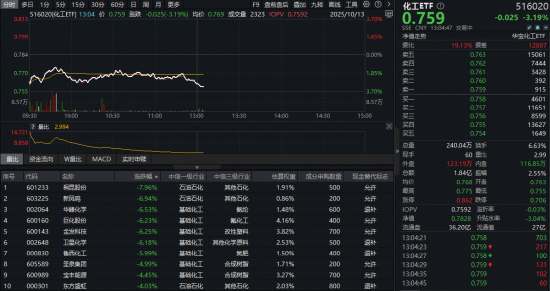
能否抄底?化工ETF(516020)跌超3%,近3日吸金超8000万元!机构:行业整体格局向好
Xin Lang Ji Jin· 2025-10-13 05:24
Group 1 - The chemical sector experienced a significant pullback on October 13, with the chemical ETF (516020) declining by 3.19% [1][2] - Key stocks in the sector, including Tongkun Co., Ltd., fell over 7%, while several others like Xin Fengming and Huafeng Chemical dropped more than 6%, negatively impacting the overall sector performance [1][2] - The chemical ETF has seen a capital inflow of over 80 million yuan in the last three trading days, indicating renewed interest from investors [1][2] Group 2 - The chemical industry is currently at a historical low in terms of profitability and valuation, with a profit margin of 4.14% for the chemical raw materials and products sector as of August 2025 [3] - The price-to-book ratio for the chemical ETF (516020) is at 2.4 times, which is in the 41.57 percentile of the last decade, suggesting a favorable long-term investment opportunity [3] - The construction of new projects in the basic chemical sector has seen a decline for three consecutive quarters, confirming a supply turning point and indicating a potential improvement in the industry landscape [4] Group 3 - Investment strategies suggest focusing on sectors with significant profit elasticity, such as pesticides, organic silicon, and polyester filament, which are expected to benefit from supply-side improvements [4] - The chemical ETF (516020) tracks the CSI segmented chemical industry index, covering various sub-sectors and concentrating nearly 50% of its holdings in large-cap stocks like Wanhua Chemical and Salt Lake Industry [4] - Investors can also consider the chemical ETF linked funds (A class 012537/C class 012538) for exposure to the chemical sector [4]