消费

Search documents
2025年5月经济数据点评:政策驱动特征明显
CMS· 2025-06-16 15:12
Economic Performance - In May, the industrial added value of large-scale enterprises increased by 5.8% year-on-year, with a month-on-month growth of 0.61%[4] - Fixed asset investment from January to May grew by 3.7% year-on-year, marking the lowest level this year[4] - Retail sales in May reached 4.13 trillion yuan, with a year-on-year growth of 6.4%, exceeding market expectations of 4.85%[5] Industrial Sector Insights - The equipment manufacturing sector saw a 9.0% year-on-year increase in added value, contributing 54.3% to overall industrial growth[4] - High-tech manufacturing growth slowed to 8.6%, down by 1.4 percentage points from April, primarily due to high base effects and reduced policy stimulus[4] - The export delivery value of large-scale industrial enterprises increased by only 0.6% year-on-year, indicating weakened external demand[4] Investment Trends - Equipment and tool investment surged by 17.3% year-on-year, contributing 63.6% to overall investment growth, driven by policies like "old-for-new" and equipment upgrades[4] - Real estate investment in May fell by 10.7%, with residential investment declining by 10.0%, reflecting ongoing pressures in the property sector[5] - Infrastructure investment recorded a growth rate of 10.42%, supported by special bonds and long-term treasury bonds, despite a slight decline from April[5] Consumer Behavior - Essential consumer goods such as grain and oil saw a growth rate of 14.6%, indicating resilience in basic consumption[5] - The "old-for-new" policy significantly boosted retail sales in categories like home appliances and furniture, with growth rates of 53.0% and 25.6% respectively[5] - Automotive retail sales grew by only 1.1%, significantly lower than the overall retail growth, primarily due to the decline in subsidies for new energy vehicles[5] Future Outlook - Industrial growth may slow marginally in June, with high-frequency data indicating a shift towards the off-season for several upstream industries[5] - Manufacturing investment is expected to remain high, driven by policy support for equipment updates and green transformation, but may face constraints from low export demand[5] - Retail sales growth may slightly decline, with ongoing policy support being a key factor in sustaining consumer demand[5]
宏观经济宏观月报:5月增长动能从出口与投资转向消费-20250616
Guoxin Securities· 2025-06-16 13:12
Economic Growth - In May, the industrial added value above designated size grew by 5.8% year-on-year, a decrease of 0.3 percentage points from the previous month[1] - The total retail sales of consumer goods reached 41,326 billion yuan in May, with a year-on-year growth of 6.4%, accelerating by 1.3 percentage points from the previous month[1] - Fixed asset investment (excluding rural households) in May was 191,947 billion yuan, growing by 3.7% year-on-year, down by 0.3 percentage points from the previous month[1] Consumption and Investment Trends - The monthly GDP growth rate for May was approximately 5.0%, a slight decrease of 0.1 percentage points from April, aligning with the annual economic growth target[2] - Domestic consumption growth significantly increased in May, offsetting the decline in investment and export growth, indicating a shift in economic momentum towards consumption[2] - The government’s focus on boosting consumption is expected to enhance its role in economic growth in the second half of 2025[3] Employment and Unemployment - The urban surveyed unemployment rate in May was 5.0%, down by 0.1 percentage points from the previous month, indicating an improvement in employment conditions[1][17] - The unemployment rate in major cities also showed a similar trend, reflecting seasonal adjustments and improvements in the job market[17] Export and Import Performance - The total import and export value in May was 38,098 billion yuan, with exports at 22,767 billion yuan, growing by 6.3%, while imports decreased by 2.1%[1] - The decline in both exports and imports suggests a cooling off from previous "export rush" activities[47] Inflation and Price Trends - The Consumer Price Index (CPI) in May remained stable year-on-year at -0.1%, while the core CPI increased by 0.6%, indicating a mild upward trend in core prices[51] - The Producer Price Index (PPI) saw a year-on-year decline of 3.3%, with the drop in production material prices being a significant factor[63]
中国宏观数据点评:5月消费表现强劲,但投资和生产数据逊于预期
SPDB International· 2025-06-16 09:35
Economic Performance - In May, the retail sales of consumer goods increased by 6.4% year-on-year, up from 5.1% in April, significantly exceeding the market expectation of 4.9%[2] - The growth rate of fixed asset investment fell to 3.7% year-on-year, slightly below the market expectation and April's figure of 4.0%[3] - Industrial production growth declined to 5.8% in May from 6.1% in April, also below the expected 6.0%[7] Consumer Trends - The sales growth of communication equipment surged to 33.0% in May, up from 19.9% in April, while home appliance sales jumped to 53.0% from 38.8%[2] - Restaurant consumption growth rose to 5.9%, an increase of 0.7 percentage points from April[2] - The consumer price index (CPI) remained negative at -0.1% for the fourth consecutive month, indicating low inflation[8] Investment and Housing Market - Real estate development investment fell by 10.7% year-on-year in May, worsening from the previous month's decline of 10.3%[3] - The average price of new homes in 70 major cities decreased by 0.22% month-on-month in May, compared to a decline of 0.12% in April[6] - The sales area of commercial housing in early June dropped by 9.4% year-on-year, reflecting ongoing weakness in the housing market[8] Policy Outlook - The government is expected to introduce fiscal support of 0.5-1.0 trillion yuan (approximately 0.35%-0.7% of GDP) by September, given the current economic conditions[1] - A potential reduction in the reserve requirement ratio (RRR) by 50 basis points and interest rate cuts of 10-20 basis points are anticipated in the second half of the year[1]
超3300只个股上涨
第一财经· 2025-06-16 04:18
Core Viewpoint - The article highlights the current performance of various sectors in the stock market, with a focus on the oil and gas sector showing strong gains amidst geopolitical uncertainties and a supportive long-term outlook for oil supply and demand [1][5]. Sector Performance Summary - The oil and gas extraction and service sector has seen a significant increase of 4.42%, with major stocks like Zhen Oil and Beiken Energy hitting the daily limit [2][4]. - Other sectors showing positive performance include gaming (+3.50%), film and cinema (+3.09%), and wind power equipment (+2.96%), while sectors like precious metals (-1.79%) and traditional liquor (-0.79%) experienced declines [2]. - The overall market saw over 3,300 stocks rising, indicating a broad-based rally [1]. Institutional Insights - Everbright Securities maintains a positive long-term outlook on the "Big Three" oil companies and the oil service sector, citing a favorable supply-demand balance in the oil market [5]. - Minsheng Securities suggests monitoring geopolitical developments and OPEC+ production levels, recommending investments in resilient oil companies with strong resource advantages [5]. - Fund manager Wang Zhangliang notes that while the A-share market is currently in a weak technical phase, it is supported by fundamentals, with a focus on oil and gas as a leading sector [7]. - Guotai Junan Securities emphasizes the importance of technology and new production capabilities, suggesting a "dumbbell strategy" for investment, balancing between technology growth and stable consumer sectors [7].





投资策略周报:关于港股和消费的两大核心问题-20250615
KAIYUAN SECURITIES· 2025-06-15 05:13
Group 1: AH Premium Dynamics - The report discusses the current state of the AH premium, indicating that it has significantly narrowed and may have further room to decline, potentially returning to the lower levels seen between 2016-2019 [1][10][30] - The narrowing of the AH premium is attributed to two main factors: a record net inflow of southbound funds and a temporary improvement in liquidity conditions, which have alleviated pressure on H-share valuations [1][10][24] - The report highlights that as of June 12, 2025, the AH premium index was at 128.05, notably below the established mid-point of 140.68 since 2020, with the overall premium of A-shares over H-shares dropping to 27%, a five-year low [10][12][30] Group 2: Consumer Sector Insights - The report emphasizes that the core driver of the current consumer market rally is not merely a dichotomy between "new consumption" and "traditional consumption," but rather a deeper structural change, with Delta G (marginal change in profit growth) being a key indicator [2][32][36] - Three investment themes are proposed based on Delta G: focusing on sectors with improved economic forecasts, sectors with significant upward revisions in profit forecasts, and industries showing signs of profit recovery, particularly those transitioning from negative to positive growth [2][41][56] - Specific sectors highlighted for their structural opportunities include beverages, e-commerce, motorcycles, personal care products, and packaging, with notable profit growth expected in these areas [2][41][56] Group 3: Investment Strategy Recommendations - The report suggests a diversified investment strategy focusing on domestic consumption, technology growth, cost improvement sectors, and structural opportunities in international markets, particularly in light of easing geopolitical risks [3][64] - The recommended sectors for investment include clothing, automobiles (including electric two-wheelers), general retail, personal care products, food and beverage, and new retail, with a focus on areas showing marginal profit growth improvement [3][64] - The report also advises caution regarding exposure to high geopolitical risk sectors, suggesting a preference for stable dividend stocks and gold as long-term holdings [3][64]
以史为鉴丨3年前俄乌冲突爆发后,A股是怎么走的?
Mei Ri Jing Ji Xin Wen· 2025-06-15 01:05
Core Viewpoint - The recent geopolitical tensions between Israel and Iran have triggered a risk-off sentiment in global capital markets, impacting the A-share market, which experienced a sudden decline on June 13, 2025 [2][20]. Market Reaction - On June 13, sectors such as oil, gold, and military industries saw gains, disrupting the upward momentum of other sectors like finance, new consumption, gaming, and media [4][10]. - The market's trading tone on the following Monday will depend on whether the conflict escalates or de-escalates, with historical patterns suggesting potential outcomes [4][20]. Historical Context - A comparison is drawn to the initial phase of the Russia-Ukraine conflict in February 2022, where the A-share market reacted similarly to geopolitical tensions, with a notable decline followed by a brief recovery [6][8]. - On February 24, 2022, the A-share market saw a significant drop, with the ChiNext index falling by 2.11% as panic set in [6][8]. Sector Performance - In the wake of the Russia-Ukraine conflict, sectors such as oil service and precious metals initially surged before experiencing a pullback, while military-related sectors peaked and then declined [10][18]. - The data shows that on February 24, 2022, oil service engineering and precious metals sectors rose by 7.13% and 7.06%, respectively, while consumer and technology sectors faced declines [9][11]. Investment Trends - The article identifies three main trends in the A-share market during geopolitical conflicts: 1. Risk-off sentiment leads to capital flowing into defensive sectors like oil, gold, and military [15][16]. 2. A quick rebound occurs within a week as the market digests negative news [17]. 3. Significant sector differentiation, with energy and military sectors performing well while consumer and tech sectors decline due to reduced risk appetite [18][19]. Future Outlook - Analysts suggest that the A-share market may not replicate the downturn seen in March-April 2022, as the market is expected to return to its original rhythm over time [20][21]. - The upcoming week will see significant economic data releases, including industrial production and fixed asset investment reports, which could influence market sentiment [27][28].
国泰君安:“狮子之力”空袭,美股或承压
Ge Long Hui· 2025-06-14 03:56
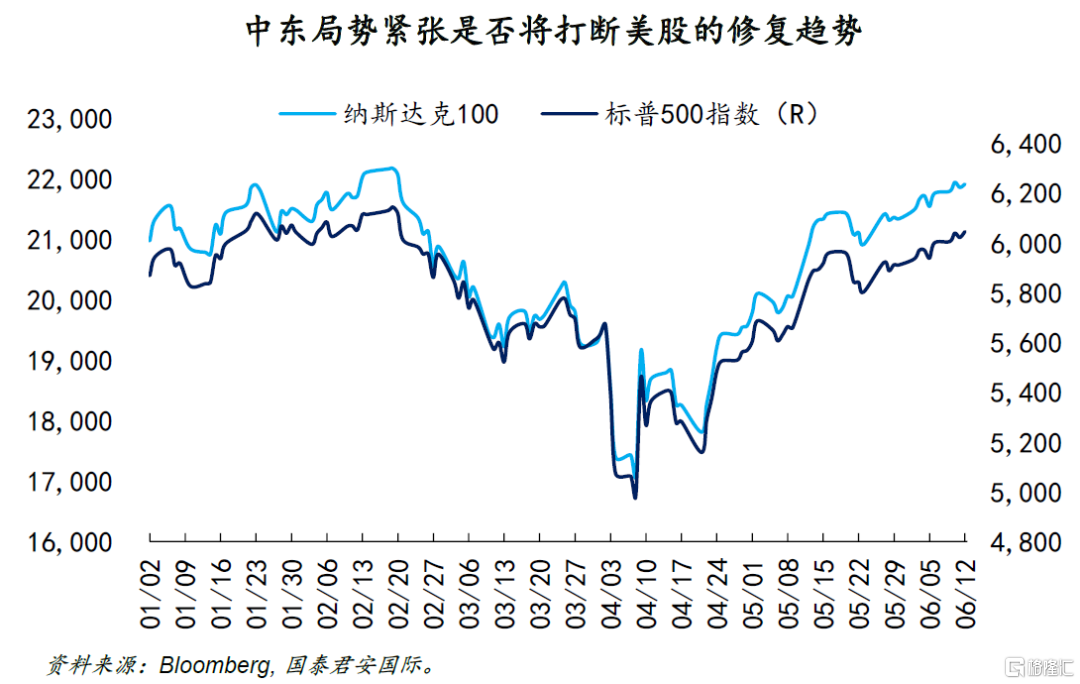
Market Overview - Recent recovery in US stock indices continues since the market bottomed out in early April, with the S&P 500 index rising 2.3% and the Nasdaq 100 index increasing 2.6% over the last 10 trading days [4][5] - Positive US employment data, a decline in inflation rates towards long-term targets, and progress in US-China trade talks have collectively supported the upward trend in the stock market [4][5] Industry Performance - The technology sector has shown strong performance, benefiting from the resilience of the US economy and the recent US-China trade negotiations, which have alleviated some market concerns regarding tariffs imposed by the Trump administration [5][6] - The energy sector has also performed well, driven by rising international oil prices amid escalating tensions in the Middle East, particularly between Israel and Iran [8][11] - Energy prices have been on the rise since April-May, with investors anticipating further increases if conflicts in the Middle East escalate, potentially impacting oil supply routes [8][11] Consumer Sector Challenges - The consumer sector, both essential and discretionary, has faced challenges due to the cost pressures from tariffs imposed during the Trump administration, which have affected profit expectations [11][12] - Recent CPI data indicates a slowdown in inflation, with May CPI rising only 0.1% month-over-month, below market expectations, suggesting that consumer companies are hesitant to raise prices due to fears of losing customers [11][12] - The significant increase in customs tariff revenue, which surged 270% to $23 billion in May, reflects the impact of new tariffs, further complicating the outlook for consumer companies [11][12] Inflation and Economic Outlook - The recent decline in inflation data provides the Federal Reserve with some policy flexibility, potentially supporting the stock market [13] - However, the impact of tariffs on inflation may not be fully captured in the current data, and rising energy prices due to geopolitical tensions could lead to a rebound in inflation [13] - Investors are encouraged to focus on structural opportunities within the market, particularly in traditional energy and telecommunications sectors, while technology stocks remain attractive due to valuation recovery and stable demand for AI [13]
中金研究 | 本周精选:宏观、策略、房地产
中金点睛· 2025-06-14 00:27
Real Estate Industry - The real estate market is expected to stabilize gradually, divided into three phases: housing transaction volume, housing prices, and real estate investment [2] - The core point for entering a positive cycle is the upward shift in housing price expectations due to changes in supply and demand structure, which should be a key signal for market patience [2] - Policy measures need to be more decisive to facilitate stabilization, focusing on adjusting supply and demand structures and mitigating risks from enterprises [2] - The probability of a "medium policy" scenario for 2025 is high, with housing sales potentially performing better than expected due to the prolonged effects of the 926 policy [2] - A recovery in total housing sales to historical reasonable levels could lead to significant upward potential, with new housing transaction volumes likely to see greater recovery [2] Strategy - The A-share market is expected to show resilience and growth, with a potential bottom having formed in early April 2025 [7] - The market's upward potential will depend on a comprehensive policy package, particularly fiscal policies, to support the recovery trend [7] - Key investment themes include mergers and acquisitions, artificial intelligence, undervalued quality leaders, refined consumption, and counter-cyclical policy support [7] Macroeconomy - The Chinese economy is experiencing a "quasi-balance" recovery, with GDP growth improving while prices remain weak [15] - The real estate sector's drag on the economy is expected to continue narrowing, contributing to the quasi-balance recovery [15] - Consumer behavior is shifting towards quality and rational consumption, with the Z generation becoming a driving force in the new consumption wave [19]

[6月13日]指数估值数据(下跌的品种,何时迎来右侧上涨呢;港股估值表更新;抽奖福利)
银行螺丝钉· 2025-06-13 13:55
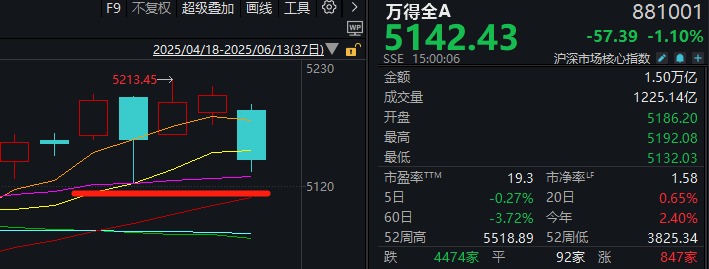
Market Overview - The A-share market experienced slight declines, with large-cap stocks showing minimal volatility while small-cap stocks faced more significant drops [2][5] - The value style demonstrated relative resilience against market downturns [3] - The Hang Seng Index's decline was less severe compared to A-shares, indicating a relatively stable performance [7] Investment Strategy - The article emphasizes the benefits of dollar-cost averaging during bear markets, suggesting that investing during the downturn can lower costs and lead to profits when the market recovers [14][15] - The "smile curve" concept is introduced, illustrating the cyclical nature of market performance, where downturns (left side) can be followed by recoveries (right side) [14][16] Earnings and Valuation Insights - The earnings growth of listed companies is identified as a core driver for long-term index increases, with historical fluctuations in earnings growth noted [21][22] - The article highlights that earnings growth is not uniform, with certain years experiencing slowdowns or negative growth, impacting investor sentiment and valuations [22][24] - The Hang Seng Index's earnings grew by 16% year-on-year in the first quarter, ranking among the top global indices [39] Sector Performance - The technology sector in Hong Kong is noted for its significant recovery, having previously experienced a 60% drop from 2021 to 2022, but is now entering a growth phase [32] - The pharmaceutical index is also recovering, albeit with a two-year lag compared to the technology sector [33] - Consumer sectors are still in a downturn, similar to the pharmaceutical sector two years prior, indicating ongoing challenges [35][36] Valuation Metrics - Various indices are presented with their respective price-to-earnings (P/E) ratios, price-to-book (P/B) ratios, dividend yields, and return on equity (ROE), providing a snapshot of current valuations [44][45] - The article categorizes indices into undervalued (green), fairly valued (yellow), and overvalued (red), aiding investors in decision-making [61] Economic Cycles - The article discusses the cyclical nature of economic conditions, suggesting that periods of low performance can present investment opportunities, while overly optimistic conditions may signal caution [47][51] - Historical patterns indicate that significant market peaks often occur during overheated economic phases, reinforcing the need for strategic investment approaches [51][52]
ETF市场周报 | 指数走势出现分歧!创新药相关ETF估值修复持续
Sou Hu Cai Jing· 2025-06-13 09:21
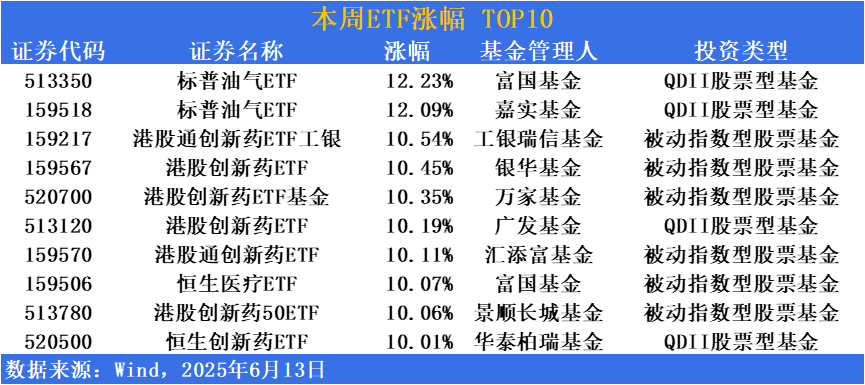
Market Overview - A-shares experienced steady growth in the first half of the week, followed by an overall adjustment in the latter half, with May CPI showing a month-on-month decline [1] - The three major indices had mixed performances, with the Shanghai Composite Index and Shenzhen Component Index down by 0.25% and 0.60% respectively, while the ChiNext Index rose by 0.22% [1] - Global uncertainty has led to increased interest in defensive assets, with high-dividend assets maintaining significant allocation value [1] ETF Performance - The top-performing ETFs this week included several related to innovative pharmaceuticals, with notable gains exceeding 10% for multiple funds [2] - Conversely, consumption and technology-related ETFs saw significant declines, with the top losers experiencing drops of over 4% [4][5] Investment Trends - China's share of global business development (BD) transactions has surged from 5% in 2021 to 42% by May 2025, indicating a growing international recognition of Chinese innovative pharmaceuticals [3] - Major transactions, such as the $60 billion collaboration between Heng Rui Medicine and Hercules, highlight the increasing trend of Chinese companies entering international markets [3] Fund Flows - The ETF market saw a net outflow of 43.36 billion yuan, with a notable preference for conservative investments, particularly in bond ETFs [6][8] - The top inflows were seen in bond ETFs, with the Credit Bond ETF leading with an inflow of over 30 billion yuan [8] Upcoming ETFs - Four new ETFs are set to launch next week, including the Changcheng CSI Dividend Low Volatility 100 ETF, which aims to provide a combination of high dividends and low volatility [10] - The Tianhong CSI A500 Enhanced Strategy ETF is also highlighted for its strong historical performance and potential for superior returns through active management [12]