地产

Search documents
金属周期品高频数据周报:7月M1和M2增速差收窄至-3.2个百分点,创近49个月新高-20250818
EBSCN· 2025-08-18 10:52
Investment Rating - The report maintains an "Overweight" rating for the steel and non-ferrous metals sectors [6] Core Insights - The liquidity indicators show that the M1 and M2 growth rate difference narrowed to -3.2 percentage points in July, marking a 49-month high [1][11] - The construction and real estate sectors are experiencing a decline, with key enterprises' average daily crude steel output hitting a year-to-date low in late July [2][20] - The profitability of titanium dioxide and flat glass remains low, with significant negative margins reported [70] Summary by Sections Liquidity - The M1 and M2 growth rate difference was -3.2 percentage points in July, a month-on-month increase of 0.5 percentage points [1][17] - The BCI small and medium enterprise financing environment index for July was 46.09, down 6.16% month-on-month [1][17] - The London gold spot price decreased by 1.86% compared to the previous week [1] Infrastructure and Real Estate Chain - Key enterprises' average daily crude steel output reached a year-to-date low in late July [2][38] - The national real estate new construction area from January to July 2025 showed a year-on-year decline of 19.40% [20] - The national cement price index decreased by 0.37% this week, with a cement profit of 29 yuan/ton [56] Industrial Products Chain - The operating rate of semi-steel tires is at a five-year high, with a current rate of 72.07%, down 2.28 percentage points [2] - Major commodity prices showed mixed results, with cold-rolled steel, copper, and aluminum prices increasing by 1.24%, 0.69%, and 0.24% respectively [2] Export Chain - The new export orders PMI for China in July was 47.10%, a decrease of 0.6 percentage points [4] - The CCFI comprehensive index for container shipping rates was 1193.34 points, down 0.62% [4] Valuation Metrics - The Shanghai Composite Index increased by 2.37%, with the industrial metals sector performing best at +5.31% [4] - The PB ratio of the ordinary steel sector relative to the Shanghai and Shenzhen markets is currently at 0.54, with a historical high of 0.82 [4] Investment Recommendations - The report suggests that the profitability of the steel sector is expected to recover to historical average levels, following regulatory support for the industry [5]
出行火热,地产降温
Haitong Securities International· 2025-08-18 09:22
Consumption - Travel and tourism activity remains high, with significant recovery in urban and intercity population movement, reflected in increased subway ridership and flight operations[7] - Retail and wholesale volumes for automobiles have slightly declined, indicating a weakening effect of promotional activities and subsidies[7] - Movie attendance and box office revenues have significantly decreased post-summer, indicating a drop in consumer interest[7] Investment - New special bonds issued reached CNY 3.08 trillion as of August 16, with a recent acceleration in issuance[20] - Real estate transaction volumes remain subdued, with new home sales in 30 cities showing a slight recovery but still down year-on-year[20] - Construction activity is marginally improving, with asphalt operating rates increasing and cement shipment rates recovering seasonally[20] Trade and Prices - Import and export volumes are showing divergence, with a 11.1% decline in imports from China to South Korea and a 4.3% drop in global exports[26] - Domestic export freight rates have decreased for seven consecutive weeks, reflecting a retreat from previous shipping surges due to tariff concerns[26] - The Producer Price Index (PPI) remains flat overall, with industrial prices showing little change except for a notable 15% increase in lithium carbonate prices[44] Liquidity - The 10-year government bond yield rose by 5.7 basis points to 1.75%, indicating a tightening liquidity environment[47] - The US dollar index fell by 42 basis points, influenced by moderate inflation data from July, which strengthened expectations for a potential interest rate cut in September[47]
A股内生动力较强 上行趋势有望延续
Qi Huo Ri Bao· 2025-08-18 01:11
Core Viewpoint - The A-share market has regained upward momentum after a brief pullback, with the Shanghai Composite Index breaking through key resistance levels, indicating strong internal demand and market participation from domestic investors [1][2]. Group 1: Market Performance - The Shanghai Composite Index reached a new high of 3704 points on August 14, 2024, following a breakthrough of the previous high of 3674 points on August 13 [1]. - Trading activity has increased significantly, with the total trading volume in the Shanghai and Shenzhen markets exceeding 2.2 trillion yuan, and the margin financing balance surpassing 2.05 trillion yuan [1][2]. - The margin financing balance rose to 20,551.9 billion yuan by August 14, 2024, marking a significant increase in market activity [2]. Group 2: Capital Inflow and Market Sentiment - The rise in margin financing indicates that traders are increasing their equity allocations in the A-share market, reflecting a growing market activity [2]. - The proportion of margin financing to the total market capitalization is currently at 2.3%, significantly lower than the 4.7% observed in 2015, suggesting that the current market is not overly leveraged [2]. - Financial data from July shows a substantial increase in non-bank financial institution deposits, indicating a shift of funds from savings to equity investments [3]. Group 3: Future Outlook - The A-share market is expected to continue its upward trend until the end of October, barring any unexpected negative developments or external liquidity constraints [4]. - The market's structural dynamics are driven by sector rotations, with significant performances from cyclical sectors and technology-related stocks, particularly in AI and semiconductor industries [5][7]. - Short-term external uncertainties have decreased, contributing positively to market sentiment, with recent developments in U.S.-China trade relations and economic indicators supporting the outlook for Chinese assets [6].
开源证券当下配置建议:科技+军工+反内卷&PPI扩散方向+稳定型红利
Xin Lang Cai Jing· 2025-08-18 00:17
Group 1 - The report suggests an industry allocation strategy termed "4+1," focusing on technology growth, self-control, and military sectors, including liquid cooling, robotics, gaming, AI applications, and military technologies such as missiles, drones, satellites, and deep-sea technology. Additionally, it highlights the fintech and brokerage sectors due to their high correlation with indices [1] - The cyclical sectors benefiting from the expectation of marginal improvement in PPI and some low-level rebound include steel, chemicals, non-ferrous metals, and building materials, with potential valuation recovery opportunities in insurance, liquor, and real estate [1] - The report identifies sectors with anti-involution elasticity and broader potential, indicating that the current anti-involution trend extends beyond traditional cyclical industries, with mid-term potential in solar energy, lithium batteries, engineering machinery, healthcare, and certain manufacturing and growth directions in Hong Kong's Hang Seng Internet [1] - Structural opportunities for overseas expansion are noted, particularly due to the easing of China-Europe trade relations, benefiting high-export categories like automobiles and wind power, as well as niche exports such as snacks [1] - The report emphasizes the importance of stable dividend stocks, gold, and optimized high-dividend assets for foundational investment [1]
惠理投资盛今:中国资产具备多重核心竞争优势
Shang Hai Zheng Quan Bao· 2025-08-17 13:36
Core Viewpoint - The Hong Kong stock market has shown strong performance this year, driven by multiple core competitive advantages of Chinese assets, which are expected to enhance their attractiveness to international capital [1][2]. Group 1: Factors Driving Hong Kong Stock Market Strength - Three main factors are identified as driving the strength of the Hong Kong stock market: the "hard technology" wave, the rise of the "new economy," and the weakening of the US dollar [2]. - The "hard technology" revolution is expected to bring profound changes to production and lifestyle, with leading Chinese internet companies poised to capitalize on AI applications [2]. - The "new economy" has become a pillar of the Hong Kong stock market, with its market capitalization share increasing from 27% at the end of 2015 to an expected 51% by the end of 2024 [2]. - The weakening US dollar has led to a reallocation of funds, with a slowdown in foreign capital outflow from the Hong Kong market, making it an attractive option for global capital seeking undervalued assets [2]. Group 2: Core Competitive Advantages of Chinese Assets - Chinese assets possess three core competitive advantages: a complete modern industrial system, increased R&D investment leading to brand premium, and significant long-term investments in core technology fields [3]. - The manufacturing sector in China has achieved low-cost, high-efficiency capabilities through vertical integration and scale advantages [3]. - Chinese companies are increasingly recognized for their global competitiveness in areas such as AI, semiconductors, new energy, and aerospace [3]. Group 3: Investment Opportunities in A-Share Market - The A-share market presents four key investment opportunities: stable cash returns in sectors like telecommunications, finance, and utilities; potential in the internet sector and consumer sub-industries due to policy support and AI commercialization; growth in the biopharmaceutical industry driven by improved policies and global competitiveness; and a stabilization in the real estate sector along with improved prospects for chemicals and raw materials [3].
PPI回升的宏观影响
Western Securities· 2025-08-17 13:07
Group 1: PPI Trends and Economic Impact - Since July, the "anti-involution" policy has led to a rebound in some commodity prices, suggesting that PPI may stabilize and rise in the second half of the year[1] - As of July 2025, the cumulative decline in PPI is 9.6%, with a duration of 37 months, which is longer than the median duration of previous declines[10] - If PPI stabilizes and rises, it is expected to accelerate corporate profits, nominal GDP growth, and residents' income growth[1] - During PPI rising periods, the median year-on-year growth rate of industrial enterprises' revenue is 24.1%, while during falling periods, it drops to 5.4%[21] Group 2: Industry and Consumption Insights - In July, China's retail sales growth narrowed to 3.7%, the lowest in six months, indicating a slowdown in consumer spending[35] - The operating rate of blast furnaces remains above 83%, while PTA operating rates have seen significant declines recently[35] - The real estate market has shown signs of cooling after a brief improvement in transaction volumes[35] Group 3: Macro Policy and Market Performance - The central bank has implemented policies to maintain liquidity and reduce financing costs, including interest subsidies for personal consumption loans[3] - As of August 16, the Chinese equity market has outperformed major asset classes, driven by a strong M1 growth rate and reduced deposit willingness due to equity market gains[2] - The upcoming Jackson Hole global central bank meeting from August 21 to 23 is a key event to watch for potential policy implications[65] Group 4: Risks and Considerations - There are concerns regarding the sustainability of macro policies, potential declines in the real estate market, and increasing geopolitical risks[66] - The high actual interest rates resulting from declining PPI may suppress credit demand, impacting overall economic activity[32]
7月经济数据点评:供需双承压,但债市仍谨慎
Shenwan Hongyuan Securities· 2025-08-16 13:48
Group 1 - The report highlights that consumer spending has weakened since peaking in May-June 2025, with retail sales growth for January to July 2025 at 4.8%, down 0.2 percentage points from the previous period, significantly impacted by the restaurant sector, which saw a growth rate of 3.8% [2][3] - Industrial value-added growth for July 2025 was 6.3%, a decline of 0.1 percentage points from June, with production in "anti-involution" sectors like automotive and photovoltaic experiencing notable decreases [3][4] - Fixed asset investment growth has accelerated its decline, with a cumulative year-on-year growth rate of 1.6% in July 2025, down 1.2 percentage points from June, driven by weak performance in real estate, infrastructure, and manufacturing sectors [3][5] Group 2 - The bond market has shown a weakening in pricing based on fundamentals, with the yield curve flattening, indicating pessimistic expectations for the economy despite weak demand in the real sector [3] - The report anticipates that the 10-year government bond yield will range between 1.65% and 1.80% in August and September 2025, with conditions for further yield declines being more stringent [3] - The report notes that August is a peak supply month for government bonds, and if market adjustments worsen, there is a possibility that the central bank may restart bond purchases [3]
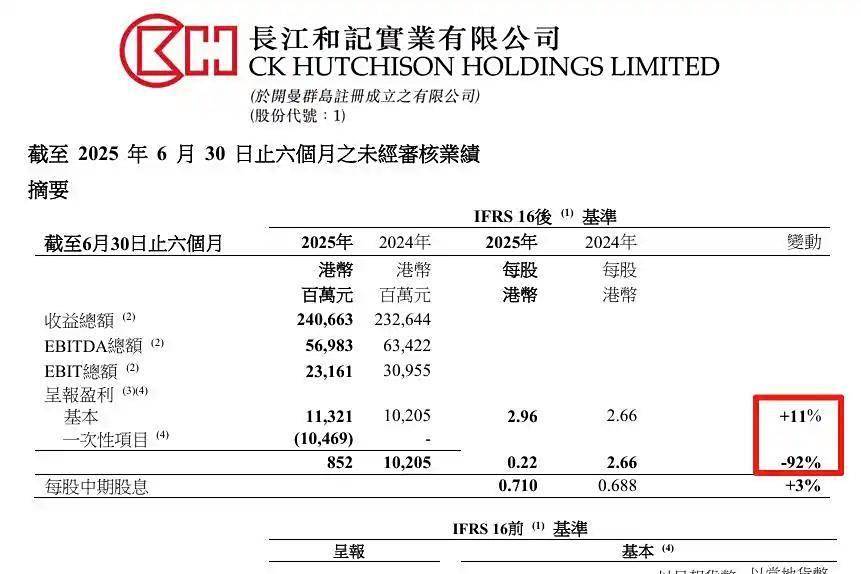
长和集团净利润暴跌92%,李嘉诚懵了!避而不谈卖港口
Sou Hu Cai Jing· 2025-08-16 11:52
Core Viewpoint - The financial report of CK Hutchison Holdings revealed a dramatic 92% drop in net profit, attributed to a one-time non-cash loss from the merger of its UK telecom business, which obscured the underlying growth in core operations [1][3]. Financial Performance - The company's net profit attributable to ordinary shareholders for the first half of 2025 was only HKD 852 million, down from HKD 10.205 billion in the previous year [2]. - Excluding the one-time non-cash loss of HKD 10.469 billion, the actual profit would have been HKD 11.321 billion, reflecting an 11% year-on-year increase [1][2]. - Total revenue for the first half of 2025 was HKD 240.663 billion, compared to HKD 232.644 billion in 2024 [2]. Strategic Moves - The company has remained silent on a significant transaction involving the sale of 43 ports valued at USD 22.8 billion to a BlackRock consortium, indicating a strategic adjustment in response to regulatory pressures [5]. - The management hinted that the transaction would be postponed until after 2025 and is seeking to involve major mainland investors [5]. Business Segments - The port division reported revenue of HKD 235.97 billion, a 9% increase, with significant growth in storage revenue from Mexico and Europe [7]. - Retail business revenue grew by 8%, driven by strong sales of health and beauty products in the UK and Poland [7]. Challenges - The retail business in mainland China showed weak performance due to sluggish consumer spending, and the real estate sector faced significant challenges, with a 92% drop in sales revenue in Hong Kong [7]. - The vacancy rate in Hong Kong's office market reached a historical high of 17%, reflecting the struggles of the real estate segment [7]. Cash Management Strategy - The company emphasized a cautious approach to capital expenditure and new investments, maintaining strict cash flow management [8]. - As of June 30, the total cash and liquid investments amounted to HKD 1,372.68 billion, with a net debt to total capital ratio of 14.7% [10]. - The merger with the UK telecom business generated approximately HKD 13 billion in cash, contributing to a substantial "cash moat" for the company [10].


A股市场运行周报第54期:认准“系统性‘慢’牛”格局,看中长、略短期-20250816
ZHESHANG SECURITIES· 2025-08-16 08:57
Core Viewpoints - The A-share market is experiencing a "systematic slow bull" pattern, with the Shanghai Composite Index breaking through the 2024 high of 3674, indicating a potential target of 3731, the peak of the 2021 structural bull market [1][4][57] - The report emphasizes a balanced allocation strategy focusing on "large finance + broad technology" sectors, suggesting to increase short and medium-term positions near key support levels [1][5][58] Weekly Market Overview - Major indices recorded positive returns, with the Shanghai Composite Index rising 1.70%, and the ChiNext Index showing a significant increase of 8.58% [12][55] - The financial and technology sectors are driving market performance, with comprehensive financial and non-bank financial sectors rising by 7.07% and 6.57% respectively [15][55] - The real estate sector showed signs of recovery, with a 3.79% increase, while the red-chip style weakened, with banks dropping by 3.22% [56] Market Sentiment and Capital Flow - The average daily trading volume in the Shanghai and Shenzhen markets increased to 2.08 trillion yuan, up from 1.68 trillion yuan the previous week [23] - The margin trading balance rose to 2.05 trillion yuan, with a financing buy-in ratio of 10.6% [30] - The medical ETF saw the highest net inflow of 1.42 billion yuan, while the electronic ETF experienced the largest outflow of 2.38 billion yuan [30] Market Attribution - Key events influencing the market include the suspension of the 24% tariff by the US and China for 90 days, and the introduction of "dual interest subsidy" policies to support consumer markets [3][51][55] - The Consumer Price Index (CPI) showed a mild recovery, indicating signs of demand-side improvement [55] Future Market Outlook - The report anticipates continued upward momentum in the market, with the Shanghai Composite Index expected to target 3731, while emphasizing the importance of key support levels at the 20-day and 60-day moving averages [4][57] - The "systematic slow bull" nature of the current market suggests that sectors that are relatively undervalued will eventually be validated [57] Investment Strategy - The report recommends a balanced allocation strategy focusing on "large finance + broad technology," while also increasing attention to previously lagging sectors like real estate [5][58] - Investors are advised to avoid short-term trading strategies that could lead to missed opportunities and instead focus on building positions near key support levels [5][58]
[8月15日]指数估值数据(大盘上涨,回到4.5星;这轮牛市跟哪一轮比较像;抽奖福利)
银行螺丝钉· 2025-08-15 14:04
Core Viewpoint - The current market trend shows a rapid rotation between value and growth stocks, reminiscent of the market dynamics observed from 2013 to 2017, with potential for various sectors to experience upward momentum [4][5][6][26]. Market Performance - The overall market closed higher today, returning to a rating of 4.5 stars, with small and mid-cap stocks showing more significant gains compared to large-cap stocks [1][2][3]. - The Hong Kong stock market has been relatively sluggish, experiencing a decline today, despite having seen three waves of increases since last September [8][9][10]. Historical Comparison - The current market conditions are compared to the period from 2013 to 2017, where the A-share market faced a bear market due to poor fundamentals and declining corporate profits [13][28]. - The introduction of stimulus policies in 2014 led to a significant recovery in the market, particularly in the financial sector, which drove the overall market upward [14][15]. - The years 2016-2017 saw a recovery in the fundamentals of listed companies, leading to a slow bull market for value stocks, while growth stocks experienced a downturn [21][24]. Future Outlook - The market is expected to follow a similar trajectory to 2013-2014, with a potential recovery in corporate fundamentals anticipated in the latter half of 2024, coinciding with expected interest rate cuts by the Federal Reserve [28][29][30]. - The first wave of the upcoming market rally is likely to be led by the financial sector, with small-cap and technology stocks expected to follow suit in 2025 [31][32]. Investment Strategy - The investment approach remains consistent: buy during market dips and sell during peaks, while maintaining patience for optimal exit opportunities [45][47]. - The prolonged bear market from 2022 to 2024 has provided ample opportunities for accumulating quality assets through systematic investment [46].