Qi Huo Ri Bao

Search documents
棕榈油仍处下跌通道中
Qi Huo Ri Bao· 2025-11-07 00:27
Core Viewpoint - The September supply and demand report from the Malaysian Palm Oil Board (MPOB) presents a bearish outlook for palm oil, with production declining and inventory levels unexpectedly increasing, leading to a price correction in palm oil futures [1][2]. Group 1: Supply and Demand Dynamics - Malaysian palm oil production in September decreased by 0.73% month-on-month to 1.84 million tons due to rainy weather and holiday impacts [1]. - Exports increased by 7.69% month-on-month to 1.43 million tons, driven by Indonesia's tariff adjustments [1]. - Despite the increase in exports, domestic biodiesel consumption has declined, and rising imports have led to a lower-than-expected apparent consumption, resulting in an increase in inventory levels [1][2]. Group 2: Future Production and Inventory Expectations - In October, Malaysian palm oil production is expected to rise by 6% month-on-month to 1.95 million tons, significantly higher than historical averages [2]. - However, the export growth is slowing, with estimates for October exports ranging between 1.47 million to 1.48 million tons, and inventories are projected to exceed 2.4 million tons by the end of October [2]. Group 3: Market Trends and External Influences - Domestic palm oil procurement remains active, particularly for shipments in November and December, but terminal demand is weak due to the price gap between soybean oil and palm oil [3]. - India's palm oil purchasing has slowed down, with a shift towards soybean and sunflower oil due to reduced export tariffs from Argentina, leading to a decrease in palm oil market share in India [3][6]. - The overall market sentiment is bearish, driven by declining demand expectations for biodiesel and edible oil exports, alongside better-than-expected production in major producing regions [8]. Group 4: Policy and Economic Considerations - Indonesia's B50 biodiesel policy is set to be implemented in the second half of 2026, with expected biodiesel distribution increasing significantly, but there are concerns about inflation and funding shortages [4]. - The palm oil fund is projected to have a balance of $2.4 billion by the end of 2023, but this is expected to decline significantly by the end of 2025 due to rising subsidy costs [5].
低库存支持菜粕走强
Qi Huo Ri Bao· 2025-11-07 00:27
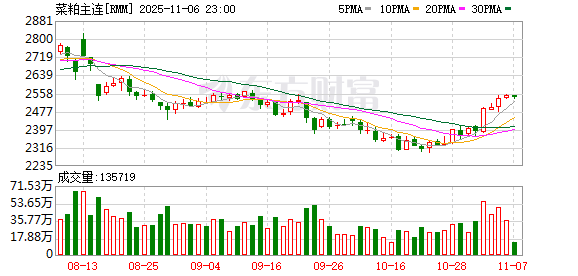
Core Viewpoint - The recent decline in temperature along the Yangtze River has led to a seasonal exit of aquaculture and a decrease in demand for rapeseed meal, but low inventory levels and supply tightness due to trade friction are supporting a rebound in rapeseed meal prices [2][5]. Group 1: Supply and Import Trends - China's rapeseed meal supply has contracted significantly, with a year-on-year decrease of 21.8% from January to September [3]. - During the same period, rapeseed imports fell by 42.2%, totaling 2.446 million tons, with imports from Canada dropping from 4.008 million tons to 2.33 million tons, a decline of 41.9% [3]. - The share of Canadian rapeseed meal in China's total imports has decreased from 72% to 49% year-on-year [3]. Group 2: Processing and Production Challenges - Domestic rapeseed oil mills are experiencing increased shutdowns despite high theoretical crushing profits, primarily due to rising import costs from anti-dumping policies and concerns over stringent inspections [4]. - The rapeseed crushing volume in October was only about 150,000 tons, and production is expected to remain low until the end of the year [4]. Group 3: Price Dynamics - Despite being in a traditional demand slump, low inventory levels are providing effective support for rapeseed meal prices, with coastal oil mills' rapeseed inventory dropping to a historical low of 6,000 tons by the end of October [5]. - The market is facing a tight supply of usable rapeseed meal, exacerbated by high costs due to a 100% anti-dumping tariff on Canadian rapeseed meal [5]. - Overall, while domestic demand for rapeseed meal is weak, low import volumes are likely to sustain low inventory levels, suggesting that rapeseed meal prices may strengthen and move away from historical lows [5].

预期提振 国内外豆价联动上涨
Qi Huo Ri Bao· 2025-11-07 00:20
Group 1 - The domestic and international soybean markets have shown significant upward momentum since October 15, driven by expectations of Chinese trade procurement, with U.S. Chicago CBOT soybean prices reaching a 15-month high, surpassing 1100 cents per bushel [1] - The increase in soybean meal prices is attributed to rising import costs and the recovery of domestic oil mill margins, leading to accelerated procurement of forward soybeans [1] - As of November 4, the procurement completion rate for December shipment soybeans was 38.1%, with 40% being U.S. soybeans and 60% Brazilian soybeans, while the January shipment procurement rate remains in single digits, primarily for U.S. soybeans [1] Group 2 - The current price structure in the domestic futures market shows a near strong and far weak trend, with U.S. soybean import tariffs remaining higher than those for Brazilian soybeans, making Brazilian soybeans more attractive for domestic commercial purchases [2] - Analysts expect U.S. soybean prices to remain strong with fluctuations, particularly with the upcoming USDA report on November 15, which is anticipated to lower U.S. soybean yield, total exports, and ending stock projections [2] - The domestic soybean meal market faces dual pressures, with high crushing volumes exceeding 9 million tons in November and ample spot supply, alongside hedging pressures from overseas procurement by oil mills [2] Group 3 - Soybean oil prices are less affected by trade policies and primarily follow the trends of the oilseed sector, with limited downside potential due to current low price levels [3] - Future soybean oil price movements will depend on factors such as China's imports of U.S. soybeans, reserve auction policies, and changes in Indonesian palm oil production and inventory [3]
成本支撑增强 沪钢后市有望反弹
Qi Huo Ri Bao· 2025-11-07 00:19
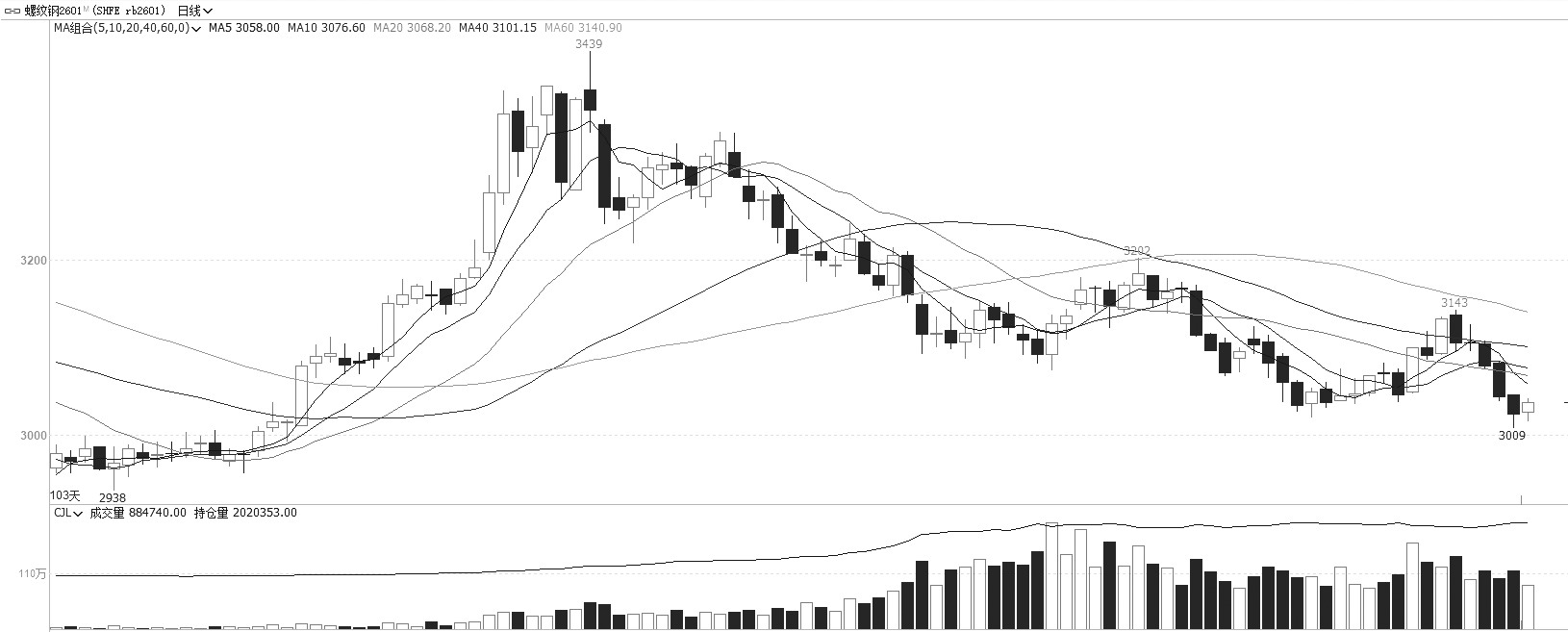
Group 1: Market Trends - In October, rebar and hot-rolled coil prices showed a trend of initially declining and then rebounding, driven by high inventory and weak demand in the first half, followed by macroeconomic improvements and inventory destocking in the latter half [1] - Looking ahead to November, demand may weaken marginally due to seasonal factors, but the extent is expected to be limited, with five major steel products likely to continue destocking [1] Group 2: Production and Capacity - The Ministry of Industry and Information Technology revised the capacity replacement implementation measures, tightening the replacement ratio requirements, indicating that steel production capacity will face strict constraints in the medium to long term [2] - Daily molten iron output decreased from 2.4181 million tons at the beginning of October to 2.3636 million tons by the end of the month, with expectations of further declines in November due to demand expectations and profit conditions [2] Group 3: Export Performance - From January to September 2025, China's cumulative steel exports reached 98.6964 million tons, a year-on-year increase of 17.14%, with September exports at 11.9593 million tons [3] - The export willingness of steel mills has increased due to a lack of significant domestic demand growth, and it is expected that direct steel exports will remain at a high level in November and December [3] Group 4: Domestic Demand - Overall domestic demand remains stable, with real estate demand for steel continuing to be weak, but infrastructure steel demand may see some recovery towards the end of the year [4] - Manufacturing investment showed a year-on-year growth of 4% from January to September 2025, indicating resilience in the sector [4] Group 5: Inventory Dynamics - Steel prices rebounded in July and August due to policy support, leading to high inventory levels for rebar and hot-rolled coils, but inventory destocking has been slow in September and October [5] - The last two weeks of October saw a resumption of destocking for rebar, suggesting that inventory pressure may gradually ease in November [5] Group 6: Raw Material Support - Raw material prices are expected to remain strong in November, driven by downstream restocking expectations, with low coal and coke inventories and slow recovery in domestic supply [6] - Iron ore prices are supported by a high basis and global pricing dynamics, benefiting from overseas interest rate cuts and macroeconomic improvements [6] Group 7: Price Outlook - Short-term steel prices are expected to continue adjusting due to concerns over inventory and demand, but with rising exports, domestic policy expectations, and strong cost support, the downside for rebar and hot-rolled coil prices is limited, with a rebound anticipated in November [8]
供应宽松制约生猪上涨空间
Qi Huo Ri Bao· 2025-11-07 00:17
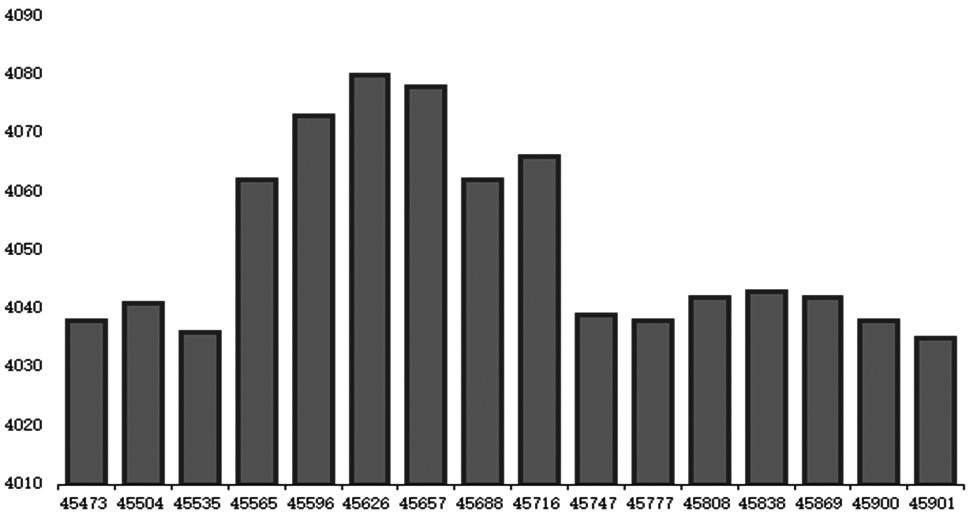
近期,国内生猪现货市场在经历短暂反弹后再次调头下行,期货市场亦同步走弱。截至10月31日,生猪期货主力2601合约收盘价较前期反 弹高点下跌约5%,反映出市场情绪再度趋于谨慎。本轮猪价"止涨转跌"并非孤立现象,而是基本面供应充裕、需求边际转弱等多重因素共 同作用的结果,预示着四季度中后期猪价仍将面临一定的供应压力。 能繁母猪存栏偏高奠定供应基础 从生猪生长的周期来看,能繁母猪存栏水平决定了10个月后市场的生猪供应潜力。根据农业农村部发布的数据,2024年四季度至2025年三 季度末,全国能繁母猪存栏量持续维持在4000万头以上,高于农业农村部设定的3900万头正常保有量。这一数据表明,能繁母猪产能仍处 于相对宽松区间,为后续商品猪供应提供了坚实基础。 图为能繁母猪存栏量(单位:万头) 企业建库意愿降低与消费提振递减 在国庆后的一轮反弹中,猪价逐渐逼近行业完全成本线,部分利好因素开始减弱甚至消退。 1.冻品入库经济性明显下降 在猪价跌破现金流成本线时,部分屠宰企业倾向于将鲜肉转为冻肉储备,以此平衡市场供应,并博取远期猪价上涨的利润。然而,随着近 期猪价反弹至行业平均养殖完全成本线附近,冻品入库的经济性显著下降。 ...
供应端压力显著 PVC向下测试支撑
Qi Huo Ri Bao· 2025-11-07 00:12
Core Viewpoint - The PVC market is currently facing significant pressure due to high social inventory and weak demand, leading to a potential test of historical low price support levels [1] Group 1: Social Inventory - PVC social inventory remains high, with a slight month-on-month decrease of 0.5% to 1.03 million tons by the end of October, but a year-on-year increase of 25.09% [3] - The East China region holds 0.9716 million tons of inventory, down 0.57% month-on-month but up 25.95% year-on-year, while South China shows an increase of 0.54% month-on-month to 0.0584 million tons, with a year-on-year rise of 12.30% [3] - High inventory levels are a key factor suppressing PVC prices, with the accumulation occurring even during the traditional consumption peak season [2][5] Group 2: Demand Side - The real estate sector, a major downstream market for PVC, remains sluggish, with significant year-on-year declines in investment, new construction, completion, and sales areas [4] - Although there has been a slight increase in operating rates for pipe and profile manufacturers due to promotions, the overall demand growth potential is limited, failing to provide effective support for PVC prices [4] - Despite challenges, PVC exports have surged, with a cumulative export volume of 3.3941 million tons from January to September, marking a year-on-year increase of 47.78% [4] Group 3: Production and Pricing - Domestic PVC production remains high, with an operating load of 78.26% as of October 31, consistent with levels from 2023 and 2024 [2] - The unit loss for calcium carbide-based PVC producers has reached 770 yuan per ton, while ethylene-based PVC losses have narrowed to approximately 475 yuan per ton [2] - The overall weak market for PVC is expected to persist, with supply pressures and high social inventory continuing to dominate, despite some cost support from stable calcium carbide prices [5]
深夜,美股、欧股集体大跌!美联储大消息,降息生变!预期提振,美豆涨势猛烈
Qi Huo Ri Bao· 2025-11-06 23:34
Market Overview - US stock markets experienced a significant decline, with the Dow Jones Industrial Average falling by 0.84%, the S&P 500 dropping by 1.12%, and the Nasdaq Composite decreasing by 1.90% [1][2] - European markets also faced downturns, with the FTSE 100 down by 0.42%, the DAX 30 down by 1.19%, and the CAC 40 down by 1.38% [2] Economic Indicators - Concerns over the job market intensified, with US companies laying off a total of 153,074 workers in October, a 183% increase from September and nearly three times the number from the same month last year, marking the highest October layoffs since 2022 [3] - The US non-farm employment decreased by 9,100 in October, following a previous increase of 33,000 [3] Federal Reserve Policy - The Federal Reserve's officials expressed mixed signals regarding future interest rate cuts, contributing to market volatility [3] - The probability of a 25 basis point rate cut in December is estimated at 70.6%, while the likelihood of maintaining the current rate is 29.4% [4] Commodity Market - Domestic and international soybean prices have seen significant increases since October 15, driven by expectations of Chinese trade purchases [5] - The price of US soybeans reached a 15-month high, surpassing 1,100 cents per bushel, with a notable increase in procurement rates for December shipments [5] - However, the current pricing dynamics suggest that US soybeans may lack competitiveness compared to Brazilian soybeans due to higher import costs [6] Future Outlook - Analysts predict that US soybean prices will remain strong, with attention on the USDA's November supply and demand report expected to lower projections for soybean yield, total exports, and final inventory [6] - The domestic soybean meal market faces dual pressures from high crushing volumes and overseas procurement hedging [6] - The outlook for soybean oil is less affected by US-China trade policies, primarily following the trends of the oilseed sector, with limited downside potential due to current low prices [7]

债市 强势行情不具备持续性
Qi Huo Ri Bao· 2025-11-06 19:31
10月以来,央行中长期投放工具买断式逆回购及中期借贷便利(MLF)继续净投放,在货币政策呵护 下资金面维持宽松格局。10月27日,央行行长宣布将恢复二级市场国债买卖操作,进一步强化资金面合 理充裕预期。在资金面合理充裕背景下,近期债市偏强运行。 在三季度经济继续温和恢复的背景下,稳增长政策适时加力。9月29日,5000亿元新型政策性金融工具 额度获监管部门批复,其中国开行、农发行、进出口行分别获得2500亿元、1500亿元和1000亿元额度。 10月底,5000亿元资金已全部投放完毕,共支持2300多个项目,项目总投资约7万亿元,重点投向数字 经济、人工智能、消费基础设施,以及交通、能源、地下管网建设改造等城市更新领域。此外,中央财 政从地方政府债务结存限额中安排5000亿元,其中2000亿元专项债券额度,专门用于支持部分省份投资 建设,3000亿元支持地方化解存量政府投资项目债务、消化政府拖欠企业账款。 考虑到三季度实际GDP增速达4.8%,累计增速为5.2%,实现全年经济增长目标压力较小。简单测算, 四季度GDP增速实现4.4%就能完成全年5%的增速目标。随着5000亿元新型政策性金融工具启动、5000 ...
2025国际贵金属论坛顺利召开
Qi Huo Ri Bao· 2025-11-06 09:35
Core Insights - The "2025 Tengchong Scientist Forum - New Materials and Industrial Financial Innovation Development Special Event and 2025 Precious Metals Forum" will be held in Shanghai, supported by Galaxy Futures, attracting over 450 guests from relevant fields [1][3] - Ma Kai, Deputy General Manager of Galaxy Futures, highlighted the challenges China faces as the largest consumer and processor of platinum, including resource scarcity and high external dependence [3] - The forum featured discussions on the strategic importance of comprehensive planning for platinum group metals in resource security, supply stability, application expansion, efficient recycling, and market trading [3] Financial and Industry Perspectives - Three key pathways were proposed to leverage finance for industrial development: using financial tools to support stable growth, empowering through in-depth research to accurately grasp market trends, and building data systems to enhance industry operations [3] - A keynote speech titled "Panorama of the Precious Metals Market: Evolution of Driving Logic and Future Outlook" was delivered by Wang Luchen, a senior researcher at Galaxy Futures [3] - The forum included seven major topics, with contributions from various domestic and international academicians and industry experts, covering areas such as hydrogen energy electrochemistry and the macroeconomic outlook between China and ASEAN [3] Parallel Sessions - Three parallel sub-forums were held, focusing on "New Technologies and Applications of Precious Metals," "Recycling and Value Management of Precious Metal Resources," and "'Precious Metals + AI' New Technologies and Applications" [3] - A total of 18 thematic reports were presented during these sub-forums, showcasing cutting-edge explorations and practical achievements in the integration of technology, industry, and finance within the precious metals sector [3]

国际油价跌势放缓
Qi Huo Ri Bao· 2025-11-06 00:35
从供应端来看,一方面,虽然欧佩克+近期宣布暂停2026年1月到3月的增产计划,使最近油价跌势放缓,但截至2025年12月 底,欧佩克+增产规模依然超过300万桶/日。目前,欧佩克+产油国产量以及中东地区原油出口量都有明显增长。另一方 面,美国等非欧佩克+产油国的原油产量也在稳步增长,巴西、挪威等国家产量创新高。 图为巴西原油产量及产能 国庆假期结束后,原油市场波动加大,国际油价先抑后扬,随后进入横盘震荡阶段。10月初,国际油价大幅下跌,布伦特原 油期货价格一度跌破60美元/桶,WTI原油期货价格最低触及55.96美元/桶。随后,美国对俄罗斯实施新制裁,引发市场对 俄油供应中断的担忧,国际油价快速反弹。11月2日,欧佩克+增产"刹车",国际油价跌势放缓。 综上所述,虽然欧佩克+暂停了2026年1月到3月的增产计划,缓解了供应压力,但中长期供大于求的市场格局未变,油价仍 然存在下跌风险。 编辑:张瑶 图为挪威原油产量及产能 俄乌冲突方面,10月中下旬,特朗普取消匈牙利布达佩斯会谈,转而对俄罗斯卢克石油公司与俄罗斯石油公司实施制裁。虽 然俄罗斯10月原油出口并未受到明显影响,但后续若关键的石油港口和管道持续受到乌克 ...