
有色金属

Search documents
市场分析:电池有色行业领涨,A股震荡上行
Zhongyuan Securities· 2026-03-27 11:07
Investment Rating - The industry is rated as "outperforming the market," indicating an expected increase of over 10% in the industry index relative to the CSI 300 index over the next six months [15]. Core Insights - The A-share market experienced a low opening followed by a slight upward trend, with significant performance from sectors such as batteries, energy metals, non-ferrous metals, and chemical pharmaceuticals, while sectors like electricity, insurance, banking, and aerospace equipment showed weaker performance [3][4][8]. - The average price-to-earnings ratios for the Shanghai Composite Index and the ChiNext Index are 16.08 times and 46.21 times, respectively, which are above the median levels of the past three years, suggesting a favorable environment for medium to long-term investments [4][14]. - The total trading volume on the two exchanges was 18,640 billion, which is above the median of the past three years, indicating robust market activity [4][14]. - Key market pressures stem from overseas factors, particularly the potential escalation of conflicts in the Middle East, which could lead to rising oil prices and increased global stagflation pressures [4][14]. - Domestic macroeconomic policies are becoming clearer, providing a solid support base for the market, with the central bank committing to maintaining adequate liquidity through various tools [4][14]. - The report suggests that investors should closely monitor macroeconomic data, changes in overseas liquidity, and policy developments, with a short-term focus on investment opportunities in batteries, energy metals, non-ferrous metals, and power equipment sectors [4][14]. Summary by Sections A-share Market Overview - On March 27, the A-share market opened low but rose slightly, with the Shanghai Composite Index facing resistance around 3,924 points. The market showed a general upward trend throughout the day, with over 80% of stocks rising, particularly in energy metals, chemical pharmaceuticals, and medical services [8][10]. - The Shanghai Composite Index closed at 3,913.72 points, up 0.63%, while the Shenzhen Component Index closed at 13,760.37 points, up 1.13% [8][10]. Future Market Outlook and Investment Recommendations - The report anticipates that the Shanghai Composite Index will likely maintain a fluctuating trend, advising investors to pay attention to macroeconomic indicators and policy changes [4][14]. - Short-term investment opportunities are highlighted in sectors such as batteries, energy metals, non-ferrous metals, and power equipment [4][14].
研究所晨会观点精萃-20260327
Dong Hai Qi Huo· 2026-03-27 09:41
1. Report Industry Investment Rating No information provided in the text. 2. Core Viewpoints of the Report - Overseas, there are doubts about the so - called US - Iran peace talks. The US is reported to be formulating a "fatal blow" military plan against Iran, and Iran believes the US negotiation stance is a "third deception" plan. Oil prices have risen again, the Fed's interest - rate hike expectations have resurfaced, the US dollar index and US Treasury yields have strengthened significantly, and global risk appetite has cooled significantly. Domestically, the Chinese economy rebounded better than expected from January to February, exports far exceeded expectations, and inflation continued to recover. The goals and policy intensity in the government work report for 2026 are lower than those in 2025. The short - term trading logic of the market focuses on Middle - East geopolitical risks. In the short term, the domestic economy is better than expected, but due to the mixed geopolitical news in the Middle East, the stock index fluctuates weakly and with increased volatility. [3][4] - For assets, the stock index fluctuates weakly and with increased volatility in the short term, and it is advisable to wait and see cautiously; government bonds fluctuate in the short term, and it is advisable to wait and see cautiously; in the commodity sector, black metals fluctuate weakly in the short term, and it is advisable to wait and see cautiously; non - ferrous metals fluctuate weakly in the short term, and it is advisable to wait and see cautiously; energy and chemical products fluctuate significantly in the short term, and it is advisable to go long cautiously; precious metals fluctuate significantly and weaken in the short term, and it is advisable to wait and see cautiously. [3] 3. Summary by Relevant Catalogs 3.1 Macro - finance - Overseas, doubts about the US - Iran peace talks, rising oil prices, resurgent Fed interest - rate hike expectations, strengthening of the US dollar index and US Treasury yields, and cooling of global risk appetite. Domestically, the economy and inflation are better than expected in January - February, and the goals and policy intensity in 2026 are lower than in 2025. The short - term stock index fluctuates weakly and with increased volatility. [3] - Asset suggestions: short - term cautious wait - and - see for stock indices, government bonds, black metals, non - ferrous metals, and precious metals; short - term cautious long - position for energy and chemical products. [3] 3.2 Stock Index - Affected by sectors such as insurance, communication services, and photovoltaics, the domestic stock market continued to decline significantly. The economy and inflation are better than expected from January to February, and the goals and policy intensity in 2026 are lower than in 2025. The short - term trading logic focuses on Middle - East geopolitical risks, and the stock index fluctuates weakly and with increased volatility. It is advisable to wait and see cautiously in the short term. [4] 3.3 Precious Metals - The precious metals market fell on Thursday night. The main contract of Shanghai gold closed at 980.08 yuan/gram, down 2.83%; the main contract of Shanghai silver closed at 16841 yuan/kilogram, down 5.66%. Spot gold restarted its decline, and finally closed down 2.85% at 4377.95 US dollars/ounce; spot silver finally closed down 4.32% at 68.11 US dollars/ounce. Precious metals fluctuate significantly and weaken in the short term, and it is advisable to wait and see cautiously. [5] 3.4 Black Metals - **Steel**: The domestic steel futures and spot markets declined slightly on Thursday, and the trading volume was low. The real demand improved marginally, the apparent consumption of five major steel products increased by 19.49 tons week - on - week, and the inventory decline continued to expand. The supply decreased slightly this week, but the molten iron output increased. The steel market will follow the cost in the short term, and attention should be paid to the price adjustment risk after the cost decline. [6][7] - **Iron Ore**: The spot price of iron ore rebounded significantly on Thursday, and the futures performance was relatively strong. There are rumors of setbacks in iron ore negotiations. The demand for iron ore is still resilient, and the supply has increased. It is expected that the room for further price increase is limited, and attention should be paid to the phased adjustment risk after the energy price weakens. [7] - **Silicon Manganese/Silicon Iron**: The spot prices of silicon iron and silicon manganese rebounded on Thursday, and the futures continued to fluctuate. The alloy prices were supported by the rebound of crude oil prices. The operating rate of silicon manganese increased slightly, and the daily output decreased slightly. The steel procurement in March has basically ended, and the market is waiting for the situation in April. It is advisable to treat the futures prices of silicon iron and silicon manganese with a slightly bullish and fluctuating mindset. [8] 3.5 Non - ferrous Metals and New Energy - **Copper**: The copper spot TC is close to - 70 US dollars/ton, a new low. The by - product income makes up for the smelting profit. The refined copper production growth rate is high. The core contradiction lies in the mine end. The inventories at home and abroad are accumulating, and the social inventory has decreased significantly. The sustainability of inventory reduction needs to be observed. [9] - **Aluminum**: On Thursday, due to Iran's opposition to the US proposal, the risk appetite decreased, but the aluminum price was supported. The domestic primary aluminum production increased significantly from January to February, and the pattern of weak domestic and strong overseas may change temporarily. The domestic primary aluminum import remains high, and the supply pressure still exists. [9] - **Zinc**: The domestic zinc ingot inventory continued to decline to 21.44 tons on Thursday, but it is still at a high level in recent years. The zinc ore processing fees in some regions have rebounded, and the domestic smelting output remains relatively high. The demand is not optimistic. [9][10] - **Lead**: The imports of refined lead and crude lead increased significantly from January to February. The production of primary lead and secondary lead increased seasonally. The demand is entering the off - season, and the social inventory of primary lead has decreased. The LME lead inventory is at a high level in the same period in recent years. [11] - **Nickel**: Indonesia may levy a windfall tax on nickel from April 1. The core contradiction lies in the mine end. The RKAB quota in 2026 has decreased significantly, and the MHP supply may decline. The nickel price has support below, but the upside is limited due to high inventories at home and abroad. [12] - **Tin**: The imports of tin ore from Myanmar increased significantly in the first two months, and the import sources are more diversified. The demand is not good overall, but the social inventory has decreased due to downstream replenishment. [13] - **Lithium Carbonate**: The main contract of lithium carbonate fell 0.64% on Thursday. The supply and demand are both strong, and the social inventory is continuously decreasing. It is expected to fluctuate in the support range, and it is advisable to lay out positions at low prices. [14] - **Industrial Silicon**: The main contract of industrial silicon rose 0.58% on Thursday. The supply and demand are both weak, the production capacity is surplus, and the inventory is at a high level. It is priced close to the cost, and it is advisable to operate within the range. [15] - **Polysilicon**: The main contract of polysilicon fell 2.78% on Thursday. The inventory is continuously accumulating at a high level, and the spot price is falling. It is expected to fluctuate weakly, and it is advisable for short - sellers to hold positions cautiously or take profits in a timely manner. [15] 3.6 Energy and Chemicals - **Crude Oil**: The US sent mixed signals, and the market is not sure if the US - Iran negotiation will end the Middle - East conflict quickly. Trump postponed the strike on Iran's energy facilities by 10 days. The short - term oil price will face a pattern of a slightly rising center and increased volatility. [16] - **Asphalt**: The asphalt price follows the rising oil price, but the downstream is in the off - season, and the demand is affected by high prices. The supply is low, and the short - term absolute price will fluctuate significantly with the oil price. [16] - **PX**: The PX price follows the rising oil price, but the downstream start - up recovery is slow, and it is affected by negative feedback. It is likely to fluctuate in the short term. [17] - **PTA**: The PTA price follows the rising oil price, but the downstream negative feedback is obvious, and the rebound space is limited. It will remain slightly bullish and fluctuating before the oil price rises significantly. [17] - **Ethylene Glycol**: The ethylene glycol price rebounds slightly with the rising oil price. The port inventory reduction is limited, and the export expectation is increasing. The basis has strengthened slightly and is likely to fluctuate after a decline. [18] - **Short - fiber**: The short - fiber price remains slightly bullish and fluctuating with the rising oil price. The downstream production reduction suppresses the recovery space, but it can be supported by the cost in the later stage. [18] - **Methanol**: The inland methanol market is strong, and the port basis has strengthened. The inventory at the port and production enterprises has decreased. The supply has tightened, and the fundamentals have been repaired. The price is still firm, but attention should be paid to the marginal changes caused by geopolitical relaxation and downstream negative feedback. [19] - **PP**: The price of PP is supported by the continuous inventory reduction. The market is expected to remain strong, and the navigation situation in the Strait of Hormuz is the main uncertainty. [20] - **LLDPE**: The LLDPE price is firm. The supply is decreasing, the demand is increasing, and the inventory is being reduced rapidly. It is expected to continue to operate strongly, and geopolitical dynamics are the key variables affecting the external supply. [21] - **Urea**: The domestic urea market is stable. The supply has decreased slightly, the demand shows a pattern of "weak agricultural and strong industrial", and the export policy window is closed. The price is expected to fluctuate within a narrow range. [22][23] 3.7 Agricultural Products - **US Soybeans**: The 05 - month soybean contract on the CBOT market closed down 0.06% overnight. The US soybean export sales increased significantly in the week ending March 19. Attention should be paid to the revised biofuel blending target and the end - of - month planting area report on Friday. [24] - **Soybean and Rapeseed Meal**: The inventory of imported soybeans and soybean meal is decreasing rapidly, supporting the soybean meal basis. The risk of delayed shipment and arrival of Brazilian soybeans still exists. The rapeseed meal inventory has increased, and it fluctuates with the soybean meal. [24] - **Soybean and Rapeseed Oil**: The domestic soybean oil inventory is decreasing rapidly, and the supply is tight in the short term, supporting the basis. The supply pressure of rapeseed oil may increase, and it is under pressure along with soybean and palm oil. [25] - **Palm Oil**: The Malaysian palm oil futures rose 0.35% overnight, supported by the strong Chicago soybean oil price, rising crude oil price, and strong export data. The domestic palm oil import is affected by the inverted profit, and the market transaction is light. [25] - **Corn**: The national corn price adjusts within a narrow range. The futures price fluctuates strongly, supporting the spot market. The sales of grassroots grain sources in the producing areas have slowed down, and the inventory at ports and deep - processing enterprises is low. However, the acceptance of high - priced corn by downstream feed enterprises is decreasing, and the possible rice auction in early April may have a negative impact. [26] - **Hogs**: The pig production capacity is in the pain period of adjustment, the demand is slightly improving but still in the off - season, and the breeding loss is increasing. The short - term futures and spot prices may continue to fall, and there are risks in the futures market. [27][28]
行业轮动双周度跟踪:边际增持有色、钢铁、医药(2026年03月24日期)-20260327
SINOLINK SECURITIES· 2026-03-27 08:23
1. Report Industry Investment Rating - No information provided in the given content 2. Core Viewpoints of the Report - As of March 22, 2026, the model recommends investing in non - ferrous metals, media, communication, steel, non - bank finance, and pharmaceutical biology, with marginal increases in non - ferrous metals, steel, and pharmaceutical biology. Non - bank finance, steel, and communication are mainly driven by expected boosts, while non - ferrous metals, media, and pharmaceutical biology are mainly driven by price - volume reversals and capital flows [2] - The industry rotation model assesses market micro - structure from fundamental, price - volume, and sentiment dimensions, and constructs a strategy using 7 relatively effective factors [2] 3. Summary by Relevant Catalogs 3.1 Industry Rotation Model and Recommended Industries - The industry rotation model analyzes from three dimensions: fundamentals, price - volume, and sentiment. It back - tests original factors bi - weekly and expands price - volume factors from multiple dimensions, ultimately selecting 7 factors to build a strategy [2] - Recommended industries are non - ferrous metals, media, communication, steel, non - bank finance, and pharmaceutical biology, with marginal increases in non - ferrous metals, steel, and pharmaceutical biology [2] 3.2 Industry ETF Portfolio - The industry ETF portfolio includes Southern China Securities Shenwan Non - Ferrous Metals ETF, GF China Securities Media ETF, Guotai China Securities All - Index Communication Equipment ETF, Guotai China Securities Steel ETF, E Fund CSI 300 Non - Bank Financial ETF, and E Fund CSI 300 Medical and Health ETF [4] - Details of each ETF, such as weight, year - end scale, institutional investors, trading volume, and returns, are provided. For example, the Southern China Securities Shenwan Non - Ferrous Metals ETF has a weight of 16.67%, a year - end scale of 20.591 billion yuan, and a one - year return of 77.03% [5] 3.3 Performance of the Industry Rotation Strategy - The industry rotation strategy declined 1.18% in the past two weeks, with an excess return of 3.18%. The excess return in the past year was 20.68%, the Sharpe ratio was 1.93, and the Calmar ratio was 3.83 [5][7] 3.4 Strategy/Composite Factor Back - testing Results - Different factors (price - volume, fundamental, and sentiment) have different IC means, IC standard deviations, ICIRs, and frequencies of IC>0. For example, the成交均价因子 has an IC mean of 4.02% and an ICIR of 15.14% [10] - After optimization, the composite factor has an IC mean of 7.81%, an ICIR of 32.49%, and a frequency of IC>0 of 46.64% [10]
粤开市场日报-20260327-20260327
Yuekai Securities· 2026-03-27 07:55
Market Overview - The A-share market showed a general upward trend today, with the Shanghai Composite Index rising by 0.63% to close at 3913.72 points, and the Shenzhen Component Index increasing by 1.13% to 13760.37 points. The ChiNext Index rose by 0.71% to 3295.88 points, while the STAR Market 50 Index increased by 0.93% to 1300.76 points. Overall, 4335 stocks rose while 1070 stocks fell, with a total trading volume of 1853.3 billion yuan, a decrease of 90.3 billion yuan from the previous trading day [1][10]. Industry Performance - Among the Shenwan first-level industries, the leading sectors included pharmaceuticals and biotechnology, non-ferrous metals, basic chemicals, beauty care, and agriculture, forestry, animal husbandry, and fishery, with respective increases of 3.70%, 2.88%, 2.55%, 1.86%, and 1.81%. Conversely, the utilities, telecommunications, banking, coal, and household appliances sectors experienced declines, with decreases of 0.78%, 0.56%, 0.50%, 0.23%, and 0.05% respectively [1][12]. Concept Sector Performance - The concept sectors that saw the highest gains today included lithium mining, lithium battery electrolytes, lithium extraction from salt lakes, innovative drugs, Contract Research Organizations (CRO), generic drugs, antibiotics, Tibet revitalization, weight loss drugs, biotechnology, selected medical services, vitamins, small metals, medical supplies exports, and semiconductor materials [2][11].
有色期权早报-20260327
Wu Kuang Qi Huo· 2026-03-27 05:56
Report Industry Investment Rating - Not provided in the content Core Viewpoints - The implied volatility of various有色金属 options (aluminum alloy, aluminum, alumina, copper, nickel, lead, tin, zinc) maintains fluctuations above the mean level of 0.0000 [6][18][30][42][54][66][78][90] - Different options have different pressure and support levels, and the positions of the PCR of option positions are also different, which can be used as a reference for investment decisions [6][18][30][42] Summary by Relevant Catalogs 1. Aluminum Alloy (AD) - **Futures Market Data**: The ad2604 contract closed at 22930 yuan yesterday, up 230 yuan or 1.01% from the previous day. The trading volume was 4542 lots, a decrease of 686 lots from the previous day, and the open interest was 3563 lots, a decrease of 490 lots from the previous day [6] - **Option Factor - Volume and Position PCR**: The trading volume of AD (aluminum alloy call option) was 35, with a change of 264; the open interest was 542, with a change of 198. The trading volume of AD (aluminum alloy put option) was 316, with a change of -127; the open interest was 367, with a change of 38 [4] - **Option Factor - Pressure and Support**: The pressure level of AD (aluminum alloy option) is 26600, and the support level is 21200. The weighted implied volatility is 21.91%, with a change of -6.07%, and the annual average implied volatility is 13.76% [5] - **Option Strategy Suggestion**: Directional strategy: None; Volatility strategy: Construct a short call + put option combination strategy to obtain option time - value income, and dynamically adjust the positions to keep the delta of the positions neutral, such as S_AD2605P22400, S_AD2605C23800 [7] 2. Aluminum (AL) - **Futures Market Data**: The al2605 contract closed at 23860 yuan yesterday, up 150 yuan or 0.63% from the previous day. The trading volume was 314226 lots, a decrease of 34252 lots from the previous day, and the open interest was 266870 lots, an increase of 5712 lots from the previous day [18] - **Option Factor - Volume and Position PCR**: The trading volume of AL (aluminum call option) was 30171, with a change of -88928; the open interest was 50776, with a change of 3113. The trading volume of AL (aluminum put option) was 21761, with a change of 30691; the open interest was 31480, with a change of 4266 [16] - **Option Factor - Pressure and Support**: The pressure level of AL (aluminum option) is 26200, and the support level is 23000. The weighted implied volatility is 21.85%, with a change of -2.47%, and the annual average implied volatility is 16.74% [17] - **Option Strategy Suggestion**: Directional strategy: None; Volatility strategy: Construct a short call + put option combination strategy to obtain option time - value income, and dynamically adjust the positions to keep the delta of the positions neutral, such as S_AL2605P23000, S_AL2605P23400, S_AL2605C25000, S_AL2605C26000 [19] 3. Alumina (AO) - **Futures Market Data**: The ao2605 contract closed at 2963 yuan yesterday, down 65 yuan or 2.14% from the previous day. The trading volume was 568924 lots, an increase of 43246 lots from the previous day, and the open interest was 220782 lots, a decrease of 10697 lots from the previous day [30] - **Option Factor - Volume and Position PCR**: The trading volume of AO (alumina call option) was 40972, with a change of -102303; the open interest was 76789, with a change of 8762. The trading volume of AO (alumina put option) was 14459, with a change of -87559; the open interest was 26643, with a change of 3034 [28] - **Option Factor - Pressure and Support**: The pressure level of AO (alumina option) is 3500, and the support level is 2800. The weighted implied volatility is 36.52%, with a change of -3.08%, and the annual average implied volatility is 32.88% [29] - **Option Strategy Suggestion**: Directional strategy: Construct a call option bull spread combination strategy to obtain directional income; Volatility strategy: Construct a short call + put option combination strategy to obtain option time - value income, and dynamically adjust the positions to keep the delta of the positions neutral, such as S_AO2605P2800, S_AO2605C3200 [31] 4. Copper (CU) - **Futures Market Data**: The cu2605 contract closed at 95590 yuan yesterday, up 1080 yuan or 1.14% from the previous day. The trading volume was 134036 lots, a decrease of 63951 lots from the previous day, and the open interest was 192458 lots, a decrease of 5937 lots from the previous day [42] - **Option Factor - Volume and Position PCR**: The trading volume of CU (copper call option) was 37678, with a change of -59021; the open interest was 42419, with a change of 2882. The trading volume of CU (copper put option) was 36708, with a change of 28991; the open interest was 38201, with a change of 4301 [40] - **Option Factor - Pressure and Support**: The pressure level of CU (copper option) is 100000, and the support level is 90000. The weighted implied volatility is 28.33%, with a change of -1.24%, and the annual average implied volatility is 23.24% [41] - **Option Strategy Suggestion**: Directional strategy: Construct a put option bear spread combination strategy to obtain directional income, such as B_CU2605P104000, S_CU2605P90000; Volatility strategy: None [43] 5. Nickel (NI) - **Futures Market Data**: The ni2605 contract closed at 136130 yuan yesterday, up 1450 yuan or 1.07% from the previous day. The trading volume was 460381 lots, an increase of 18036 lots from the previous day, and the open interest was 188824 lots, an increase of 7678 lots from the previous day [54] - **Option Factor - Volume and Position PCR**: The trading volume of NI (nickel call option) was 62178, with a change of -85869; the open interest was 28302, with a change of 4892. The trading volume of NI (nickel put option) was 21035, with a change of -35729; the open interest was 15942, with a change of 3790 [52] - **Option Factor - Pressure and Support**: The pressure level of NI (nickel option) is 140000, and the support level is 120000. The weighted implied volatility is 43.65%, with a change of -4.05%, and the annual average implied volatility is 31.22% [53] - **Option Strategy Suggestion**: Directional strategy: None; Volatility strategy: Construct a short call + put option combination strategy with a short - bias to obtain option time - value, and dynamically adjust the positions to keep the delta of the positions short, such as S_NI2605P126000, S_NI2605P130000, S_NI2605C146000, S_NI2605C150000 [55] 6. Lead (PB) - **Futures Market Data**: The pb2605 contract closed at 16495 yuan yesterday, up 50 yuan or 0.30% from the previous day. The trading volume was 57581 lots, an increase of 8292 lots from the previous day, and the open interest was 79125 lots, a decrease of 5853 lots from the previous day [66] - **Option Factor - Volume and Position PCR**: The trading volume of PB (lead call option) was 2284, with a change of -4866; the open interest was 3690, with a change of 614. The trading volume of PB (lead put option) was 2250, with a change of -2610; the open interest was 4632, with a change of 738 [64] - **Option Factor - Pressure and Support**: The pressure level of PB (lead option) is 19600, and the support level is 16200. The weighted implied volatility is 20.07%, with a change of 0.19%, and the annual average implied volatility is 18.37% [65] - **Option Strategy Suggestion**: Directional strategy: None; Volatility strategy: Construct a short call + put option combination strategy to obtain option time - value income, and dynamically adjust the positions to keep the delta of the positions neutral, such as S_PB2605P15800, S_PB2605P16200, S_PB2605C17200, S_PB2605C17600 [67] 7. Tin (SN) - **Futures Market Data**: The sn2604 contract closed at 352430 yuan yesterday, up 6610 yuan or 1.91% from the previous day. The trading volume was 215643 lots, a decrease of 33699 lots from the previous day, and the open interest was 18892 lots, a decrease of 2195 lots from the previous day [78] - **Option Factor - Volume and Position PCR**: The trading volume of SN (tin call option) was 15028, with a change of 140897; the open interest was 9114, with a change of 1574. The trading volume of SN (tin put option) was 8660, with a change of -77629; the open interest was 6212, with a change of 1747 [76] - **Option Factor - Pressure and Support**: The pressure level of SN (tin option) is 450000, and the support level is 300000. The weighted implied volatility is 55.55%, with a change of -2.99%, and the annual average implied volatility is 38.16% [77] - **Option Strategy Suggestion**: Directional strategy: Construct a put option bear spread combination strategy to obtain directional income, such as B_SN2605P360000, S_SN2605P330000; Volatility strategy: None [79] 8. Zinc (ZN) - **Futures Market Data**: The zn2605 contract closed at 22935 yuan yesterday, down 65 yuan or 0.28% from the previous day. The trading volume was 96768 lots, a decrease of 37112 lots from the previous day, and the open interest was 101745 lots, an increase of 153 lots from the previous day [90] - **Option Factor - Volume and Position PCR**: The trading volume of ZN (zinc call option) was 14174, with a change of -12033; the open interest was 18056, with a change of 2928. The trading volume of ZN (zinc put option) was 12047, with a change of -9160; the open interest was 9908, with a change of 1320 [88] - **Option Factor - Pressure and Support**: The pressure level of ZN (zinc option) is 24000, and the support level is 22400. The weighted implied volatility is 17.12%, with a change of -2.07%, and the annual average implied volatility is 17.86% [89] - **Option Strategy Suggestion**: Directional strategy: Construct a put option bear spread combination strategy to obtain directional income, such as B_ZN2605P24200, S_ZN2605P22000; Volatility strategy: None [91]
资金行为研究双周报:杠杆资金多头聚焦公用事业等红利防御板块-20260327
ZHONGTAI SECURITIES· 2026-03-27 05:44
Market Overview - The market shows structural differentiation in capital flow, with large orders' outflow momentum narrowing. Institutional funds exhibit a net outflow from the Wande All A and Sci-Tech Innovation indices, but the outflow momentum has significantly decreased. The ChiNext index shows fluctuating capital flows, indicating a competitive dynamic among institutional funds [2][6][25] - Retail investors maintain a consistent trend, showing a slow net inflow into the Wande All A and ChiNext indices, while remaining cautious towards the Sci-Tech Innovation index [6][25] Capital Flow by Market Capitalization and Valuation Style - Large-cap stocks demonstrate strong support, while small-cap stocks exhibit heightened sensitivity to market fluctuations. Institutional funds have reduced net outflows from high-valuation indices, indicating a shift in market dynamics [17][25] - The recent volatility in the CSI 300 reflects strong market support and pricing power among large-cap stocks, while small-cap stocks are more susceptible to liquidity fluctuations [17][25] Capital Flow by Major Industry Style - Institutional funds are cautiously returning to cyclical manufacturing and consumption sectors, with a notable shift from outflows to inflows in these categories as of March 23. Retail investors continue to heavily invest in cyclical manufacturing [25][62] - The dividend sector shows less volatility, indicating strong stability in this segment during turbulent market conditions [25] Capital Flow by Primary Industry Upstream Resources - Institutional outflows from non-ferrous metals have narrowed, while basic chemicals show a similar trend of reduced outflow. Retail investors are actively accumulating in the non-ferrous metals sector, with their capital scale surpassing other industries [37][40] Midstream Materials & Manufacturing - The electric equipment sector maintains high competitive intensity, with institutional buying power in construction materials showing a temporary increase. Institutional funds have reduced outflows in electric equipment significantly since March 19 [40][62] Downstream Essential Consumption - Institutional funds have not shown significant buying momentum in essential consumption sectors, although the outflow trend has slowed down recently. Notably, there has been substantial outflow from pharmaceuticals and agriculture sectors [47][62] Downstream Discretionary Consumption - In discretionary consumption, institutional funds are showing a fluctuating inflow in light industry manufacturing, while the home appliance sector has shifted from net inflow to net outflow, with recent outflows narrowing [52][62] TMT (Technology, Media, and Telecommunications) - The TMT sector shows slight net inflows in communications, while electronics experience oscillating outflows. The sector is primarily driven by small retail investments [55][62] Large Financials - Institutional interest in non-bank financials has decreased significantly, with retail investors increasing their net inflows in this sector since March 19 [62][68] Support Services - The public utility sector shows significant volatility in institutional capital flow, alternating between net inflows and outflows, highlighting a competitive market dynamic [71][62] Leverage Capital Overview - The margin financing balance has slightly decreased, with the average collateral ratio lowering, indicating that leverage risks remain manageable. As of March 25, the total margin financing and securities lending balance is approximately 2.62 trillion yuan [75][81] - The trading activity in margin financing has declined, with the proportion of margin trading transactions at 9.45%, reflecting a continued adjustment in market sentiment [77][81] - The overall leverage capital holding level has slightly adjusted, with significant declines observed in the oil and gas sector and construction materials, indicating a cooling off from previous highs [81]
盘中拉升!三大板块,涨停潮!
证券时报· 2026-03-27 04:40
Market Overview - A-shares opened lower but rose throughout the day, with major indices collectively increasing and turning positive [1] - The A-share market saw a surge in the non-ferrous metals, pharmaceutical biology, and basic chemicals sectors, leading to a wave of stocks hitting the daily limit [1][4] A-share Performance - By the end of the morning session, the Shanghai Composite Index rose by 0.26%, the Shenzhen Component Index by 0.93%, the ChiNext Index by 0.83%, and the Sci-Tech Innovation Index by 1.08% [4] - The non-ferrous metals sector led the gains with an increase of 2.6%, with multiple stocks hitting the daily limit, including Shenzhen New Star, Haixing Co., Rongjie Co., Yunnan Zhiye, and others [4][5] Pharmaceutical Sector - The pharmaceutical biology sector also performed well, with stocks like Hotgen Biotech, Yinuo Si, Shutaishen, and Huana Pharmaceutical seeing increases of over 10% [6][7] - Notable stocks in this sector included Hotgen Biotech with a rise of 14.70% and Shutaishen with an increase of 11.50% [7] Basic Chemicals Sector - The basic chemicals sector experienced significant gains, with stocks such as Keta Biotech and Shandong Haihua hitting the daily limit [8][9] - Keta Biotech saw a remarkable increase of 19.99%, while other stocks in the sector also posted gains around 10% [9] New Listings - A new stock, Puan Medical, was listed today, with its price surging over 170% at one point during the session [11][12] - Puan Medical specializes in diabetes care and related medical devices, with a projected increase in global insulin pen needle sales from 8.81 billion units in 2022 to 9.97 billion units by 2024 [12] Hong Kong Market - The Hong Kong market experienced narrow fluctuations, with China Longgong's stock surging over 20% during the morning session [13][15] - China Longgong reported a total revenue of RMB 11.215 billion for the year 2025, reflecting a year-on-year growth of 9.81%, with significant contributions from electric loaders and export products [15][16]





恒力期货日报系列-20260327
Heng Li Qi Huo· 2026-03-27 03:33
Report Industry Investment Rating No relevant content provided. Core Viewpoints of the Report The report analyzes multiple industries including oil products, aromatics - polyester, coal chemical, salt chemical, and non - ferrous metals. Geopolitical factors, especially the situation in the Middle East, have a significant impact on the supply and price of various commodities. Market sentiment is complex and volatile, and different industries face different supply - demand situations and price trends. [3][4][6] Summary by Directory 01 Oil Products Crude Oil - **Logic**: Geopolitical news dominates market fluctuations, and Trump has postponed energy strikes. - **Fundamentals**: The shipping volume in the Strait of Hormuz is low, and the export of Russian oil is restricted, leading to a tightening of global crude oil supply. The recovery of shut - down production capacity is uncertain. - **Macro**: The Fed maintains the interest rate at 3.5% - 3.75%, and the market's expectation of a Fed rate cut is rising. The geopolitical situation in the Middle East is tense, and the macro - sentiment is weak. [3] Fuel Oil - **Logic**: Funds are flowing out, and the high - sulfur crack spread is falling. - **Fundamentals**: High - sulfur fuel oil has limited follow - up ability despite strong crude oil. The low - sulfur fuel oil is in a tight supply - demand situation, with supply being tight and demand shifting to Asia. It will continue to be strong but may experience a correction. [6][7] LPG - **Logic**: Geopolitical factors cause repeated disturbances, and there is short - term support. - **Fundamentals**: The international oil price rebound drives the LPG price up. The supply gap in the Middle East cannot be quickly filled, and the price is expected to be easy to rise and difficult to fall in the short term. [8] 02 Aromatics - Polyester PTA - **Logic**: Pay attention to geopolitical progress, and the downstream load has slightly decreased. - **Fundamentals**: The TA2605 contract has risen, the spot basis has strengthened, the PTA load has increased, and the downstream polyester load has decreased. Mainstream polyester filament manufacturers have increased production cuts. [9][10] 03 Coal Chemical Urea - **Logic**: The sentiment is generally stable, with support, but beware of policy pressure. - **Fundamentals**: The positive overseas sentiment and domestic policy pressure offset each other. The inventory has decreased, and the price is expected to remain stable. The supply is at a high level, and the demand is stable. The international price is rising, but the domestic - international price transmission is limited. [11] Methanol - **Logic**: There is still geopolitical uncertainty, but short - term import shortages provide support, and it maintains high - level operation. - **Fundamentals**: The MA2605 contract has risen. The price in the port area has rebounded, and the basis has strengthened. The import in April is expected to be low, and the port inventory may further decrease. [12] 04 Salt Chemical Soda Ash - **Logic**: The cost has increased, but the supply - demand pressure is high. - **Fundamentals**: The increase in coal prices supports the bottom price, but the supply - demand situation lacks effective support. The inventory is at a high level, and the rebound requires supply - side production cuts. [13] Glass - **Logic**: The situation of weak supply and demand continues. - **Fundamentals**: The glass inventory continues to decline, but the market sentiment has cooled. The supply is at a low level, and the price has support at a low level. The improvement in the second - hand housing market may drive the demand for glass. [14][15] Caustic Soda - **Logic**: The supply - demand side has strong support, but the futures valuation is high. - **Fundamentals**: The manufacturer's inventory pressure is small, and the supply - demand support is strong. The impact of the Strait of Hormuz blockade on the supply and demand of caustic soda needs to be continuously monitored. [16] 05 Non - Ferrous Metals Copper - **Logic**: Shanghai copper has a slight increase. - **Fundamentals**: The situation in the Middle East is complex, and the market sentiment changes. The domestic inventory is decreasing, and the cost of copper is supported. The long - term demand for copper in the new energy transformation is positive. [17] Gold - **Logic**: It fluctuates strongly. - **Fundamentals**: The uncertainty of monetary policy and the situation in the Middle East affect the US dollar index. If the US dollar index weakens, it may drive the gold price up. [18] Silver - **Logic**: It fluctuates strongly. - **Fundamentals**: The market focuses on the situation in the Middle East and the Fed's interpretation of inflation expectations. The silver price has temporarily escaped the low point but still faces uncertainties. [19] Appendix: Daily Data Monitoring of Each Sector The appendix provides daily data monitoring of various commodities, including price changes, basis, spreads, and inventory data, which helps to understand the market trends of different commodities. [21][22][23]
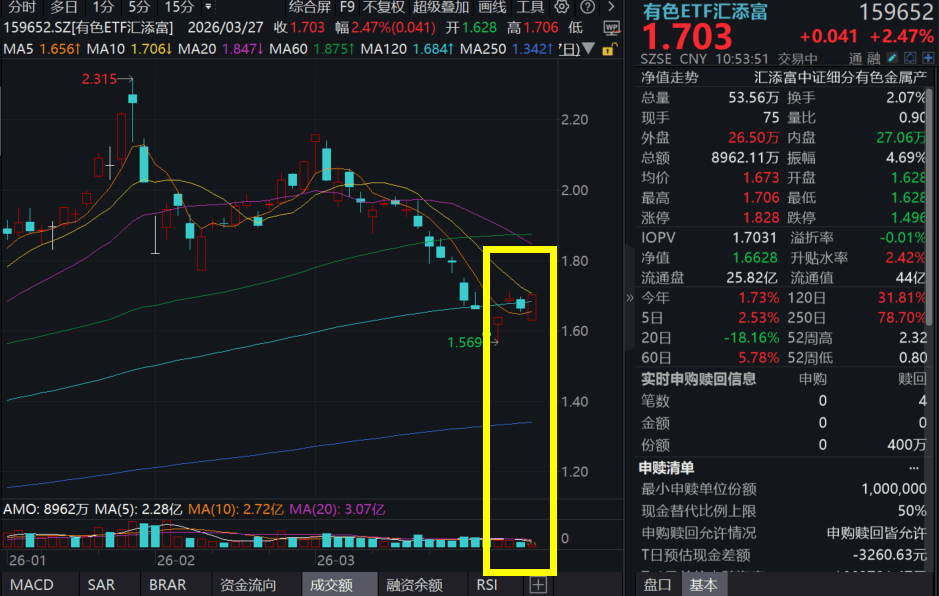
油价高企,新能源转型提速,碳酸锂大涨!赣锋锂业涨超6%,有色ETF汇添富(159652)涨超2%,机会来了?
Sou Hu Cai Jing· 2026-03-27 03:24
Group 1 - The A-share market showed signs of recovery on March 27, with the non-ferrous metal sector rising, particularly the ETF Huatai (159652), which increased by over 2% [1] - Key stocks within the non-ferrous ETF Huatai saw significant gains, including Yunnan Zhenye and Yongxing Materials hitting the daily limit, while Ganfeng Lithium rose over 6% [3] - The top ten constituent stocks of the non-ferrous ETF Huatai include Zijin Mining, Northern Rare Earth, and Ganfeng Lithium, with varying increases in their stock prices [4] Group 2 - The geopolitical situation in the Middle East has influenced metal prices, with COMEX gold futures dropping by 3.85% and LME copper down by 1.64% due to easing risk aversion following the U.S. decision to delay military action against Iran [5] - However, metal prices reversed in the morning session, with COMEX gold futures rising over 1% and LME copper increasing by 0.53% [6] - Analysts from Guojin Securities suggest that the pressure on non-ferrous metals is gradually easing, with market expectations for U.S. monetary policy being overly pessimistic compared to the Federal Reserve's stance [8] Group 3 - The global trend of "de-dollarization" is accelerating, supporting long-term gold prices as central banks continue to buy gold, marking 16 consecutive years of net purchases [8] - Industrial metals are expected to perform well in the long term due to a tightening supply-demand balance, driven by global infrastructure investments and low LME copper inventories [9] - The lithium market is projected to maintain a tight supply-demand balance, with significant growth expected in global electric vehicle sales and energy storage demand [10] Group 4 - The non-ferrous ETF Huatai (159652) is highlighted for its comprehensive coverage of various metal sectors, including gold, copper, aluminum, lithium, and rare earths, positioning it to benefit from the super cycle in non-ferrous metals [10] - The ETF has a high concentration of gold and copper, with 45% combined content, making it a leading choice in its category [12] - The ETF's performance has been driven by earnings rather than valuation, with a PE ratio of 32.30, reflecting a 45% decrease compared to five years ago, indicating a favorable valuation [14]




工业硅期货早报-20260327
Da Yue Qi Huo· 2026-03-27 03:13
1. Report Industry Investment Rating There is no information about the report's industry investment rating in the provided content. 2. Core Views of the Report Industrial Silicon - Supply: Last week, the supply of industrial silicon was 78,000 tons, remaining flat week - on - week. The cost support in the Xinjiang region remained stable, with the cost of sample oxygen - passing 553 silicon at 9,769.7 yuan/ton. The social inventory increased by 1%, and the sample enterprise inventory increased by 27%. The main port inventory decreased by 1.47%. - Demand: Last week, the demand for industrial silicon was 69,000 tons, a 47% week - on - week increase. The silicon wafer production was in a loss state, while the battery cell and component production were in a profitable state. The organic silicon inventory was at a low level, with a production profit of 2,503 yuan/ton and a comprehensive开工 rate of 68.6%, remaining flat week - on - week but lower than the historical average. The aluminum alloy ingot inventory was at a high level, and the regenerative aluminum开工 rate increased by 1.5% to 59%. - Expectation: With an increase in supply scheduling and a low - level demand recovery, and rising cost support, the industrial silicon 2605 is expected to fluctuate in the range of 8,645 - 8,825 yuan/ton [6]. Polysilicon - Supply: Last week, the polysilicon production was 19,000 tons, remaining flat week - on - week. The scheduled production for March is expected to be 84,900 tons, a 10.25% increase compared to the previous month. - Demand: Last week, the silicon wafer production was 11.78 GW, a 1.66% week - on - week decrease, and the inventory was 276,500 tons, a 2.46% week - on - week decrease. Currently, the silicon wafer production is in a loss state. The scheduled production for March is 49.01 GW, a 10.70% increase compared to the previous month. The battery cell production in February was 37.09 GW, a 10.49% month - on - month decrease. The external sales factory inventory of battery cells last week was 6.79 GW, a 16.66% week - on - week increase, and the current production is in a profitable state. The scheduled production for March is 46.36 GW, a 24.99% increase. The component production in February was 29.3 GW, a 16.76% month - on - month decrease. The expected component production for March is 41.39 GW, a 41.26% increase. The domestic monthly inventory decreased by 51.73%, and the European monthly inventory increased by 12.30%. Currently, the component production is in a profitable state. - Cost: The average cost of N - type polysilicon in the industry is 40,060 yuan/ton, with a production income of - 310 yuan/ton. - Expectation: With continuous increase in supply scheduling and overall demand showing a continuous decline, and weakening cost support, the polysilicon 2605 is expected to fluctuate in the range of 34,505 - 36,575 yuan/ton [8][9]. Overall - Bullish factors: Rising cost support and manufacturers' plans for production suspension and reduction. - Bearish factors: Slow post - holiday demand recovery and a situation of strong supply and weak demand in the downstream polysilicon market. - Main logic: Capacity clearance, cost support, and demand increment [11][12]. 3. Summary by Directory 1. Daily Views - Industrial Silicon: Analyzes the supply, demand, cost, inventory, and other aspects of industrial silicon, and provides an expected price fluctuation range [6]. - Polysilicon: Analyzes the supply, demand, cost, and other aspects of polysilicon, and provides an expected price fluctuation range [8][9]. 2. Fundamental/Position Data - Industrial Silicon: Presents data on the price, inventory, production, and开工 rate of industrial silicon, as well as the price, production, and inventory data of its downstream organic silicon and aluminum alloy [14]. - Polysilicon: Presents data on the price, inventory, production, and demand of polysilicon, as well as the price, production, and inventory data of its downstream silicon wafers, battery cells, and components [15]. Other Sections - Industrial Silicon Price - Basis and Delivery Product Spread Trends: Displays the trends of the basis and the spread between 421 and 553 silicon [17]. - Industrial Silicon Inventory: Shows the inventory data of industrial silicon in different regions and ports [20]. - Industrial Silicon Production and Capacity Utilization Trends: Presents the production and capacity utilization trends of industrial silicon in different regions [24]. - Industrial Silicon Component Cost Trends: Displays the trends of electricity prices, silicon stone prices, graphite electrode prices, and reducing agent prices in the main production areas [29]. - Industrial Silicon Cost - Sample Region Trends: Shows the cost trends of 421 and 553 silicon in Sichuan, Xinjiang, and Yunnan [32]. - Industrial Silicon Weekly Supply - Demand Balance Sheet: Presents the weekly supply - demand balance data of industrial silicon [36]. - Industrial Silicon Monthly Supply - Demand Balance Sheet: Presents the monthly supply - demand balance data of industrial silicon [39]. - Industrial Silicon Downstream - Organic Silicon - DMC Price and Production Trends: Displays the price, production, and capacity utilization trends of DMC [42]. - Industrial Silicon Downstream - Organic Silicon - Downstream Price Trends: Shows the price trends of 107 glue, raw rubber, silicone oil, and D4 [44]. - Industrial Silicon Downstream - Organic Silicon - Import - Export and Inventory Trends: Presents the import - export and inventory data of DMC [49]. - Industrial Silicon Downstream - Aluminum Alloy - Price and Supply Situation: Displays the price, supply, and import - export data of aluminum alloy [54]. - Industrial Silicon Downstream - Aluminum Alloy - Inventory and Production Trends: Presents the inventory and production data of aluminum alloy ingots [57]. - Industrial Silicon Downstream - Aluminum Alloy - Demand (Automobiles and Wheel Hubs): Shows the production and sales data of automobiles and the export data of aluminum alloy wheel hubs [60]. - Industrial Silicon Downstream - Polysilicon Fundamental Trends: Displays the cost, price, inventory, production, and demand trends of polysilicon [64]. - Industrial Silicon Downstream - Polysilicon Supply - Demand Balance Sheet: Presents the monthly supply - demand balance data of polysilicon [67]. - Industrial Silicon Downstream - Polysilicon - Silicon Wafer Trends: Shows the price, production, inventory, and demand data of silicon wafers [70]. - Industrial Silicon Downstream - Polysilicon - Battery Cell Trends: Displays the price, production, inventory, and export data of battery cells [73]. - Industrial Silicon Downstream - Polysilicon - Photovoltaic Component Trends: Presents the price, inventory, production, and export data of photovoltaic components [76]. - Industrial Silicon Downstream - Polysilicon - Photovoltaic Accessory Trends: Shows the price, production, and import - export data of photovoltaic accessories [79]. - Industrial Silicon Downstream - Polysilicon - Component Composition Cost - Profit Trends (210mm): Displays the cost and profit trends of 210mm double - sided double - glass components [82]. - Industrial Silicon Downstream - Polysilicon - Photovoltaic Grid - Connected Power Generation Trends: Presents the trends of new power generation capacity, power generation composition, and photovoltaic power station grid - connected capacity [83].