
Qi Huo Ri Bao

Search documents
豆粕期货价格显著反弹,预期有变?
Qi Huo Ri Bao· 2025-10-23 23:55
Group 1 - Recent decline in soybean meal futures prices, with the main contract dropping to 2852 CNY/ton, a 10% decrease from mid-August highs, followed by a 2.3% rebound [1] - Analysts indicate that the price trend of soybean meal futures is diverging from U.S. soybeans, with limited positive support in the domestic market due to high inventory levels [4][5] - China's soybean imports reached 8619 million tons in the first three quarters, a 5% year-on-year increase, with a significant rise in imports from May to September [4] Group 2 - The fourth quarter is expected to see a gradual decline in soybean imports, with total arrivals projected at 2460 million tons, below the estimated crushing volume [5] - Market concerns about supply gaps in Q1 2024 have diminished, partly due to Argentina's temporary tax exemption policy allowing for the purchase of 300 million tons of soybeans [5][6] - Key variables to monitor include the progress of U.S.-China trade negotiations, potential adjustments in USDA reports, and the ongoing La Niña phenomenon which may impact South American soybean yields [6]


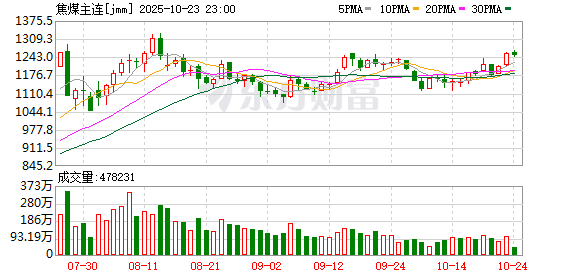
焦煤一周涨逾10%!发生了什么?
Qi Huo Ri Bao· 2025-10-23 23:55
Core Viewpoint - Recent surge in coking coal futures prices, with the main contract rising over 10% since October 15, driven by supply concerns and reduced production from Mongolia [2] Group 1: Supply and Demand Dynamics - Significant reduction in Mongolian coal production and customs clearance has raised supply concerns, with domestic coal mine operating rates declining [2] - As of October 22, coal production capacity utilization in China was reported at 85.1%, down 2.3 percentage points week-on-week, with daily raw coal output at 191.0 million tons, a decrease of 5.1 million tons [3] - The supply-demand balance has shifted to tight equilibrium, with prices remaining strong despite recent increases in futures prices [2][3] Group 2: Market Reactions and Future Outlook - The market's trading logic is shifting from expectations of increased coal production and weak steel demand to improved macroeconomic expectations and policy support [4] - Anticipation of further price increases for coking coal and coke, with potential for a third round of price hikes from major coking enterprises [4] - Analysts expect continued upward trends in coking coal prices as downstream steel mills prepare for winter stockpiling [4][5]
厚植文化根基,服务国家战略——西南期货多维赋能重庆实体经济发展
Qi Huo Ri Bao· 2025-10-23 08:26
Core Viewpoint - The company emphasizes its role in supporting the real economy through financial services, focusing on compliance, integrity, professionalism, and stability while enhancing risk management for agricultural and small enterprises [1][2]. Group 1: Promoting Inclusive Finance - The company has effectively implemented inclusive finance initiatives, particularly in supporting agriculture and small enterprises, aligning with national financial strategies [2]. - Since 2021, the company has launched "insurance + futures" projects for various agricultural products, providing risk protection for thousands of farmers and acres of farmland, with a total risk guarantee of approximately 930 million yuan for 728,000 pigs [2]. - The company's projects have received recognition, including being selected as an excellent case by the China Futures Association and winning awards for risk management excellence [2]. Group 2: Deepening Industry Chain Services - The company actively contributes to major strategic initiatives such as the Chengdu-Chongqing economic circle and the construction of modern manufacturing clusters in Chongqing [3]. - It customizes risk management solutions for state-owned logistics, warehousing, and bulk commodity trading enterprises, helping them hedge against price fluctuations in commodities [3]. - The company also focuses on emerging industries, particularly the new energy vehicle supply chain, providing specialized risk management services for key raw materials like lithium, nickel, and silicon [3]. - Future plans include leveraging political guidance to enhance business development while maintaining compliance and integrity in operations [3].
铜价2~3年有望呈螺旋式上行趋势
Qi Huo Ri Bao· 2025-10-23 03:36
Core Viewpoint - The copper market is undergoing significant changes driven by the dual forces of global energy transition and the AI technology revolution, leading to a structural shift in demand while supply faces constraints, suggesting a potential upward trend in copper prices over the next 2-3 years [1][10]. Demand Structure Changes - Traditional sectors such as construction, which once accounted for over 30% of global copper consumption, are experiencing a decline due to demographic changes and urbanization saturation, particularly in China where the share is expected to drop from over 30% to around 18% by 2030 [3][4]. - Emerging sectors like renewable energy and digital infrastructure are creating strong new demand for copper, with significant increases expected in solar and wind energy applications [5][6]. Supply Constraints - The global copper supply is facing challenges such as declining ore grades, insufficient investment in new projects, and operational disruptions in major mines like Indonesia's Grasberg, which could lead to a supply loss of approximately 30,000 tons by 2026 [8][9]. - The average ore grade has decreased from over 1.0% a decade ago to around 0.7%-0.8% currently, increasing extraction costs and limiting production [8]. Price and Profit Outlook - The copper market is expected to see a widening supply-demand gap, with projections indicating a shortfall of 80,000 tons by 2027, supporting a bullish price outlook [10]. - Global visible copper inventories are at historical lows, enhancing price elasticity, while factors such as inflation expectations and capital allocation are likely to influence copper prices positively [10][11]. Strategic Implications - The copper industry is undergoing a structural transformation, with traditional demand slowing but new growth opportunities arising from the energy transition and technological advancements [11]. - Investors are advised to focus on companies with resource advantages, technological barriers, and green competitiveness, as copper's strategic value is expected to increase [11].
结算业务
Qi Huo Ri Bao· 2025-10-23 01:04
Core Insights - The article discusses the pricing, margin calculations, delivery methods, and transaction fees for monthly average futures of three chemical products: Linear Low-Density Polyethylene (LLDPE), Polyvinyl Chloride (PVC), and Polypropylene (PP) Pricing and Settlement - The daily settlement price for monthly average futures is aligned with the corresponding physical futures price during ordinary months, while in the expiration month, it is calculated as a weighted arithmetic average of the prices from the traded days and remaining days [1] - For example, the settlement price for L2504F on March 6, 2025, is calculated using the prices from March 1-3 and the remaining 20 days [1] Margin Calculations - The margin ratio for the three chemical products' monthly average futures generally matches that of the corresponding physical futures contracts, and adjustments to the physical contracts' margin will also affect the monthly average futures [1] Delivery and Settlement Price Calculation - The delivery method for the three chemical products' monthly average futures is cash settlement, with the settlement price being the arithmetic average of the daily settlement prices of the corresponding physical futures in the month prior to the contract month [2] Transaction Fees - Initial transaction fees are set at 1 yuan per contract, with a reduced fee of 0.5 yuan for hedging transactions, subject to adjustments based on market conditions [2] - Delivery fees are also initially set at 1 yuan per contract, with a waiver of delivery fees until December 31, 2025, for the three chemical products' monthly average futures, except for designated high-frequency traders [2] Margin Discounts - The three chemical products' monthly average futures contracts are eligible for combined margin discounts, with specific details available on the Dalian Commodity Exchange's website after the contracts are listed [2]
刚刚 油价飙升!两大消息 突然引爆!特朗普:取消与普京的会面
Qi Huo Ri Bao· 2025-10-22 23:26
Group 1 - International oil prices surged, with WTI crude futures rising by 3.74% and Brent crude futures increasing by 4.94% due to new sanctions imposed by the U.S. on major Russian oil companies [2] - The European Union has approved the 19th round of sanctions against Russia, which includes a ban on importing Russian liquefied natural gas and travel restrictions on Russian diplomats [2] - Goldman Sachs reports that the Chinese stock market is entering a "slow bull" phase, predicting a 30% increase in the MSCI China Index over the next two years [4][5] Group 2 - Goldman Sachs supports the bullish outlook for Chinese stocks with four key arguments: favorable market policies, accelerating economic growth, attractive valuations, and strong capital flows [5] - The A-share market is currently experiencing a period of consolidation, with the Shanghai Composite Index hovering around 3900 points for nearly two weeks [6] - Analysts suggest that the end of the A-share adjustment phase will depend on the emergence of a clear market leader and significant volume confirmation during upward movements [7] Group 3 - Recent trends indicate that several small and medium-sized banks in China are lowering deposit rates, with some banks reducing rates by up to 80 basis points for 3-year and 5-year fixed deposits [7] - The current stability of the Loan Prime Rate (LPR) is attributed to the unchanged 7-day reverse repurchase rate, with expectations for potential downward adjustments in the future [8] - The Federal Reserve is expected to maintain a dovish stance, with a nearly 100% probability of a 25 basis point rate cut in October, which may influence domestic monetary policy in China [9]
豆油继续偏弱震荡
Qi Huo Ri Bao· 2025-10-22 23:24
Group 1: Market Overview - Domestic oilseed futures have shown a weak oscillating trend since October, with soybean oil futures maintaining a range of 8200 to 8400 yuan/ton due to policy expectations [1] - The domestic supply of soybean oil is relatively ample, with inventory at a medium to high level, which suppresses the upward price potential [1] - International soybean oil prices remain firm, and the slowdown in domestic oil mill crushing pace provides some support for soybean oil prices [1] Group 2: U.S. Soybean Export Challenges - The U.S. government shutdown and escalating U.S.-China trade tensions have weakened the influence of U.S. soybeans in the global pricing system, leading to a reduced impact on China's imported soybean costs [2] - From October to December, China is expected to maintain zero purchases of U.S. soybeans, relying on imports from Brazil and Argentina to fill the supply gap [2] - The decoupling of U.S. soybean pricing from Chinese imports is evident, with the pricing model now dominated by Brazilian soybean premiums and the exchange rate of the yuan [2] Group 3: Weather Predictions and Production Estimates - The U.S. Climate Prediction Center forecasts a 71% probability of La Niña weather from October to December, which may increase drought risks in major soybean-producing regions like Brazil and Argentina [3] - The Rosario Grain Exchange predicts Argentina's soybean production for the 2025/2026 season to be 47 million tons, lower than the USDA's previous estimate of 48.5 million tons [3] Group 4: Supply Adequacy - Prior to the National Day holiday, domestic purchases of Argentine soybeans increased due to a temporary cancellation of export taxes, covering the supply gap for the first quarter of next year [4] - In September, Argentina announced a reduction of the soybean export tax from 26% to zero, prompting Chinese buyers to secure at least 130,000 tons of soybean orders within a few days [4] - China's soybean imports in September reached 12.87 million tons, with imports from Brazil at 10.96 million tons, a year-on-year increase of 29.8%, while no U.S. soybeans were imported for the first time since November 2018 [4] Group 5: Current Market Dynamics - The oilseed market currently lacks a clear direction, with stable supply and limited news impact, resulting in oscillating futures prices [5] - The recent procurement of Argentine soybeans is sufficient to meet the first-quarter demand, thus limiting the impact of U.S.-China trade negotiations on soybean prices [5] - The soybean oil market remains unchanged, with oil mills operating normally and inventory pressures persisting, leading to a lack of significant price drivers [5]
期价创三年来新低!乙二醇估值偏低?
Qi Huo Ri Bao· 2025-10-22 23:23
"近期,乙二醇期价创三年来新低,估值其实基本符合市场预期。"远大能源化工有限公司烯烃事业部总 经理戴煜敏告诉期货日报记者。 截至昨日收盘,乙二醇期货主力合约报4051元/吨,处于近三年的低位区间。采访中,期货日报记者了 解到,乙二醇价格持续走弱是多重因素交织下的必然结果。 "曾经,我国乙二醇供应高度依赖进口;如今,国内产能已彻底改写这一格局。数据显示,2025年国内 乙二醇总产能突破2800万吨,进口依存度从早年的58.3%骤降至30%。"戴煜敏表示,即便日本、韩国等 地区淘汰老旧装置、转产或停产,但国内产能增长规模远超海外产能退出规模。全球存量产能叠加新增 产能投放,让乙二醇阶段性供应过剩的局面短期难以扭转。 值得注意的是,随着价格大幅走低,市场对乙二醇估值是否偏低的争论也越来越激烈——有人认为当前 估值已到价值投资区间,有人却觉得这才是真实价值。 "从绝对价格看,现在乙二醇价格已处于历史低位,有价值投资的潜力,但从加工利润来看,市场分歧 特别明显。"戴煜敏解释说,中东、北美产区的装置凭借原料价格低的优势,仍有较强竞争力;国内后 期新建的煤制乙二醇装置,依托煤炭资源优势,也能维持一定利润。这种成本分化现象, ...
刚刚,油价飙升!两大消息,突然引爆!特朗普:取消与普京的会面
Qi Huo Ri Bao· 2025-10-22 23:23
Group 1 - International oil prices surged, with WTI crude futures rising by 3.74% and Brent crude futures increasing by 4.94% [1] - The U.S. Treasury announced sanctions against two major Russian oil companies, including Rosneft and Lukoil, along with their subsidiaries [3] - The European Union approved the 19th round of sanctions against Russia, which includes a ban on importing Russian liquefied natural gas [3] Group 2 - Goldman Sachs reported that the Chinese stock market is entering a "slow bull" phase, predicting a 30% increase in the MSCI China Index over the next two years [5] - Four key arguments supporting the continued rise of Chinese stocks were presented: favorable policy environment, accelerating economic growth, attractive valuations, and strong capital flows [6] - The A-share market showed weak fluctuations, with the Shanghai Composite Index closing at 3913.76 points, down 0.07% [6][7] Group 3 - The A-share market has been in a consolidation phase around the 3900-point mark for nearly two weeks, with trading volume decreasing [7] - Analysts suggest that the market's direction will depend on signals from important meetings and the confirmation of economic recovery through fundamental data [7] - Recent adjustments in deposit rates by several small and medium-sized banks indicate market expectations for future interest rate declines [8] Group 4 - The People's Bank of China has not made any changes to the Loan Prime Rate (LPR) for five consecutive months, but there are indications of potential downward adjustments [8] - The U.S. Federal Reserve is expected to maintain a dovish stance, with a nearly 100% probability of a 25 basis point rate cut in October [9] - External factors are gradually reducing their constraints on domestic monetary policy, with expectations for further monetary easing in the fourth quarter [9]

供强需弱 LPG偏空格局持续
Qi Huo Ri Bao· 2025-10-22 23:22
Core Viewpoint - The LPG market is experiencing significant fluctuations due to its strong correlation with crude oil prices, seasonal variations, and recent tariff issues affecting price dynamics [1] Group 1: Market Dynamics - LPG is a terminal product and chemical raw material used in producing polypropylene and gasoline blending products, with its price closely tied to crude oil [1] - The price ratio between LPG and crude oil has seen substantial volatility, reaching a near five-year high in April [1] - The U.S. is the largest source of LPG imports for China, accounting for approximately 50% of total imports, followed by countries in the Middle East [1] Group 2: Supply and Demand - China's LPG imports are diversifying, with a notable decrease in propane imports from the U.S. to the lowest level since 2021 [1] - Domestic LPG demand is primarily driven by chemical needs, particularly from propane dehydrogenation (PDH) processes, with potential benefits for alternative production methods if PDH feedstock is restricted [1] - Current supply pressures are indicated by the October CP (Saudi LPG contract price) opening lower than expected, suggesting a significant supply burden [3] Group 3: Cost Factors - The current weak trend in crude oil prices contrasts sharply with the performance of precious and base metals, influenced by factors such as the rise of new energy vehicles and ongoing trade tensions [2] - LNG prices are currently lower than LPG prices, with an expanding price gap accelerating LNG's market penetration [2] - Shipping costs for LPG are relatively low, with favorable conditions in key transit areas like the Panama Canal [2] Group 4: Inventory and Utilization - Port inventory levels are at mid-range historical levels, while refinery inventory rates are near multi-year lows, indicating a mixed supply situation [3] - The overall chemical industry is facing profitability challenges, with declining margins in PDH and related products, contributing to a bearish outlook for LPG prices [3]